Thank you for visiting SNEWPapers!
Sign up free
The North Carolina Standard
Raleigh, Wake County, North Carolina
What is this article about?
Newspaper article discusses disturbance in North Carolina Regiment at Buena Vista, involving Col. Paine's use of a wooden horse for punishment, its destruction by Virginia soldiers, a shooting incident where Paine wounded two men (one fatally), and dismissal of Lieutenants Pender and Singeltary by Gen. Wool. Commentary urges waiting for full facts before judgment.
Clipping
OCR Quality
Full Text
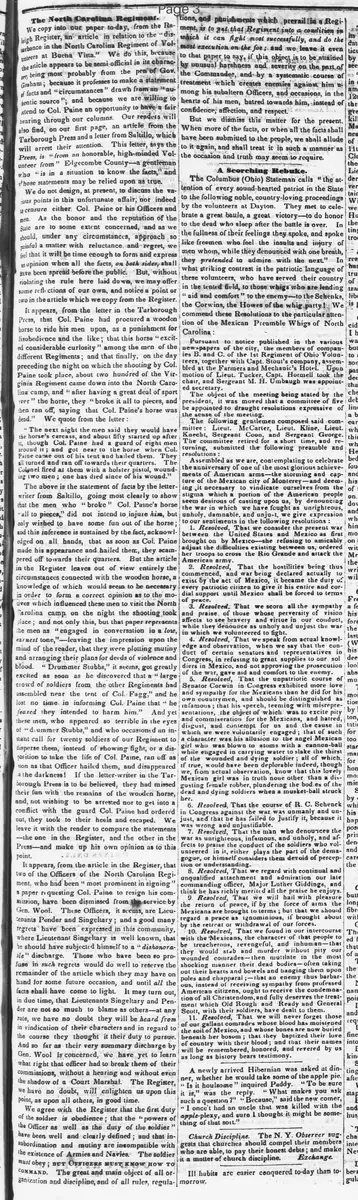
We copy from our paper to-day, from the Raleigh Register, an article in relation to the disturbance in the North Carolina Regiment of Volunteers at Buena Vista. We do this, because the article appears to be semi-official in its character—coming from Gov. Graham; because it professes to make a statement from official sources; and because we are willing to give Col. Paine an opportunity to have a fair hearing through our columns. Our replies will appear in a few days, together with an article from the Tarborough Press and a letter from Saltillo, which also go on our first page, and will arrest their attention. This letter, says the Press, is from an honorable, high-minded Volunteer officer from Edgecombe County—a gentleman who is in a situation to know the facts, and whose statements may be relied upon as true.
We do not design, at present, to discuss the various points in this unfortunate affair, not indeed to censure either Col. Paine or his officers and men. As the honor and the reputation of the State are to some extent concerned, and as we should, under any circumstances, approach so painful a matter with reluctance and regret, we feel that it will be time enough to form and express an opinion when all the facts, on both sides, shall have been spread before the public. But, without violating the rule here laid down, we may offer some reflections of our own, and notice a point or two in the article which we copy from the Register.
It appears, from the letter in the Tarborough Press, that Col. Paine had procured a wooden horse to ride his men upon, as a punishment for disobedience and the like; that this horse excited considerable curiosity among the men of the different Regiments; and that finally, on the day preceding the night on which the shooting by Col. Paine took place, about two hundred of the Virginia Regiment came down into the North Carolina camp, and after having a great deal of sport over the horse, they broke it all to pieces, and then ran off, saying that Col. Paine's horse was dead.
We quote from the letter:
The next night the men said they would have the horse's carcass, and about fifty started up after it, though Col. Paine had a guard of eight men around it; and got near to the horse when Col. Paine came out of his tent and hailed them. They all turned and ran off towards their quarters. The Colonel fired at them with a holster pistol, wounding two men; one has died since of his wound.
The above is the statement of facts by the letter-writer from Saltillo, going most clearly to show that the men who broke Col. Paine's horse all to pieces, did not intend to injure him, but only wished to have some fun out of the horse; and this inference is sustained by the fact, acknowledged on all hands, that as soon as Col. Paine made his appearance and hailed them, they scampered off towards their quarters. But the article in the Register leaves out of view entirely the circumstances connected with the wooden horse, a knowledge of which would seem to be necessary in order to form a correct opinion as to the motives which influenced these men to visit the North Carolina camp on the night the shooting took place; and not only this, but that paper represents the men as engaged in conversation in a low, earnest tone—leaving the impression upon the mind of the reader, that they were plotting mutiny and arranging their plans for deeds of violence and blood. Drummer Stubbs, it seems, got greatly excited as soon as he discovered that a large crowd of soldiers from the other Regiments had assembled near the tent of Col. Fagg, and he lost no time in informing Col. Paine that he feared they intended to harm him. And yet these men, who appeared so terrible in the eyes of Drummer Stubbs, and who occasioned an instant call for twenty soldiers of our Regiment to disperse them, instead of showing fight, or a disposition to take the life of Col. Paine, ran off as soon as that Officer hailed them, and disappeared in the darkness! If the letter-writer in the Tarborough Press is to be believed, they had missed their fun with the remains of the wooden horse, and, not wishing to be arrested nor to get into a conflict with the guard Col. Paine had ordered out, they took to their heels and escaped. We leave it with the reader to compare the statements—the one in the Register, and the other in the Press—and make up his own opinion as to this point.
It appears, from the article in the Register, that two of the Officers of the North Carolina Regiment, who had been most prominent in signing a paper requesting Col. Paine to resign his commission, have been dismissed from the service by Gen. Wool. These Officers, it seems, are Lieutenants Pender and Singeltary; and a good many regrets have been expressed in this community, where Lieutenant Singeltary is well known, that he should have subjected himself to a dishonorable discharge. Those who have been so profuse in such regrets would do well to reserve the remainder of the article which they may have on hand for some future occasion, and until all the facts shall have come to light. It may turn out, in due time, that Lieutenants Singeltary and Pender are not so much to blame as others—at any rate, we have no doubt they will be heard from in vindication of their characters and in regard to the course they thought it their duty to pursue. And so far as their very summary discharge by Gen. Wool is concerned, we have yet to learn what right that officer had to break them of their commissions, without a hearing and without even the shadow of a Court Martial. The Register, we have no doubt, will enlighten us upon this point, as upon all others, in good time.
We agree with the Register that the first duty of the soldier is obedience; that the powers of the Officer as well as the duty of the soldier have been well and clearly defined; and that insubordination and mutiny are incompatible with the existence of Armies and Navies. The soldier must obey; but Officers must know How To COMMAND.
The great and main object of all organization and discipline, and of all rules, regulations, and punishments which prevail in a Regiment, is to put that Regiment into a condition in which it can fight most successfully, and do the most execution on the foe; and we leave it even to that paper to say, if this object is to be attained by unusual harshness and severity on the part of the Commander, and by a systematic course of treatment which creates enemies against him among his subaltern Officers, and occasions, in the hearts of his men, hatred towards him, instead of confidence, affection, and respect.
But we dismiss this matter for the present. When more of the facts, or when all the facts shall have been submitted to the people, we shall allude to it again, and shall treat it in such a manner as the occasion and truth may seem to require.
What sub-type of article is it?
What themes does it cover?
What keywords are associated?
What entities or persons were involved?
Where did it happen?
Story Details
Key Persons
Location
Buena Vista, North Carolina Camp, Saltillo
Story Details
Disturbance in North Carolina Regiment: Col. Paine uses wooden horse for punishment; Virginia soldiers destroy it for fun; next night, men approach remains, flee when hailed by Paine, who shoots wounding two (one dies); officers Pender and Singeltary dismissed by Wool for requesting Paine's resignation; article calls for full facts before judgment on discipline and command.