Thank you for visiting SNEWPapers!
Sign up free
Editorial
June 15, 1807
Portland Gazette, And Maine Advertiser
Portland, Cumberland County, Maine
What is this article about?
This editorial, 'The Preacher No. 12,' quotes Paul to emphasize the high responsibility of ministers to subdue personal vices and set moral examples. It extends this to all religious professors, urging self-reform before correcting others to avoid hypocrisy.
Clipping
OCR Quality
85%
Good
Full Text
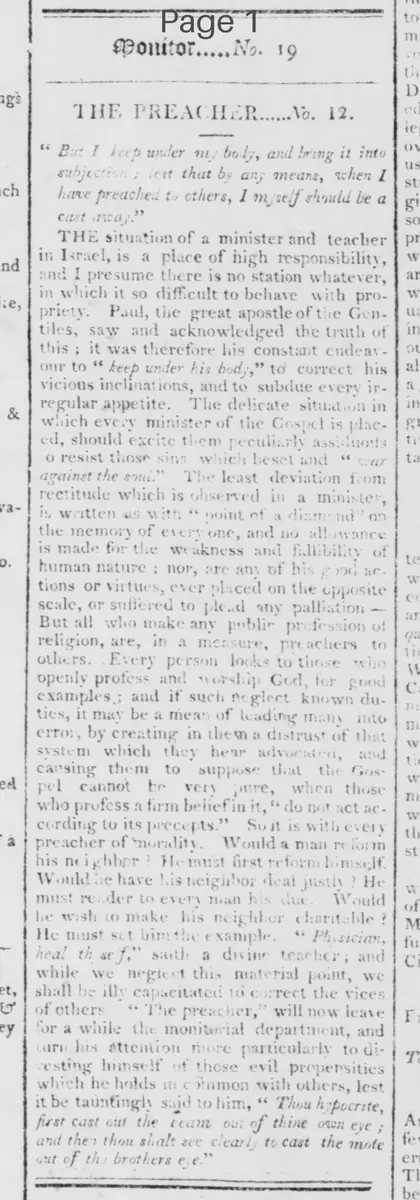
Monitor.....No. 19
THE PREACHER....No. 12.
"But I keep under my body, and bring it into
subjection: lest that by any means, when I
have preached to others, I myself should be a
castaway"
THE situation of a minister and teacher
in Israel, is a place of high responsibility,
and I presume there is no station whatever,
in which it is so difficult to behave with propriety. Paul, the great apostle of the Gentiles, saw and acknowledged the truth of
this: it was therefore his constant endeavour
to "keep under his body," to correct his
vicious inclinations, and to subdue every irregular
appetite. The delicate situation in
which every minister of the Gospel is placed,
should excite them peculiarly anxious
thoughts to resist those sins which beset and cast
against the sinner. The least deviation from
rectitude which is observed in a minister
is written as with a pen of iron and on
the memory of every one, and no allowance
is made for the weakness and fallibility of
human nature: nor, are any of his good actions
or virtues, ever placed on the opposite
scale, or suffered to plead any palliation—
But all who make any public profession of
religion, are, in a measure, preachers to
others. Every person looks to those who
openly profess and worship God, for good
examples; and if such neglect known duties,
it may be a means of leading many into
error, by creating in them a distrust of that
system which they here advocate, and
causing them to suppose that the Gospel
cannot be very pure, when those
who profess a firm belief in it, "do not act according
to its precepts." So it is with every
preacher of morality. Would a man reform
his neighbor He must first reform himself
Would he have his neighbor deal justly? He
must render to every man his due Would
he wish to make his neighbor charitable?
He must set him the example. "Physician
heal thyself." saith a divine teacher, and
while we neglect this material point, we
shall be but ill capacitated to correct the vices
of others "The preacher, will now leave
for a while the ministerial department, and
direct his attention more particularly to dis-
vesting himself of those evil properties
which he holds in common with others, lest
it be tauntingly said to him, "Thou hypocrite,
first cast out the beam out of thine own eye;
and then shalt thou see clearly to cast the mote
out of thy brother's eye"
THE PREACHER....No. 12.
"But I keep under my body, and bring it into
subjection: lest that by any means, when I
have preached to others, I myself should be a
castaway"
THE situation of a minister and teacher
in Israel, is a place of high responsibility,
and I presume there is no station whatever,
in which it is so difficult to behave with propriety. Paul, the great apostle of the Gentiles, saw and acknowledged the truth of
this: it was therefore his constant endeavour
to "keep under his body," to correct his
vicious inclinations, and to subdue every irregular
appetite. The delicate situation in
which every minister of the Gospel is placed,
should excite them peculiarly anxious
thoughts to resist those sins which beset and cast
against the sinner. The least deviation from
rectitude which is observed in a minister
is written as with a pen of iron and on
the memory of every one, and no allowance
is made for the weakness and fallibility of
human nature: nor, are any of his good actions
or virtues, ever placed on the opposite
scale, or suffered to plead any palliation—
But all who make any public profession of
religion, are, in a measure, preachers to
others. Every person looks to those who
openly profess and worship God, for good
examples; and if such neglect known duties,
it may be a means of leading many into
error, by creating in them a distrust of that
system which they here advocate, and
causing them to suppose that the Gospel
cannot be very pure, when those
who profess a firm belief in it, "do not act according
to its precepts." So it is with every
preacher of morality. Would a man reform
his neighbor He must first reform himself
Would he have his neighbor deal justly? He
must render to every man his due Would
he wish to make his neighbor charitable?
He must set him the example. "Physician
heal thyself." saith a divine teacher, and
while we neglect this material point, we
shall be but ill capacitated to correct the vices
of others "The preacher, will now leave
for a while the ministerial department, and
direct his attention more particularly to dis-
vesting himself of those evil properties
which he holds in common with others, lest
it be tauntingly said to him, "Thou hypocrite,
first cast out the beam out of thine own eye;
and then shalt thou see clearly to cast the mote
out of thy brother's eye"
What sub-type of article is it?
Moral Or Religious
Social Reform
What keywords are associated?
Preacher Responsibilities
Moral Example
Religious Hypocrisy
Self Reform
Gospel Precepts
Vice Subdual
What entities or persons were involved?
Paul The Apostle
Ministers Of The Gospel
Editorial Details
Primary Topic
Responsibilities Of Preachers To Subdue Vices And Set Examples
Stance / Tone
Exhortatory Moral Instruction
Key Figures
Paul The Apostle
Ministers Of The Gospel
Key Arguments
Ministers Hold A Position Of High Responsibility And Must Subdue Personal Vices
Public Deviations From Rectitude In Ministers Are Harshly Judged Without Allowance For Human Weakness
All Religious Professors Serve As Examples And Their Neglect Can Lead Others To Distrust The Gospel
Self Reform Is Essential Before Attempting To Correct Others' Vices
Hypocrisy Undermines Moral Preaching, As Per Biblical Admonitions