Thank you for visiting SNEWPapers!
Sign up free
Letter to Editor
April 23, 1802
The Kentucky Gazette
Lexington, Fayette County, Kentucky
What is this article about?
A letter to the Kentucky Gazette defending the study of Latin and Greek against objections, arguing they prepare youth for sciences, form the basis of English vocabulary, and are essential for linguistic understanding.
Clipping
OCR Quality
95%
Excellent
Full Text
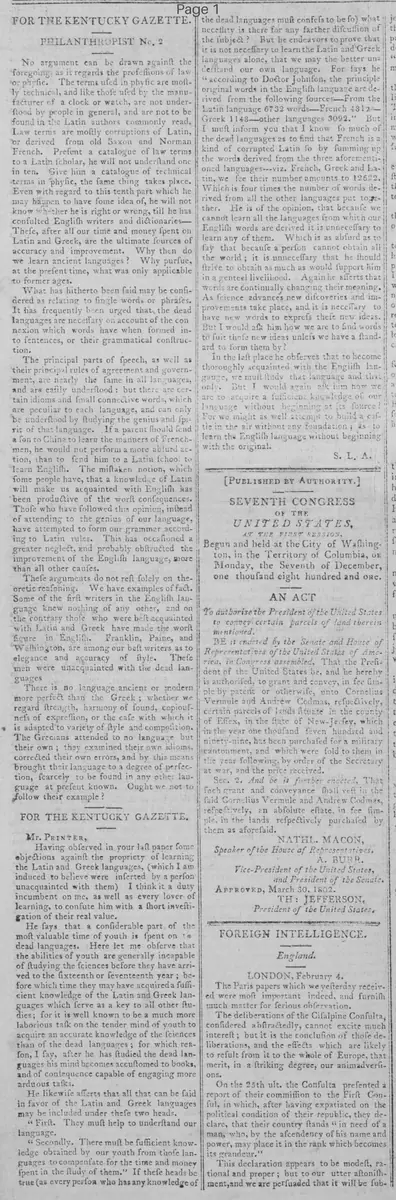
FOR THE KENTUCKY GAZETTE.
Mr. PRINTER,
Having observed in your last paper some
objections against the propriety of learning
the Latin and Greek languages, (which I am
induced to believe were inserted by a person
unacquainted with them) I think it a duty
incumbent on me, as well as every lover of
learning, to confute him with a short investi-
gation of their real value.
He says that a considerable part of the
most valuable time of youth is spent on dead languages. Here let me observe that
the abilities of youth are generally incapable
of studying the sciences before they have arri-
ved to the sixteenth or seventeenth year; be-
fore which time they may have acquired a suffi-
ient knowledge of the Latin and Greek lan-
guages which serve as a key to all other stu-
dies; for it is well known to be a much more
laborious task on the tender mind of youth to
acquire an accurate knowledge of the sciences
than of the dead languages; for which rea-
son, I say, after he has studied the dead lan-
guages his mind becomes accustomed to books,
and of consequence capable of engaging more
arduous tasks.
He likewise asserts that all that can be said
in favor of the Latin and Greek languages
may be included under these two heads.
"First. They must help to understand our
language.
"Secondly. There must be sufficient know.
ledge obtained by our youth from those lan-
guages to compensate for the time and money
spent in the study of them." If these heads be
true (as every person who has any knowledge of the dead languages must confess to be so) what necessity is there for any farther discussion of the subject? But he endeavors to prove that it is not necessary to learn the Latin and Greek languages alone, that we may the better un-
derstand our own language. For says he
"according to Doctor Johnson, the principle original words in the English language are de-
rived from the following sources—From the
Latin language 6732 words—French 4812
Greek 1148—other languages 3092." But
I must inform you that I know so much of the dead languages as to find that French is a kind of corrupted Latin so by summing up the words derived from the three aformentioned languages—viz. French, Greek and La-
tin, we see their number amounts to 12692.
Which is four times the number of words de-
rived from all the other languages put toge-
ther. He is of the opinion, that because we cannot learn all the languages from which our English words are derived it is unnecessary to learn any of them. Which is as absurd as to say that because a person cannot obtain all the world; it is unnecessary that he should strive to obtain as much as would support him in a genteel livelihood. Again he asserts that words are continually changing their meaning.
As science advances new discoveries and im-
provements take place, and it is necessary to have new words to express these new ideas.
But I would ask him how we are to find words to suit those new ideas unless we have a stand-
ard to form them by?
In the last place he observes that to become thoroughly acquainted with the English lan-
guage, we must study that language and that only. But I would again ask him how we are to acquire a sufficient knowledge of our language without beginning at its source?
For we might as well attempt to build a cas-
tle in the air without any foundation ; as to learn the English language without beginning with the original.
S. L. A.
Mr. PRINTER,
Having observed in your last paper some
objections against the propriety of learning
the Latin and Greek languages, (which I am
induced to believe were inserted by a person
unacquainted with them) I think it a duty
incumbent on me, as well as every lover of
learning, to confute him with a short investi-
gation of their real value.
He says that a considerable part of the
most valuable time of youth is spent on dead languages. Here let me observe that
the abilities of youth are generally incapable
of studying the sciences before they have arri-
ved to the sixteenth or seventeenth year; be-
fore which time they may have acquired a suffi-
ient knowledge of the Latin and Greek lan-
guages which serve as a key to all other stu-
dies; for it is well known to be a much more
laborious task on the tender mind of youth to
acquire an accurate knowledge of the sciences
than of the dead languages; for which rea-
son, I say, after he has studied the dead lan-
guages his mind becomes accustomed to books,
and of consequence capable of engaging more
arduous tasks.
He likewise asserts that all that can be said
in favor of the Latin and Greek languages
may be included under these two heads.
"First. They must help to understand our
language.
"Secondly. There must be sufficient know.
ledge obtained by our youth from those lan-
guages to compensate for the time and money
spent in the study of them." If these heads be
true (as every person who has any knowledge of the dead languages must confess to be so) what necessity is there for any farther discussion of the subject? But he endeavors to prove that it is not necessary to learn the Latin and Greek languages alone, that we may the better un-
derstand our own language. For says he
"according to Doctor Johnson, the principle original words in the English language are de-
rived from the following sources—From the
Latin language 6732 words—French 4812
Greek 1148—other languages 3092." But
I must inform you that I know so much of the dead languages as to find that French is a kind of corrupted Latin so by summing up the words derived from the three aformentioned languages—viz. French, Greek and La-
tin, we see their number amounts to 12692.
Which is four times the number of words de-
rived from all the other languages put toge-
ther. He is of the opinion, that because we cannot learn all the languages from which our English words are derived it is unnecessary to learn any of them. Which is as absurd as to say that because a person cannot obtain all the world; it is unnecessary that he should strive to obtain as much as would support him in a genteel livelihood. Again he asserts that words are continually changing their meaning.
As science advances new discoveries and im-
provements take place, and it is necessary to have new words to express these new ideas.
But I would ask him how we are to find words to suit those new ideas unless we have a stand-
ard to form them by?
In the last place he observes that to become thoroughly acquainted with the English lan-
guage, we must study that language and that only. But I would again ask him how we are to acquire a sufficient knowledge of our language without beginning at its source?
For we might as well attempt to build a cas-
tle in the air without any foundation ; as to learn the English language without beginning with the original.
S. L. A.
What sub-type of article is it?
Persuasive
Informative
What themes does it cover?
Education
What keywords are associated?
Latin Language
Greek Language
Education
English Etymology
Youth Studies
Dead Languages
Doctor Johnson
What entities or persons were involved?
S. L. A.
Mr. Printer
Letter to Editor Details
Author
S. L. A.
Recipient
Mr. Printer
Main Argument
learning latin and greek is essential for youth as it prepares the mind for studying sciences, provides the foundation for understanding english vocabulary (deriving over 12,000 words from these sources), and serves as the root from which the english language originates.
Notable Details
References Doctor Johnson's Etymology Showing 6,732 Latin, 4,812 French (Corrupted Latin), And 1,148 Greek Words In English
Analogy: Absurd To Reject Learning Roots Because Not All Languages Can Be Learned, Like Refusing Partial Wealth
Analogy: Building A Castle In The Air Without Foundation