Thank you for visiting SNEWPapers!
Sign up free
Lynchburg Daily Virginian
Lynchburg, Virginia
What is this article about?
The British Chancellor of the Exchequer presented a financial plan for 1854-5, noting prosperous revenue but war costs requiring doubled income tax to cover a £2,840,000 deficiency, plus temporary exchequer bills and reduced stamp duties on bills of exchange.
Clipping
OCR Quality
Full Text
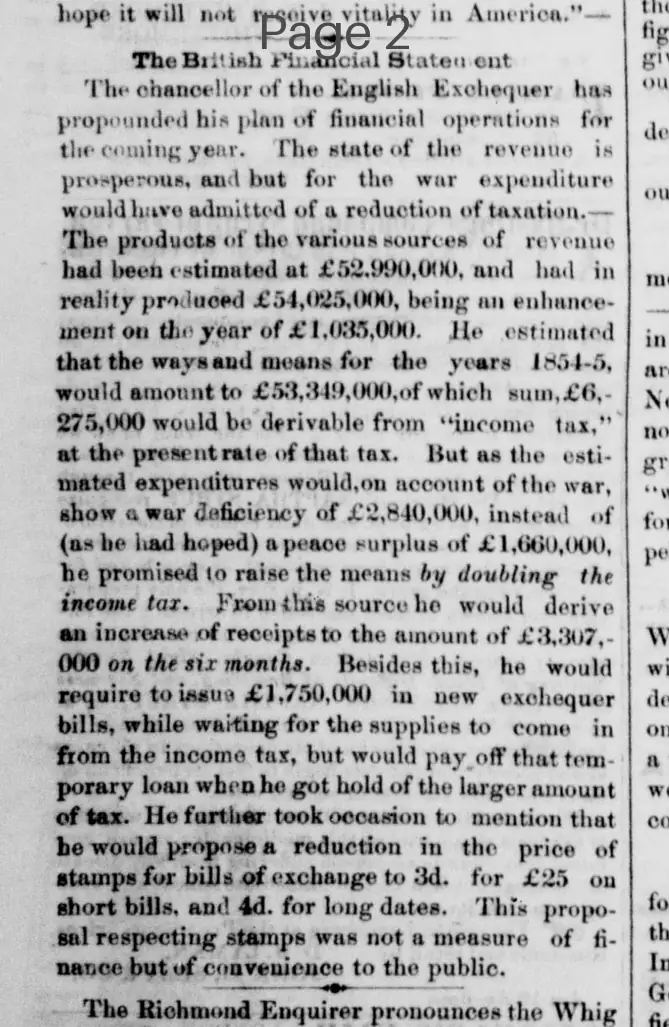
The chancellor of the English Exchequer has propounded his plan of financial operations for the coming year. The state of the revenue is prosperous, and but for the war expenditure would have admitted of a reduction of taxation.—The products of the various sources of revenue had been estimated at £52,990,000, and had in reality produced £54,025,000, being an enhancement on the year of £1,035,000. He estimated that the ways and means for the year 1854-5, would amount to £53,349,000, of which sum, £6,275,000 would be derivable from "income tax," at the present rate of that tax. But as the estimated expenditures would, on account of the war, show a war deficiency of £2,840,000, instead of (as he had hoped) a peace surplus of £1,660,000, he promised to raise the means by doubling the income tax. From this source he would derive an increase of receipts to the amount of £3,307,000 on the six months. Besides this, he would require to issue £1,750,000 in new exchequer bills, while waiting for the supplies to come in from the income tax, but would pay off that temporary loan when he got hold of the larger amount of tax. He further took occasion to mention that he would propose a reduction in the price of stamps for bills of exchange to 3d. for £25 on short bills, and 4d. for long dates. This proposal respecting stamps was not a measure of finance but of convenience to the public.
What sub-type of article is it?
What keywords are associated?
Where did it happen?
Foreign News Details
Primary Location
England
Event Date
1854
Outcome
doubling of income tax expected to yield £3,307,000 increase; issuance of £1,750,000 in new exchequer bills; reduction in stamp prices for bills of exchange to 3d. for £25 short bills and 4d. for long dates.
Event Details
The Chancellor outlined financial operations for 1854-5, with revenue estimated at £53,349,000 including £6,275,000 from current income tax. War expenditures created a £2,840,000 deficiency instead of a hoped-for £1,660,000 surplus, leading to a proposal to double the income tax and issue temporary exchequer bills, to be repaid from increased tax receipts. He also proposed reducing stamp duties on bills of exchange for public convenience.