Thank you for visiting SNEWPapers!
Sign up free
Editorial
January 8, 1887
The Universalist
Chicago, Cook County, Illinois
What is this article about?
Theological editorial interprets 1 Corinthians 15:22 and seed analogy to argue resurrection applies to the body dying in Adam, while the soul remains alive in Christ; refutes misinterpretations affirming immediate spiritual body and immortality.
Clipping
OCR Quality
98%
Excellent
Full Text
The Resurrection of the Body
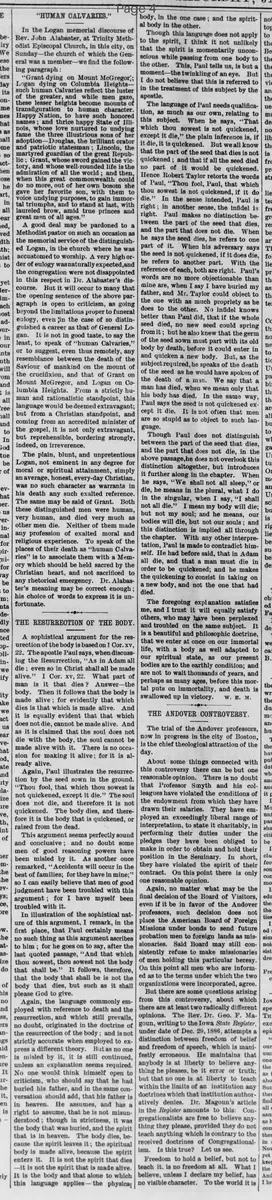
A sophistical argument for the resurrection of the body is based on 1 Cor. xv, 22. The apostle Paul says, when discussing the Resurrection, "As in Adam all die; even so in Christ shall all be made alive." I Cor. xv, 22. What part of man is it that dies? Answer—the body. Then it follows that the body is made alive; for evidently that which dies is that which is made alive. And it is equally evident that that which does not die, cannot be made alive. And as it is claimed that the soul does not die with the body, the soul cannot be made alive with it. There is no occasion for making it alive; for it is already alive.
Again, Paul illustrates the resurrection by the seed sown in the ground. "Thou fool, that which thou sowest is not quickened, except it die." The soul does not die, and therefore it is not quickened. The body dies, and therefore it is the body that is quickened, or raised from the dead.
This argument seems perfectly sound and conclusive; and no doubt some men of good reasoning powers have been misled by it. As another once remarked, "Accidents will occur in the best of families; for they have in mine;" so I can easily believe that men of good judgment have been troubled with this argument; for I have myself been troubled with it.
In illustration of the sophistical nature of this argument, I remark, in the first place, that Paul certainly means no such thing as this argument ascribes to him; for he goes on to say, after the last quoted passage, "And that which thou sowest, thou sowest not the body that shall be." It follows, therefore, that the body that shall be is not the body that dies, but such as it shall please God to give.
Again, the language commonly employed with reference to death and the resurrection, and which still prevails, no doubt, originated in the doctrine of the resurrection of the body; and is not strictly accurate when employed to express a different theory. But as no one is misled by it, it is still continued, unless an explanation seems required. No one would think himself open to criticism, who should say that he had buried his father, and in the same conversation should add, that his father is in heaven. He assumes, and has a right to assume, that he is not misunderstood; though in strictness, it was the body that was buried, and the spirit that is in heaven. The body dies, because the spirit leaves it; the spiritual body is made alive, because the spirit enters it. It is not the spirit that dies—it is not the spirit that is made alive. It is the body and that alone to which this language applies—the physical body, in the one case; and the spiritual body in the other.
Though this language does not apply to the spirit, I think it not unlikely that the spirit is momentarily unconscious while passing from one body to the other. This, Paul tells us, is but a moment—the twinkling of an eye. But I do not believe that this is referred to in the treatment of this subject by the apostle.
The language of Paul needs qualification, as much as our own, relating to this subject. When he says, "That which thou sowest is not quickened, except it die," the plain inference is, if it die, it is quickened. But we all know that the part of the seed that dies is not quickened: and that if all the seed died no part of it would be quickened. Hence Robert Taylor retorts the words of Paul, "Thou fool, Paul, that which thou sowest is not quickened, if it do die." In the sense intended, Paul is right; in another sense, the infidel is right. Paul makes no distinction between the part of the seed that dies, and the part that does not die. When he says the seed dies, he refers to one part of it. When his adversary says the seed is not quickened, if it does die, he refers to another part. With the reference of each, both are right. Paul's words are no more objectionable than mine are, when I say I have buried my father, and Mr. Taylor could object to the one with as much propriety as he does to the other. No infidel knows better than Paul did, that if the whole seed died, no new seed could spring from it; but he also knew that the germ of the seed sown must part with its old body by death, before it could enter in and quicken a new body. But, as the subject required, he speaks of the death of the seed as he would have spoken of the death of a man. We say that a man has died, when we mean only that his body has died. In the same way, Paul says the seed is not quickened except it die. It is not often that men are so stupid as to object to such language.
Though Paul does not distinguish between the part of the seed that dies, and the part that does not die, in the above passage, he does not overlook this distinction altogether, but introduces it further along in the chapter. When he says, "We shall not all sleep," or die, he means in the plural, what I do in the singular, when I say, "I shall not all die." I mean my body will die: but not my soul; and he means, our bodies will die, but not our souls; and this distinction is implied all through the chapter. With any other interpretation, Paul is made to contradict himself. He had before said, that in Adam all die, and that a man must die in order to be quickened; and he makes the quickening to consist in taking on a new body, and not the one that had died.
The foregoing explanation satisfies me, and I trust it will equally satisfy others, who may have been perplexed and troubled on the same subject. It is a beautiful and philosophic doctrine, that we enter at once on our immortal life, with a body as well adapted to our spiritual state, as our present bodies are to the earthly condition; and are not to wait thousands of years, and perhaps as many ages, before this mortal puts on immortality, and death is swallowed up in victory.
W. E. M.
A sophistical argument for the resurrection of the body is based on 1 Cor. xv, 22. The apostle Paul says, when discussing the Resurrection, "As in Adam all die; even so in Christ shall all be made alive." I Cor. xv, 22. What part of man is it that dies? Answer—the body. Then it follows that the body is made alive; for evidently that which dies is that which is made alive. And it is equally evident that that which does not die, cannot be made alive. And as it is claimed that the soul does not die with the body, the soul cannot be made alive with it. There is no occasion for making it alive; for it is already alive.
Again, Paul illustrates the resurrection by the seed sown in the ground. "Thou fool, that which thou sowest is not quickened, except it die." The soul does not die, and therefore it is not quickened. The body dies, and therefore it is the body that is quickened, or raised from the dead.
This argument seems perfectly sound and conclusive; and no doubt some men of good reasoning powers have been misled by it. As another once remarked, "Accidents will occur in the best of families; for they have in mine;" so I can easily believe that men of good judgment have been troubled with this argument; for I have myself been troubled with it.
In illustration of the sophistical nature of this argument, I remark, in the first place, that Paul certainly means no such thing as this argument ascribes to him; for he goes on to say, after the last quoted passage, "And that which thou sowest, thou sowest not the body that shall be." It follows, therefore, that the body that shall be is not the body that dies, but such as it shall please God to give.
Again, the language commonly employed with reference to death and the resurrection, and which still prevails, no doubt, originated in the doctrine of the resurrection of the body; and is not strictly accurate when employed to express a different theory. But as no one is misled by it, it is still continued, unless an explanation seems required. No one would think himself open to criticism, who should say that he had buried his father, and in the same conversation should add, that his father is in heaven. He assumes, and has a right to assume, that he is not misunderstood; though in strictness, it was the body that was buried, and the spirit that is in heaven. The body dies, because the spirit leaves it; the spiritual body is made alive, because the spirit enters it. It is not the spirit that dies—it is not the spirit that is made alive. It is the body and that alone to which this language applies—the physical body, in the one case; and the spiritual body in the other.
Though this language does not apply to the spirit, I think it not unlikely that the spirit is momentarily unconscious while passing from one body to the other. This, Paul tells us, is but a moment—the twinkling of an eye. But I do not believe that this is referred to in the treatment of this subject by the apostle.
The language of Paul needs qualification, as much as our own, relating to this subject. When he says, "That which thou sowest is not quickened, except it die," the plain inference is, if it die, it is quickened. But we all know that the part of the seed that dies is not quickened: and that if all the seed died no part of it would be quickened. Hence Robert Taylor retorts the words of Paul, "Thou fool, Paul, that which thou sowest is not quickened, if it do die." In the sense intended, Paul is right; in another sense, the infidel is right. Paul makes no distinction between the part of the seed that dies, and the part that does not die. When he says the seed dies, he refers to one part of it. When his adversary says the seed is not quickened, if it does die, he refers to another part. With the reference of each, both are right. Paul's words are no more objectionable than mine are, when I say I have buried my father, and Mr. Taylor could object to the one with as much propriety as he does to the other. No infidel knows better than Paul did, that if the whole seed died, no new seed could spring from it; but he also knew that the germ of the seed sown must part with its old body by death, before it could enter in and quicken a new body. But, as the subject required, he speaks of the death of the seed as he would have spoken of the death of a man. We say that a man has died, when we mean only that his body has died. In the same way, Paul says the seed is not quickened except it die. It is not often that men are so stupid as to object to such language.
Though Paul does not distinguish between the part of the seed that dies, and the part that does not die, in the above passage, he does not overlook this distinction altogether, but introduces it further along in the chapter. When he says, "We shall not all sleep," or die, he means in the plural, what I do in the singular, when I say, "I shall not all die." I mean my body will die: but not my soul; and he means, our bodies will die, but not our souls; and this distinction is implied all through the chapter. With any other interpretation, Paul is made to contradict himself. He had before said, that in Adam all die, and that a man must die in order to be quickened; and he makes the quickening to consist in taking on a new body, and not the one that had died.
The foregoing explanation satisfies me, and I trust it will equally satisfy others, who may have been perplexed and troubled on the same subject. It is a beautiful and philosophic doctrine, that we enter at once on our immortal life, with a body as well adapted to our spiritual state, as our present bodies are to the earthly condition; and are not to wait thousands of years, and perhaps as many ages, before this mortal puts on immortality, and death is swallowed up in victory.
W. E. M.
What sub-type of article is it?
Moral Or Religious
What keywords are associated?
Resurrection
Body
Soul
Paul
Seed Analogy
Immortality
1 Corinthians
What entities or persons were involved?
Apostle Paul
Robert Taylor
Editorial Details
Primary Topic
Interpretation Of Resurrection Of The Body In 1 Corinthians 15
Stance / Tone
Explanatory Refutation Of Sophistical Arguments Affirming Immediate Spiritual Immortality
Key Figures
Apostle Paul
Robert Taylor
Key Arguments
- the resurrection quickens the body that dies, not the immortal soul
- paul's seed analogy illustrates bodily resurrection, not soul quickening
- language of death and resurrection applies to body, not spirit
- spirit may be momentarily unconscious but enters new spiritual body
- paul implies distinction between body and soul throughout the chapter
- immediate immortality with new body, not waiting for physical resurrection