Thank you for visiting SNEWPapers!
Sign up free
Alexandria Daily Advertiser
Alexandria, Virginia
What is this article about?
A newspaper warns against subscribing to 'Travels through Louisiana' by General Collot, claiming it's fraudulent. A 1804 letter from New Orleans exposes Collot's limited 1796 travels along the Mississippi, his arrest, and fabrications in the proposed book to deceive the public post-Louisiana Purchase.
Clipping
OCR Quality
Full Text
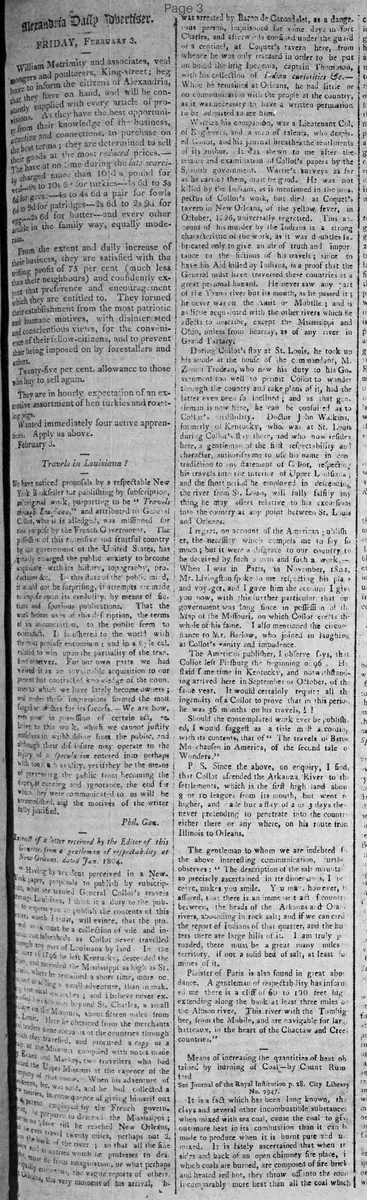
We have noticed proposals by a respectable New York Bookseller for publishing by subscription, an original work, purporting to be "Travels through Louisiana," and attributed to General Collot, who it is alleged, was commissioned for that purpose by the French Government. The purchase of this extensive and fruitful country by the government of the United States, has greatly enlarged the public anxiety to become acquainted with its history, topography, productions &c. In this state of the public mind, it would not be surprising, if attempts are made to impose upon its credulity, by means of fictitious and curious publications. That the work before us is of this description, the terms of its annunciation to the public seem to contradict. It is offered to the world with the most profuse encomium; and in a style calculated to win upon the partiality of the transient observer. For our own parts we had viewed it as an invaluable acquisition to our present but contracted knowledge of the countries to which we have lately become owners; and under these impressions formed the most sanguine wishes for its success. We are however now in possession of certain facts relative to this work, which we cannot justify ourselves in withholding from the public, and although their disclosure may operate to the injury of a speculation entered into perhaps with too much avidity, yet if they be the means of preserving the public from becoming the dupes of cunning and ignorance, the end for which they were communicated to us will be accomplished, and the motives of the writer fully justified.
Phil. Gaz.
Extract of a letter received by the Editor of this Gazette, from a gentleman of respectability at New Orleans, dated Jan. 1804.
"Having by accident perceived in a New-York paper, proposals to publish by subscription, what are termed General Collot's travels through Louisiana, I think it a duty to the public to request you to publish the contents of this letter, which I trust, will evince, that the proposed work must be a collection of vile and incoherent falsehoods as Collot never travelled through any part of Louisiana by land. In the summer of 1796 he left Kentucky, descended the Ohio, and ascended the Mississippi as high as St. Louis, where he remained a short time, more occupied in business than in scientific pursuits, selling his small adventure and researches beyond the village of Lewis on the Missouri, he obtained about fifteen miles from the merchants from the country through which they travelled, and maps of the Missouri compiled with notes made, procured a copy of a Evans and Mackay travelers who had visited the Upper Missouri at the expense of the company of which that name. When his adventure of Arkansas was sold and he had collected a quantity of rarities in person no he prepared employed in consequence till to he descend by reached the of giving the New Orleans, French Mississippi himself govern- out uged oded hist in bsexcusisn sciling rescarches small beyond adventure and St i believe Charles than never in mak ex- lage Lenis on the Here Missouri he cbrained about from fitteen the mtes merchants from e acou s o the cont throuh uich they travelled. and dap of the Miosun compiled with notes made procured a ropy ot a Evans nd Mackay tw traveiters who had sited the Upper Massouri at the expence of the mpany of hat nane Wnen his adventure of arkeens e was sold and he had collected a ent in rarities person no he ylare prepued in emplayed consequence till to he descend by reached the of giving the New Orleans, French Mississippi hinseif govern- out d be ever tavel twenty miles, ais the and burk ecuntries of the which river he so protesses that perhaps all the ine qudly must errenecus be from very moinent of his arrival. h- inagination the vague reports or what was arrested by Baron de Carondelet, as a dangerous person, imprisoned for some days in fort Charles, and afterwards confined under the guard of a sentinel, at Coquet's tavern here, from whence he was only released in order to be put on board the brig Iphigenia, captain Thompson, with his collection of Indian curiosities &c. While he remained at Orleans, he had little or no communication with the people of the country, as it was necessary to have a written permission to be admitted to see him. Warries his companion, was a Lieutenant Col. of Engineers, and a man of talents, who despised Collot, and his journal breathes the sentiments of its author. It was shewn to me after the seizure and examination of Collot's papers by the Spanish government. Warries Surveys as far as he carried them, must be good. He was not killed by the Indians, as is mentioned in the prospectus of Collot's work, but died at Coquet's tavern in New Orleans, of the yellow fever, in October 1796, universally regretted. This account of his murder by the Indians is a strong characteristic of the work, as it was doubtless fabricated only to give an air of truth and importance to the fictions of his travels; since to have his Aid killed by Indians, is a proof that the General must have traversed these countries at a great personal hazard. He never saw any part of the Yazoo river but its mouth, as he passed it; he never was on the Amit or Mobile; and is as little acquainted with the other rivers which he affects to describe, except the Mississippi and Ohio, unless from hearsay, as of any river in Grand Tartary. During Collot's stay at St. Louis, he took up his abode at the house of the commandant, M. Zenon Trudeau, who knew his duty to his Government too well to permit Collot to wander through the country and take plans of it, had the latter even been so inclined; and as that gentleman is now here, he can be consulted as to Collot's credibility. Doctor John Watkins, formerly of Kentucky, who was at St. Louis during Collot's stay there, and who now resides here, a gentleman of the first respectability and character, authorises me to use his name in contradiction to any statement of Collot, respecting his travels into the interior of Upper Louisiana; and the short period he employed in descending the river from St. Louis, will fully falsify any thing he may assert relative to his excursions into the country at any point between St. Louis and Orleans:
I regret, on account of the American publisher, the necessity which compels me to say so much; but it were a disgrace to our country to be deceived by such a man and such a work. When I was in Paris, in November, 1802, Mr. Livingston spoke to me respecting his plans and voyage, and I gave him the account I give you now, with this further particular, that our government was long since in possession of the map of the Missouri, on which Collot erects the whole of his fame. I also mentioned the circumstance to Mr. Barlow, who joined in laughing at Collot's vanity and imbecility. The American publisher, I observe, says, that Collot left Pittsburgh the beginning of '96. He staid some time in Kentucky, and notwithstanding arrived here in September or October, of the same year. It would certainly require all the ingenuity of a Collot to prove that in this period he was 36 months on his travels. ! ! Should the contemplated work ever be published, I would suggest as a title more consonant with its contents, that of "The travels of Baron Munchausen in America, of the second tale of Wonders."
P. S. Since the above, on enquiry, I find that Collot ascended the Arkansas River to the settlements, which is the first high land about 8 or 10 leagues from its mouth, but went no higher, and made but a stay of 2 or 3 days there, never pretending to penetrate into the country either there or anywhere, on his route from Illinois to Orleans.
The gentleman to whom we are indebted for the above interesting communication, further observes: "The description of the salt mountain so precisely ascertained in its dimensions, I perceive, makes you smile. You may, however, be assured, that there is an immense tract of country between the heads of the Arkansas and Ouachita rivers, abounding in rock salt: and if we can credit the report of Indians of that quarter, and the hunters there are large hills of it. I am truly persuaded, there must be a great many miles of territory, if not a solid bed of salt, at least full mines of it.
Plaister of Paris is also found in great abundance. A gentleman of respectability has informed me there is a cliff of 60 to 100 feet high extending along the bank at least three miles on the Alabama river, This river with the Tombigbee, form the Mobile, and are navigable for large batteaux, in the heart of the Chickasaw and Creek countries."
What sub-type of article is it?
What themes does it cover?
What keywords are associated?
What entities or persons were involved?
Where did it happen?
Story Details
Key Persons
Location
Louisiana, New Orleans, St. Louis, Mississippi River, Ohio River
Event Date
1796
Story Details
A letter exposes General Collot's proposed 'Travels through Louisiana' as fraudulent, detailing his limited 1796 river travels, arrest in New Orleans, companion Warries' death from yellow fever, and lack of inland exploration, warning against public deception post-Louisiana Purchase.