Thank you for visiting SNEWPapers!
Sign up free
Richmond Enquirer
Richmond, Richmond County, Virginia
What is this article about?
In a March 23, 1818, House speech, Mr. Forsyth argues against sending a US minister to Buenos Ayres, citing limited commercial benefits from South American independence, potential agricultural rivalry, political instability in La Plata, and risks of war with Spain, while affirming US neutrality and sympathy for the revolutionaries.
Merged-components note: Merged split components of Mr. Forsyth's speech on U.S. policy toward South American independence, continued across columns and pages; relabeled from 'story' to 'foreign_news' as it reports on international affairs.
Clippings
1 of 2
OCR Quality
Full Text
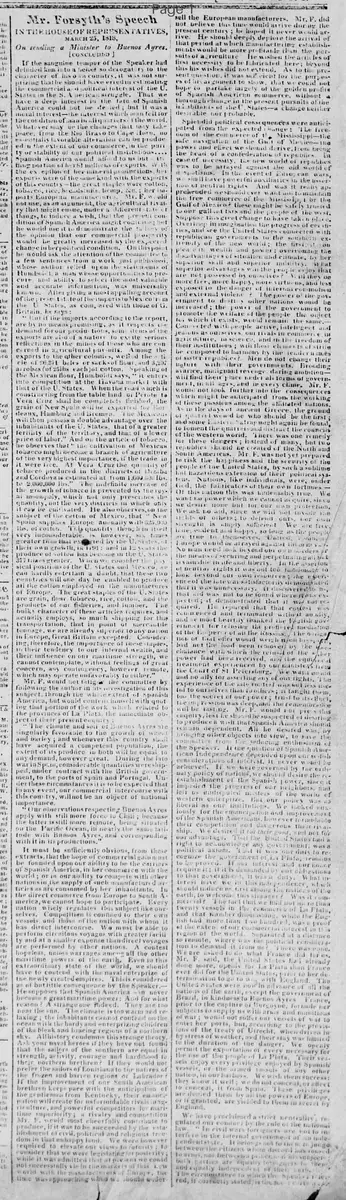
If the sanguine temper of the Speaker had betrayed him into a belief so derogatory to the character of his own country, it was not surprising that he should have erred in estimating the commercial and political interest of the U. States in the S. American struggle. That we have a deep interest in the fate of Spanish America could not be denied: but it was a moral interest—the interest which man feels for the condition of a suffering brother at the other side of the world. Whatever may be the changes that may take place, from the Rio Bravo to Cape Horn, no essentially favorable alteration can be produced in the extent of our commerce, in the purity or stability of our political institutions.... Spanish America would afford to us but a trifling portion of her immense exports. With the exception of her mineral productions, her exports were of the same kind with the exports of this country—the great staples were cotton, tobacco, rice, beef, skins, hemp, &c.: her imports European manufactures. Mr. F. would not use, as an argument, the agricultural rivalry that might ensue, under a different state of things, to induce a wish, that the present condition of Spanish America might continue: but he would use it to demonstrate the fallacy of the opinion that our commercial prospects would be greatly increased by the expected change in her political condition.
On this point he would ask the attention of the committee to a few sentences from a work just published whose author relied upon the statements of Humboldt, a man whose opportunities to procure and ability to select the most valuable and accurate information, was universally known. After giving a most appalling account of the present state of the industry of Mexico as compared with those of G. Britain, he says: "Even if the imports according to the report, are by no means promising. as it respects the demand for our productions, some items of the exports are of a nature to excite serious reflections in the minds of those who are concerned in agricultural pursuits. Among the exports to the other colonies, we find the article of 26,571 bales or sacks of Flour, and 3,207 arrobas (of 25 lbs each) of cotton. Speaking of the Mexican flour. Humboldt says, "it enters into competition at the Vera Cruz market with that of the U. States. When the road which is constructing from the table land of Perote to Vera Cruz shall be completely finished, the grain of New Spain will be exported to Bordeaux. Hamburg and Bremen. The Mexicans will then possess a double advantage over the inhabitants of the U. States. that of a greater fertility of the territory, and that of a lower price of labor." And on the article of tobacco, he observes that "the cultivation of Mexican tobacco might become a branch of agriculture of the very highest importance. if the trade in it were free. At Vera Cruz the quantity of tobacco produced in the districts of Dzaba and Cordova is estimated at from 1,000,000 to 2,000,000 lbs." The indefinite increase of the growth of tobacco is prevented by the royal monopoly, which not only prescribes the quantity, but the very districts in which only it can be cultivated. He also observes, on the subject of the cotton of Mexico, that "New Spain supplies Europe annually with 6,000,000 lbs. of cotton. This quantity though in itself very inconsiderable. is. however, six times greater than that exported by the U. States, from their own growth, in 1805: and in 15 years the produce of cotton has become in the U. States 37 times greater. When we consider the physical positions of the U. States and Mexico. we can hardly entertain a doubt, that these two countries will one day be enabled to produce all the cotton employed in the manufactures of Europe. The great staples of the U. States are grain, flour tobacco, rice, cotton, and the products of our fisheries, and lumber. The bulky character of these articles requires, and actually employs, so much shipping for the transportation, that in point of mercantile tonnage, we are already superior to any nation in Europe, Great Britain excepted. Considering, therefore, the importance of these staples, to their tendency to our internal wealth, and their influence on our marine strength, we cannot contemplate, without feelings of great concern, any contingencies, however remote, which may operate unfavorably to either."
Mr. F. would not tantalize the committee by following the author in his more extensive investigation of this subject, through the whole extent of Spanish America, but would content himself with quoting that portion of the work which related to the provinces of La Plata. the immediate object of their present enquiry: "The climate and soil of Buenos Ayres are singularly favorable to the growth of wheat. and barley; and whenever this country shall have acquired a competent population, the extent of its produce in both will be equal to any demand, however great. During the late war in Spain, considerable quantities were shipped, under contract with the British government, to the ports of Spain and Portugal. Under these circumstances it is to be expected that in any event. our commercial intercourse with this country, will not be an object of national importance. Our observations respecting Buenos Ayres apply with still more force to Chili; because the latter is still more remote. being situated on the Pacific Ocean, in nearly the same latitude with Buenos Ayres, and corresponding with it in its productions."
It must be sufficiently obvious, from these extracts, that the hope of commercial gain must be founded upon our ability to be the carriers of Spanish America. in her commerce with the world; or in our ability to compete with other nations in the supply of such manufactured articles as are consumed by her inhabitants. In the direct commerce from Europe to South America, we cannot hope to participate. Every nation wisely regulates this subject like our selves. Competition is confined to their own vessels and those of the nation with whom it has direct intercourse. We must be able to perform circuitous voyages with greater facility and at a smaller expense than direct voyages are performed by other nations. A contest hopeless, unless war rages among all the other maritime powers of the earth."
Even in this extraordinary state of the world, we should have to contend with the naval enterprise of the newly created empires. This is considered as of but little consequence by the Speaker.— He supposes that Spanish America can never become a great maritime power: And for what reason? A strange one indeed. They are too near the sun. The climate is too warm and relaxing: the inhabitants cannot contend on the ocean with the hardy and enterprising children of the bleak and bracing regions of a northern sky. All history condemns this strange theory. Ask your naval heroes if they have not found that the sailors of the southern state equal in strength, activity, courage and hardihood to their northern brethren? If they would not prefer the sailors of Louisiana to the natives of The frozen and barren regions of Labrador? If the improvement of our South American brethren keeps pace with the anticipation of the gentleman from Kentucky. their emancipation will create for us formidable rivals in agriculture, and powerful competitors for maritime superiority; a rivalry and competition Mr. F. would most cheerfully contemplate to produce. if it was to be succeeded by the establishment of civil, political and religious freedom in that unhappy land.
We were however required to elevate our view, to look to futurity: to consider that we were legislating for posterity; while it was admitted that at present we could not successfully vie in the markets of the world with the manufacturers of Europe, the time was approaching when we should under sell the European manufacturers. Mr. F. did not believe this time would arrive during the present century; he hoped it never would arrive. He should deeply deplore the arrival of that period at which manufacturing establishments would be more profitable than the pursuits of agriculture he wished the articles of first necessity to be fabricated here; beyond this his wishes did not extend. As to the present question. it was sufficient for the purposes of his argument to show, that we could not hope to partake largely of the golden profits of Spanish American commerce, without a thorough change in the present pursuits of the inhabitants of the U. States—a change neither desirable nor probable.
Splendid political consequences were anticipated from the expected change: The peace. of the commerce of the Mississippi—the safe navigation of the Gulf of Mexico—in the power and effect we should derive, from being the head of a confederation of republics in case of necessity. the new world of republics was to be arrayed against the old world of despotisms. In the event of European wars, we shall have powerful auxiliaries in the assertion of neutral rights And was it really apprehended we should ever want aid to maintain the free commerce of the Mississippi or the Gulf of Mexico? these might be safely trusted to our gallant tars and the people of the west.
Suppose this great change to have taken place. Overleap imagination the progress of centuries, and see the United States connected with republican governments to the southern extremity of the new world; the first in wealth and power: overcoming the disadvantages of situation and climate, by her superior skill and superior industry. what superior advantages do the people enjoy that are not possessed by ourselves? will they be more free, more happy, more virtuous, and less exposed to the danger of internal commotion and external violence? The glory of the government to direct other nations would be increased; the duty of the government to promote the welfare of the people the object to which it exists. would remain the same.— Connected with people active, intelligent and jealous as ourselves. our rivals in commerce in agriculture, in science, and in the freedom of their institutions; will these elements of strife be composed to harmony by the fraternal ties of sister republics?. Men do not change their nature with their governments. Brooding avarice, malignant revenge. daring ambition will find their place under all forms of government, in all ages, and in every clime.
"Mr. F. would not look further into the consequences which might be anticipated from the working of these passions among the affiliated nations. As in the days of ancient Greece. the ground of quarrel would be who should be the first; and some Lacedaemonian might again be found. to foment the quarrels and distract the councils of the western world. There was one remedy for these dangers; instead of many. but two republics should be created of the North and South Americas. Mr. F. was not yet prepared to risk the happiness and the security of the people of the United States, by such a sublime but hazardous extension of their political system. Nations, like individuals, were, under God, the fabricators of their own fortunes - Of this nation this was eminently true. We want no power which we cannot acquire, since we desire none but for our own protection. We ask no aid, since we wish not invade the right- of others; to defend ours. our own strength is amply sufficient We are free. independent and happy, so long as the people are true to themselves. Guard, well. I hope would be arrayed against lint m va. No man need look beyond our own borders for the means of securing and perpetuating all that yet is valuable in life and liberty. in the assertion of neutral rights it was not too ludicrous to look beyond our own resources; the experience of the late war satisfactorily demonstrated that it was unnecessary. it discovered to B-, that aid was not to be found where it was ex- pected; it demonstrated that it was not re- quired.' tie regretted that that contest was commenced and terminated without an ally, and he most heartily thanked the English gov. exnnsnt for refusing the proposed mediation of the Lper s of all the nations./the oorgaf nor ot toat oter wooid weigh upon bo-si fr had mut thre load neen removey by the yar- chaiouce with whuch the tetn-d of the her power had beed rreeived, aid tbe vqanfical neatent exptiencra by our manisles tem the Conit of t Petersburg. Ne wapi doaid and no ally tor asseilmg any of ond rights. The experlence of the nate conterl was sut reas uise- tni to oarseives than io others; it tangh them, too the seciet at our powcr; trust to ilsetleet, the in resstou was deep,did the reaenibranhe will be lastng. Mr. F. wouid ioi pie s this cnqairy, lest le shosid be suspected ef desiting to proddce a wish that Spanish Auncnica shond renaln dependent. All le desired was, Dy bringing oiher objects into view, to save the comiittee trom te sedueung enthnsiasm of the Spranty. It the questicu of Spani h Ame- rican Indegendeuce depaded upon out su disb connudetations ot mnterst. it ne ver woned he achteved. Ii we were governed by tae oidi- naty poticy of nations, we shovld desire the re- estabhslument of the Spabish jower, since t imyeded the progress of oar neishbats. aad ieli us undisputed n. sters of the worlo of western enteiplze. But onr puiey Was as libcial as our iastitntivis. We tooked rus- jously for the emanctrellol and noptove ent ofthe Spanish Amnericnts. houever ie rmdable their coypetiion aod dat gcrous thir ndi- ship. W e desired a tor their good, amd net for our advuntago. Tiat the Unit d states Lad a right to ackuowlegge any goitsiment, wasa polittival axtoni. I bat it was oar duiy to re- coguize the Aovctnent of La Piata, remaus to be ptoved. If ona mntetesi an.d ourhoccr require it; it it is dcndanded by ut oikgatiok4 to ihat goverunent, " wisn duty. What in- terest hase we in tis mdodence, wich should nduce ms trst atong the nalieas of the carth,to welcome ths shaagere Was it com- mendial? The tact that we had not o to than twenty vesscls in the cohunetee ol La Ilale, and (hat namber dutasimg. wble the Eag" lish bad more tian fo luudied, was jroof of the extent ofour co.dnerciar nte.est inttis regton ot the world. Separated at a distmnce so remote, where was thr polt.cal eensiicid- ton to deinatd it fom ue? nete was vone. Weare csked to do what Frame did torue. Mr. F. said, the United stetes hai atready done more, Opeuiv tor Ia Piata chan f rance ever did for the Unted states, fitus toher de- temmralion to go to w with Logland. The United states were now in advance of all the natlons of the oarth, exeept the governent of Brazdl, in kinduess to Buenos Ayres France, prior to the caplure or Wurgoyne, forbade her subjects to supyy ne vith aris and miuitions of war; wonid not suifer our vesscls of wat to ente: her ports, but, according to the provis- lons of the treaty of Uirecht. when driven in by stress of weather, aed their slay was himied to the duration of the danger. We opcnly permit the exportation of every necessary for the nse of the people of La Phita. Their ves. sels cnjoy every prvilece enjoyed by Spamsls vessels, or the wraned vesals of auy other natiou,w our harbors. We wish dhem success: they know it well; wedonot conceal,oraflect to conceal, it from Spait. Ihese privile ges are den.ed themn by ai the powers of Earope, or i gratted, are yieided to them m scciet by Engiand. We hnave prechuimed a striet nemtruliiy' re gulated our contucr by the rale oi the nutional Iaw. " In civil wars foreigners are vot to ie terfe re in the faternal goveinmeot of an ude. Fendentstte. It beiotgs ned to then. to jneg between the citizens whom dstord bas ronsed to ains, nor betweeha pa Lcth: ti nis snoject both t4ities ate equaliy tere ghrrs to thep. and egoaliy lndepecdent of thet eit. ThroCircumstaere to watchthe SpCakIie. red, it cortcetis sfated is ths he icrta d
sell the European manufacturers. Mr. F. did not believe this time would arrive during the present century; he hoped it never would arrive. He should deeply deplore the arrival of that period at which manufacturing establishments would be more profitable than the pur- suits of agriculture he wished the articles of first necessity to be fabricated here; beyond this his wishes did not extend. As to the present question. it was sufficient for the purposes of his argument to show, that we could not hope to partake largely of the golden profits of Spanish American commerce, without a thorough change in the present pursuits of the inhabitants of the U. States—a change neither desirable nor probable. Splendid political consequences were anticipated from the expected change: The peace. of the commerce of the Mississippi—the safe navigation of the Gulf of Mexico—in the power and effect we should derive, from being the head of a confederation of republics in case of necessity. the new world of republics was to be arrayed against the old world of despotisms. In the event of Euro. pean wars, we shall have powerful auxiliaries in the assertion of neutral rights And was it really apprehended we should ever want aid to maintain the free commerce of the Mississippi or the Gulf of Mexico? these might be safely trusted to our gallant tars and the people of the west. Suppose this great change to have taken place. Overleap imagination the progress of centuries, and see the United States connected with republican governments to the southern extremity of the new world; the first in wealth and power: overcoming the disadvantages of situation and climate, by her superior skill and superior industry. what superior advantages do the people enjoy that are not possessed by ourselves? will they be more free, more happy, more virtuous, and less exposed to the danger of internal commotion and external violence? The glory of the government to direct other nations would be increased; the duty of the government to promote the welfare of the people the object to which it exists. would remain the same.— Connected with people active, intelligent and jealous as ourselves. our rivals in commerce in agriculture, in science, and in the freedom of their institutions; will these elements of strife be composed to harmony by the fraternal ties of sister republics?. Men do not change their nature with their governments. Brooding avarice, malignant revenge. daring ambition will find their place under all forms of government, in all ages, and in every clime. "Mr. F. would not look further into the consequences which might be anticipated from the working of these passions among the affiliated nations. As in the days of ancient Greece. the ground of quarrel would be who should be the first; and some Lacedaemonian might again be found. to foment the quarrels and distract the councils of the western world. There was one remedy for these dangers; instead of many. but two republics should be created of the North and South Americas. Mr. F. was not yet prepared to risk the happiness and the security of the people of the United States, by such a sublime but hazardous extension of their political system. Nations, like individuals, were, under God, the fabricators of their own fortunes - Of this nation this was eminently true. We want no power which we cannot acquire, since we desire none but for our own protection. We ask no aid, since we wish not invade the right- of others; to defend ours. our own strength is amply sufficient We are free. independent and happy, so long as the people are true to themselves. Guard, well. I hope would be arrayed against lint m va. No man need look beyond our own borders for the means of securing and perpetuating all that yet is valuable in life and liberty. in the assertion of neutral rights it was not too ludicrous to look beyond our own resources; the experience of the late war satisfactorily demonstrated that it was unnecessary. it discovered to B-, that aid was not to be found where it was ex- pected; it demonstrated that it was not re- quired.' tie regretted that that contest was commenced and terminated without an ally, and he most heartily thanked the English gov. exnnsnt for refusing the proposed mediation of the Lper s of all the nations./the oorgaf nor ot toat oter wooid weigh upon bo-si fr had mut thre load neen removey by the yar- chaiouce with whuch the tetn-d of the her power had beed rreeived, aid tbe vqanfical neatent exptiencra by our manisles tem the Conit of t Petersburg. Ne wapi doaid and no ally tor asseilmg any of ond rights. The experlence of the nate conterl was sut reas uise- tni to oarseives than io others; it tangh them, too the seciet at our powcr; trust to ilsetleet, the in resstou was deep,did the reaenibranhe will be lastng. Mr. F. wouid ioi pie s this cnqairy, lest le shosid be suspected ef desiting to proddce a wish that Spanish Auncnica shond renaln dependent. All le desired was, Dy bringing oiher objects into view, to save the comiittee trom te sedueung enthnsiasm of the Spranty. It the questicu of Spani h Ame- rican Indegendeuce depaded upon out su disb connudetations ot mnterst. it ne ver woned he achteved. Ii we were governed by tae oidi- naty poticy of nations, we shovld desire the re- estabhslument of the Spabish jower, since t imyeded the progress of oar neishbats. aad ieli us undisputed n. sters of the worlo of western enteiplze. But onr puiey Was as libcial as our iastitntivis. We tooked rus- jously for the emanctrellol and noptove ent ofthe Spanish Amnericnts. houever ie rmdable their coypetiion aod dat gcrous thir ndi- ship. W e desired a tor their good, amd net for our advuntago. Tiat the Unit d states Lad a right to ackuowlegge any goitsiment, wasa polittival axtoni. I bat it was oar duiy to re- coguize the Aovctnent of La Piata, remaus to be ptoved. If ona mntetesi an.d ourhoccr require it; it it is dcndanded by ut oikgatiok4 to ihat goverunent, " wisn duty. What in- terest hase we in tis mdodence, wich should nduce ms trst atong the nalieas of the carth,to welcome ths shaagere Was it com- mendial? The tact that we had not o to than twenty vesscls in the cohunetee ol La Ilale, and (hat namber dutasimg. wble the Eag" lish bad more tian fo luudied, was jroof of the extent ofour co.dnerciar nte.est inttis regton ot the world. Separated at a distmnce so remote, where was thr polt.cal eensiicid- ton to deinatd it fom ue? nete was vone. Weare csked to do what Frame did torue. Mr. F. said, the United stetes hai atready done more, Opeuiv tor Ia Piata chan f rance ever did for the Unted states, fitus toher de- temmralion to go to w with Logland. The United states were now in advance of all the natlons of the oarth, exeept the governent of Brazdl, in kinduess to Buenos Ayres France, prior to the caplure or Wurgoyne, forbade her subjects to supyy ne vith aris and miuitions of war; wonid not suifer our vesscls of wat to ente: her ports, but, according to the provis- lons of the treaty of Uirecht. when driven in by stress of weather, aed their slay was himied to the duration of the danger. We opcnly permit the exportation of every necessary for the nse of the people of La Phita. Their ves. sels cnjoy every prvilece enjoyed by Spamsls vessels, or the wraned vesals of auy other natiou,w our harbors. We wish dhem success: they know it well; wedonot conceal,oraflect to conceal, it from Spait. Ihese privile ges are den.ed themn by ai the powers of Earope, or i gratted, are yieided to them m scciet by Engiand. We hnave prechuimed a striet nemtruliiy' re gulated our contucr by the rale oi the nutional Iaw. " In civil wars foreigners are vot to ie terfe re in the faternal goveinmeot of an ude. Fendentstte. It beiotgs ned to then. to jneg between the citizens whom dstord bas ronsed to ains, nor betweeha pa Lcth: ti nis snoject both t4ities ate equaliy tere ghrrs to thep. and egoaliy lndepecdent of thet eit. ThroCircumstaere to watchthe SpCakIie. red, it cortcetis sfated is ths he icrta d
device that our conduct has been consistent
with our professions. We have pleased neither
party, while more fortunate England has
succeeded in pleasing both parties. Honorable
neutrality is never grateful for pleasing to either
of the belligerents; pretended neutrality and
secret assistance is grateful to that power to
whom aid is given. England may have been
artful enough to persuade Spain that her
400,000 pounds was intended for this purpose.
While her secret supplies of arms have satisfied
the United Provinces, that England desired
only to promote their success. Our duty can
not require us to do what is useless—what is
calculated to confirm a charge made against
us, of fomenting the disturbances in Spanish
America; a charge to which probable evidence
is already afforded by the expeditions of Mi-
randa, of Carrera, of Mina, all of whom sailed
from these states to their places of respective
destination. It is the duty and the interest of
England to stand forth as the protector or first
friend of the new government. She enjoys
the fruits of their separation from the parent
country. She fomented the quarrel. Then
let her take the risk as she will take the honor
and the profits of the recognition of the new
power. Mr. Forsyth was at a loss to conjecture why it had not already been done by
England, unless she feared the undefined and
undefinable obligations of the Holy League, or
was content to reap the present profits, reserving to herself the power to secure the future,
either by recognizing the new people on favorable conditions, or by restoring them, by her
mediation, to their former master, upon con-
ditions equally favorable to her commercial
interest.
At what risk, may be asked, will this recognition be made? At the hazard of a war with
Spain. The gentleman from Kentucky says it
is not justifiable cause of war. Does he mean
in the eye of reason, or in the opinion of na-
tions? In the opinion of nations it certainly is
justifiable cause of war; and it is not to be
doubted, that were situations reversed, such a
recognition of the independence of one of these
states of the union, Louisiana, for example, by
Spain, would be instantly followed by war.
The speaker seemed, indeed, to doubt the
soundness of this position, as he pressed prin-
cipally the want of ability in Spain to make
war, not the deficiency of just motive for de-
claring it. That war would follow with Eng-
land, should Spain venture upon a contest with
us, Mr. F. did not believe. She would have
the most powerful motives for neutrality. The
glorious opportunity of ruining our commerce,
would be afforded, and would be seized with
avidity. The increased expenses of ship-
ments in American vessels, would throw the
whole of our trade into British bottoms, and
our flag would be driven from the ocean, ex-
cept where it floated over our public or private
armed ships. Mr. F. would encounter this dan-
ger of a war with Spain, with all its consequen-
ces, for an adequate motive; but he would not,
by hurrying to do an act useless at best, and
which might hereafter be performed without
hazarding any thing. At all events, he was
unwilling to encounter it until La Plata had
shown, by indisputable testimony, that she was
independent, and had the power and the will
to maintain it.
Was there a free government in La Plata.
for whose existence we ought to encounter any
hazard? Was there a government indepen-
dent of Spain, and which could not be com-
peled by the power, or seduced by the cajole.
ments of Spain, to its former vassalage? The
character of the government might be read in
the history of its formation—in the changes
which preceded it, and in its acts since it was
established. The disturbances in the Peninsula,
had induced the viceroy of Buenos Ayres, Cisneros, to call a junta in May, 1810, composed of
the officers of the royal government. In April,
1811, a new government was formed by
the inhabitants of the city of Buenos Ayres.
having been called together for that purpose.
by the municipality of the city. This govern-
ment, which, like the other, was but a name for
a new organization of the regal power, was
composed of three members and two secreta-
ries. According to the El Estatuto, one mem-
ber, exercising the executive power, was to va-
cate his seat at the expiration of six months,
and his place was to be supplied by election.
The deputies of the municipalities of the pro-
vices, were to form the electoral college. The
assembly for the election of one of the
members of the executive authority, met on
the 4th day of April, 1812, and nominated Pu-
errydon for one member of the government;
they proposed to form a constitution, but were
dissolved by the existing authority. Puerrrydon
derived no power from this nomination. The
second assembly met on the 6th of October,
1812, and elected Medrano; but, pursuing the
track of their predecessors, they met a similar
fate. The municipality, people of the city,
and troops opposed their measures, and the
assembly was dissolved by military force.
A meeting of the inhabitants of Buenos
Ayres, Cabildo Abierto, was convened on the
8th day of October, 1812, and the administra-
tion was vested in Pena, Passo, and Jonte.
Thus perished the El Estatuto, after exi-
sting twelve months, and being violated in all
its provisions. In January, 1813, a new as-
sembly met; the Constituyente, composed of
deputies, nominated by the Electoral Colleges
of the towns and cities of Rio de La Plata: the
chief acts of the new assembly was the change
of the title of the government, from Gobierno
Superior, to Supreme Poder Executiveo, and
the decree of freedom to the children of slaves.
The same decree compelled a sale of every
third male slave to be enrolled in the army,
the price being a debt due to the owners by
the state. In December, 1813, the govern-
ment of these persons was annulled by the as-
sembly, and Pozados was chosen Supreme Di-
rector, to give strength by concentrating the
Executive Power. In January, 1814, Pozados
having resigned, Alvear was appointed Su-
preme Director. In April, 1815, there was a
new revolution. A meeting of the inhabitants
of Buenos Ayres was convened, and the autho-
rity of Alvear and the assembly disowned. The
municipality was vested with the supreme
command. The municipality formed a junta
called De Observacion, by whom a new con.
stitution was published. Rondeau was named
Director, but being in military command with
the army, Col. Alvarez, a ringleader in the re-
volt, was made his substitute. Alvarez convoked a Congress, but before it assembled he was
dispossessed by another commotion of the
power he held in the absence of Rondeau. Bel-
cora was then appointed Supreme Director,
but was soon after removed, and the adminis.
tration placed in the hands of a committee.
The Congress of Tucuman met in 1816, chose
Puerrrydon Supreme Director, and declared
the independence of the provinces of La Plata
on the 9th July; proposed to publish a manifesto, one of which was published in 1817, and to form a
constitution that has not yet been matured. In
this hasty sketch of the events which led to the
establishment of the government as it now ex-
isted, it must have occurred to the members
of the committee that there was no agency of
the people in its organization, except the com-
motions in the city of Buenos Ayres; they seem
to have been the idle spectators of the move.
ments of the constituted authorities and the
military. For aught that appeared, the ancient
institutions below the head of the government,
remained as formerly. Mr. F. would not de-
tail the accusations, in executions, and ba-
nishments which were the consequences of
these changes. That the people were not
deeply interested in the successive changes,
and did not appear to have derived essential
benefits from them, was sufficiently obvious.
and all he desired to establish.
The conduct
of Puerrrydon to Carrera, since this declaration
of independence, may serve further to illu-
strate the character of this new power. Car-
rera was a Chilian, the author of the revoluti.
on, there; in the decline of his fortune, he
came to the United States, and after procu-
ring resources for renewing efforts, returned to
La Plata to execute his designs: he carried
with him the hopes and good wishes of all the
friends of freedom in the United States. Un-
fortunately he expected assistance from La
Plata, and sailed with confidence into her
ports. An expedition having been prepared
in La Plata, against Chili, instead of receiving
aid from Carrera, in the deliverance of his
country from slavery and oppression, the ostensible motive for this expedition, he was
seized, imprisoned, and finally banished: through this only satisfaction he received is to be found in
that part of Puerrrydon's excuse -o that has been
read by the Speaker, in which he deplores the
rudeness which he has been compelled to show
so contrary to the politeness and urbanity of
his own nature, and that of his government.
The motives for this course may be collected
from the recent accounts from Chili. A letter
of the 7th of October says, "more than eighty
persons of the first distinction have been seized.
ed and thrown into dungeons by the military,
on the ground of attachment to General Car-
rera, and the treasures of Chili were exhausted
by contributions to Buenos Ayres, and the
people of Chili are experiencing the benefits of
that kind of deliverance from the royal Spaniards, by O'Higgins and the army of Buenos
Ayres, that France has experienced under the
Bourbons, supported by the armies of Wel-
lington and Alexander." The power of Spain
had not been exerted against this new govern-
ment—not a Spanish soldier, or bayonet, had
been sent from Old Spain since the restoration
of Ferdinand. Was the new government possessed of the physical and moral strength to
resist her efforts when they should be made?
Gentlemen should not deceive themselves.
Spain, inert and powerless, as she was, was a
formidable power to Spanish America, by the
nature of the government, and the superstition
of its inhabitants. She had ample resources
for the purchase of assistance, should she be
driven to this resort. The time had not ar-
rived when the Spanish monarch asked himself
the important question—What part of my do-
minions will I surrender for the preservation of
the rest? When he is willing to make great sa-
crifices, he can procure ample assistance.—
Those who sold him ships for money will sell
him men for territory. His European territo-
ries may tempt Russia—his possessions in
the West Indies, England—to assist him in the
subjugation of his rebellious subjects. He
may sell La Plata for Portugal, and the parties
to the holy league may guarantee their respec.
tive cessions to each other. Shall we find in
La Plata the unanimity, energy and virtue, to
resist such arrangements, where province is
arrayed against province, under Puerrrydon
and Artegas, viewing each other with a hostili-
ty more deadly than the proverbially mutual
hatred of Spaniards and Portuguese? A still
more fatal course may be pursued. The king
of Spain may choose to try persuasion, giving
to England the promise of free commerce with
the Spanish Main; may he not easily procure
another mediation, the condition of which
shall be the conditional return of La Plata to
her dependent state?—England knew well how
to make such a mediation effectual. Let it
not be said her honor forbids it, or her interest.
Her interest is promoted by the commercial
monopoly such an arrangement will give. Her
honor always bows obedient to the dictates of
her commercial interest. If she should feel
some qualms of conscience, the Island of Cuba
will calm her scruples. But has she ever pro-
mised more than to secure the commercial in-
dependence of Spanish America? What a con-
temptible figure should we make in the eyes
of all mankind—how degraded in our opinions
—if we should recognise La Plata, and the go-
vernment should shortly after voluntarily re-
turn to the Spanish yoke.
That the committee
might not be deceived by the supposed attach.
ment felt by the new government for the Uni-
ted States—by the profession of an anxious de-
sire to follow our example, and imitate our
virtue, Mr. F. would mention a few facts, at
once illustrating the ardor of their attachment
to the United States, and the justice and honor
of the government in its dealings with indivi-
duals. The American brig Savage, of Balti-
more, sailed to Buenos Ayres with a cargo of
military stores; there they sold them to govern-
ment, to be delivered in Chili. The voyage
was performed—four months elapsed, under
various pretences, before the cargo was received, and after this delay the payment was made,
not according to contract, but at the discretion
of the government. The owner was thus plundered of his property, and injured by this de-
lay of his plunderers. The ship Enterprise, of
Philadelphia, captain Coffin, was employed.
by contract, to carry three hundred exiles from
Juan Fernandez to Valparaiso, from whence
they had been formerly banished by the royal
party. He was to have received 7,500 dollars.
He performed his contract—restored the ex-
iles to their country, and their homes. After
a detention of two months, he was paid 2,500
dollars—St. Martin, the Washington of Ame-
rica, as he is called, alleging that this was
enough.
In the armies of La Plata, English and
French officers are employed without scruple,
Americans seldom, if ever. Our countrymen
do not suit their manners, opinions, or govern-
ment. Jewett, formerly of the United States,
and Kennedy, formerly of the marine corps,
sought in Valparaiso, in 1817, commissions in the
army of St. Martin. He suspected them of at-
tachment to the Carreras, and threw them into
a dungeon, from whence they were not released
until the captain of a vessel, who procured
their liberation, entered into an engagement to
take them immediately from a soil they were
deemed unworthy to tread. To judge of the
character of the nation, from the cruelty
and harshness, or injustice, of an individual.
was not reasonable; but when that individual
was the theme of universal admiration in his
own country, it could not be considered as im-
proper to make him the standard by which to
estimate the opinions and character of his
countrymen.
Every arrival from this land of promise
brings us the history of the oppressions of the
existing government, and the fearful forebod-
ings of our countrymen, that the people, for
whom our anxious wishes are hourly expressed,
will derive no benefits from the change of
their governors—that the Spanish power will
be restored in all its rigor—or that the new au-
thorities will ever be exercised with the same
contempt of the principles of justice and of
freedom, that distinguished the ancient tyran-
ny. It might be urged, that this was news-
paper information, derived from persons of
doubtful authority. This objection was of the
same force, in its application, to all the in-
formation possessed of that country. It was
of such materials its history was composed. A
powerful, an irresistible argument, to induce
the committee to refrain from the commission
of an act of doubtful propriety, might be drawn
from this source; but Mr. F. would not trespass longer upon their patience, exhausted, as
it must be, by attending to the long and animated address of the Speaker, and his own desul-
tory reply.
What sub-type of article is it?
What keywords are associated?
What entities or persons were involved?
Where did it happen?
Foreign News Details
Primary Location
Buenos Ayres
Event Date
1818 03 23
Key Persons
Outcome
no immediate casualties reported; speech argues against us recognition of la plata independence due to minimal commercial gains, political instability, and war risks with spain, emphasizing us neutrality and moral support.
Event Details
Mr. Forsyth delivers a speech in the US House opposing the dispatch of a minister to Buenos Ayres, critiquing exaggerated commercial and political benefits from South American independence, citing Humboldt on agricultural competition, detailing La Plata's turbulent government history from 1810-1817, and highlighting instances of mistreatment of Americans and internal conflicts.