Thank you for visiting SNEWPapers!
Sign up free
The Age Herald
Birmingham, Jefferson County, Alabama
What is this article about?
Congressional proceedings in Washington on January 24: House passes bill with Rixey amendment lost; Senate debates Indian appropriation bill, criticizes Dawes commission extravagance, adopts resolution on A. Mabini's deportation, and adjourns after amendments.
Clipping
OCR Quality
Full Text
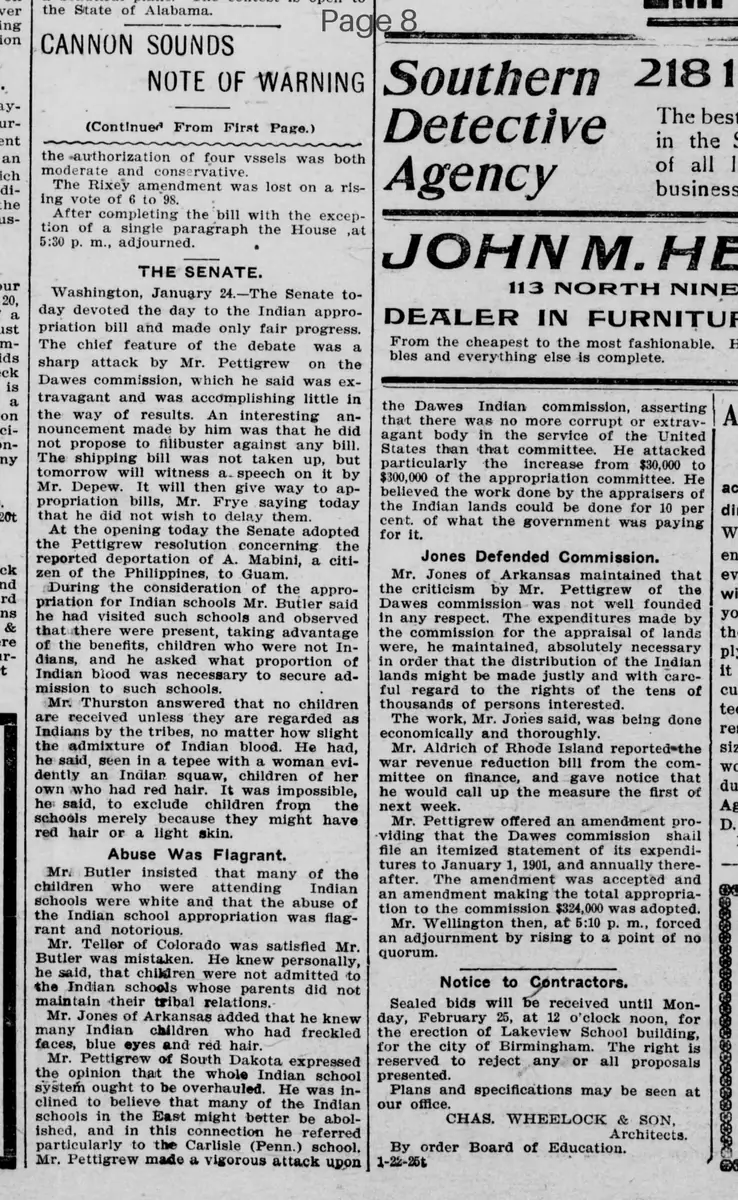
NOTE OF WARNING
(Continued From First Page.)
the authorization of four vessels was both
moderate and conservative.
The Rixey amendment was lost on a rising
vote of 6 to 98.
After completing the bill with the exception
of a single paragraph the House, at
5:30 p. m., adjourned.
THE SENATE.
Washington, January 24.-The Senate today
devoted the day to the Indian appropriation
bill and made only fair progress.
The chief feature of the debate was a
sharp attack by Mr. Pettigrew on the
Dawes commission, which he said was extravagant
and was accomplishing little in
the way of results. An interesting announcement
made by him was that he did
not propose to filibuster against any bill.
The shipping bill was not taken up, but
tomorrow will witness a speech on it by
Mr. Depew. It will then give way to appropriation
bills, Mr. Frye saying today
that he did not wish to delay them.
At the opening today the Senate adopted
the Pettigrew resolution concerning the
reported deportation of A. Mabini, a citizen
of the Philippines, to Guam.
During the consideration of the appropriation
for Indian schools Mr. Butler said
he had visited such schools and observed
that there were present, taking advantage
of the benefits, children who were not Indians.
and he asked what proportion of
Indian blood was necessary to secure admission
to such schools.
Mr. Thurston answered that no children
are received unless they are regarded as
Indians by the tribes, no matter how slight
the admixture of Indian blood. He had,
he said, seen in a tepee with a woman evidently
an Indian squaw, children of her
own who had red hair. It was impossible,
he said, to exclude children from the
schools merely because they might have
red hair or a light skin.
Abuse Was Flagrant.
Mr Butler insisted that many of the
children who were attending Indian
schools were white and that the abuse of
the Indian school appropriation was flagrant
and notorious.
Mr. Teller of Colorado was satisfied Mr.
Butler was mistaken. He knew personally.
he said, that children were not admitted to
the Indian schools whose parents did not
maintain their tribal relations.
Mr. Jones of Arkansas added that he knew
many Indian children who had freckled
faces, blue eyes and red hair.
Mr. Pettigrew of South Dakota expressed
the opinion that the whole Indian school
system ought to be overhauled. He was inclined
to believe that many of the Indian
schools in the East might better be abolished,
and in this connection he referred
particularly to the Carlisle (Penn.) school.
Mr. Pettigrew made a vigorous attack upon
the Dawes Indian commission, asserting
that there was no more corrupt or extravagant
body in the service of the United
States than that committee. He attacked
particularly the increase from $30,000 to
$300,000 of the appropriation committee. He
believed the work done by the appraisers of
the Indian lands could be done for 10 per
cent. of what the government was paying
for it.
Jones Defended Commission.
Mr. Jones of Arkansas maintained that
the criticism by Mr. Pettigrew of the
Dawes commission was not well founded
in any respect. The expenditures made by
the commission for the appraisal of lands
were, he maintained, absolutely necessary
in order that the distribution of the Indian
lands might be made justly and with careful
regard to the rights of the tens of
thousands of persons interested.
The work, Mr. Jones said, was being done
economically and thoroughly.
Mr. Aldrich of Rhode Island reported the
war revenue reduction bill from the committee
on finance, and gave notice that
he would call up the measure the first of
next week.
Mr. Pettigrew offered an amendment providing
that the Dawes commission shall
file an itemized statement of its expenditures
to January 1, 1901, and annually thereafter.
The amendment was accepted and
an amendment making the total appropriation
to the commission $324,000 was adopted.
Mr. Wellington then, at 5:10 p. m., forced
an adjournment by rising to a point of no
quorum.
What sub-type of article is it?
What themes does it cover?
What keywords are associated?
What entities or persons were involved?
Where did it happen?
Story Details
Key Persons
Location
Washington
Event Date
January 24
Story Details
House adjourns after passing bill except one paragraph, Rixey amendment lost 6-98. Senate debates Indian appropriation: Pettigrew attacks Dawes commission as extravagant and corrupt; defends against Jones; discusses Indian school admissions for mixed-blood children; adopts resolution on Mabini's deportation; sets commission appropriation at $324,000 with itemized reporting; Aldrich reports war revenue bill; adjourns at 5:10 p.m.