Thank you for visiting SNEWPapers!
Sign up free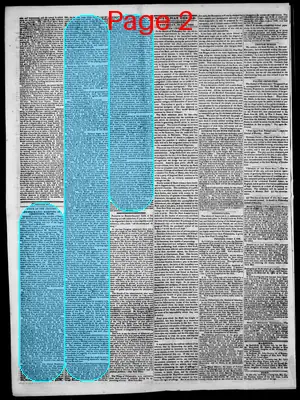
Republican Herald
Providence, Providence County, Rhode Island
What is this article about?
A large Democratic Republican meeting convened in Cheshire, Massachusetts, on Thursday, 28th ultimo, with a procession led by Col. Isaac Huntington and Maj. Simeon W. Wright. Israel W. Cook chaired, and Rev. John Beard delivered a speech praising President Jackson's administration, opposing the Bank of the United States, and reflecting on democratic principles. Patriotic resolutions were unanimously adopted.
Clipping
OCR Quality
Full Text
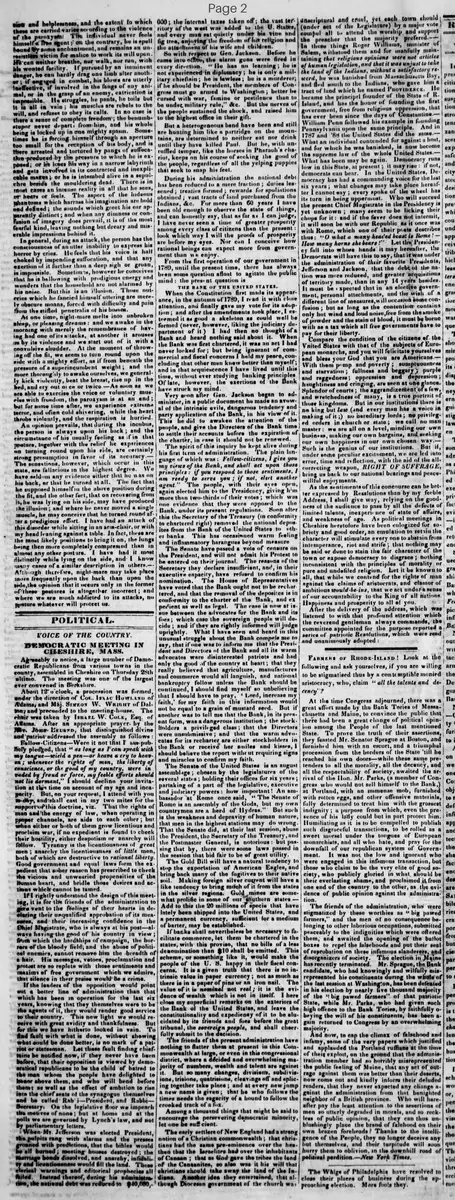
VOICE OF THE COUNTRY.
DEMOCRATIC MEETING IN CHESHIRE, MASS.
Agreeably to notice, a large number of Democratic Republicans from various towns in the county, assembled in Cheshire on Thursday 28th ultimo. The meeting was one of the largest ever convened in Berkshire.
About 1 o'clock, a procession was formed, under the direction of Col. Isaac Huntington of Adams and Maj. Simeon W. Wright of Dalton, and proceeded to the meeting-house. The chair was taken by Israel W. Cook, Esq. of Adams. After an appropriate prayer by the Rev. John Beard, that distinguished divine and patriot addressed the assembly as follows:
Fellow-Citizens—Were it not that I am publicly pledged, that "as long as I can speak with my tongue—wield a pen—or heave a cry to heaven; whenever the rights of men, the liberty of conscience, or the good of my country, were in danger by fraud or force, my feeble efforts should not lie dormant," I should decline your invitation at this time on account of my age and incapacity. But, on your request, I attend with you to-day, and shall cast in my two mites for the support of this doctrine, viz. That the rights of man and the energy of law, when operating in proper channels, are aids to each other; but when either or both of them grow licentious and proclaim war, if no expedient is found to check their hostility, either despotism or anarchy will follow. Tyranny is the licentiousness of great men; anarchy the licentiousness of little men, both of which are destructive to rational liberty.
Good government and equal laws form the expedient that sober reason has prescribed to check the vicious and unwearied propensities of the human heart, and bridle those desires and actions which cannot be tamed.
If I rightly understand the design of this meeting, it is for the friends of the administration to give vent to the feelings of their hearts in declaring their unqualified approbation of its measures, and their increasing confidence in the Chief Magistrate, who is always at his post—always having the good of his country in view from which the hardships of campaign, the horrors of the bloody field; and the abuse of political enemies, cannot remove him the breadth of a hair. His messages, vetoes, proclamation and protest are so replete with those sentiments and maxims of free government which we admire, that silence in their praise would be a crime.
If the leaders of the opposition would point out a better line of administration than that which has been in operation for the last six years, knowing that they themselves were to be the agents of it, they would render good service to their country. This new light we would receive with great avidity and thankfulness. But for this we have hitherto looked in vain. To find fault with what is done, without showing what could be done better, is no mark of a patriot or statesman. Let those fault finding chiefs be notified now, if they never have been before, that their opposition is viewed by democratical republicans to be the child of hatred to the man whom the people have delighted to honor above them, and who will bend before them; as well as the effect of ambition to rise into the chief seats of the synagogue themselves and be called Rabbi—President, and Rabbi—Secretary: On the legislative floor we impeach the motives of none; but at home and at the polls we are governed by Lynch's law, and not by parliamentary letters.
When Mr. Jefferson was elected President, the pulpits rang with alarms and the presses groaned with predictions, that the bibles would be all burned; meetinghouses destroyed; the marriage bonds dissolved, and anarchy, infidelity and licentiousness would fill the land. These clerical warnings and editorial prophecies all failed. Instead thereof, during his administration, the national debt was reduced to $40,000; the internal taxes taken off; the vast territory of the west was added to the U. States, and every man sat quietly under his vine and fig tree, enjoying the freedom of his religion and the attachment of his wife and children.
So with respect to Gen. Jackson. Before he came into office, the alarm guns were fired in every direction. "He has no learning; he is not experienced in diplomacy; he is only a military chieftain; he is lawless; he is a murderer; if he should be President, the members of Congress must go armed to Washington; better be cursed with war, famine or pestilence than to be under military rule," &c. But the nerves of the people sustained the shock, and raised him to the highest office in their gift.
But a heterogeneous band have been and still are hunting him like a partridge on the mountains, are determined to neither eat nor drink until they have killed Paul. But he, with unruffled temper, like the horses in Pharaoh's chariot, keeps on his course of seeking the good of the people, regardless of all the yelping puppies that seek to snap his feet.
During his administration the national debt has been reduced to a mere fraction; duties lessened; treaties formed; rewards for spoliations obtained; vast tracts of land purchased from the Indians, &c. For more than 60 years I have been old enough to observe the state of things, and can honestly say, that as far as I can judge, I have never seen a time of greater prosperity among every class of citizens than the present: look which way I will the proofs of prosperity are before my eyes. Nor can I conceive how rational beings can expect more from government than we enjoy.
From the first operation of our government in 1789, until the present time, there has always been some question afloat to agitate the public mind: the present question is THE BANK OF THE UNITED STATES.
When the Constitution first made its appearance, in the autumn of 1789, I read it with close attention, and finally gave my vote for its adoption; and after the amendments took place, I esteemed it as good a skeleton as could well be formed (never, however, liking the judiciary department of it) I had then no thought of a Bank and heard nothing said about it. When the Bank was first chartered, it was an act I had never looked for; but being ignorant of commercial and fiscal concerns I held my peace, concluding that other men knew better than myself: and in that acquiescence I have lived until this time, without ever studying banking principles.
Of late, however, the exertions of the Bank have struck my mind. Very soon after Gen. Jackson began to administer, in a public document he made an avowal of the intrinsic evils, dangerous tendency and party application of the Bank, in his view of it. This he did to awaken the attention of the people, and give the Directors of the Bank time to settle their accounts before the expiration of the charter, in case it should not be renewed. The spirit of this inquiry he kept alive during his first term of administration. The plain language of which was: Fellow-citizens, I give you my views of the Bank, and shall act upon those principles: if you respond to those sentiments, I am ready to serve you; if not, elect another agent. The people, with their eyes open, again elected him to the Presidency, giving him more than two-thirds of their votes; which was one evidence that they were opposed to the Bank, under its present regulations. Soon after this the Secretary of the Treasury (in conformity to chartered right) removed the national deposits from the Bank of the United States to other banks. This has occasioned warm feeling and inflammatory harangues beyond measure.
The Senate have passed a vote of censure on the President, and will not admit his Protest to be entered on their journal. The reasons of the Secretary they declare insufficient, and, in their executive capacity, have refused to confirm his nomination. The House of Representatives have voted that the Bank ought not to be rechartered, and that the removal of the deposits is in conformity to the charter of the Bank, and expedient as well as legal. The case is now at issue between the advocates for the Bank and its foes; which case the sovereign people will decide; and if they are rightly informed will judge uprightly. What I have seen and heard in this unusual struggle about the Bank compels me to say, that if one was to inform me that the President and Directors of the Bank and all its warm advocates were disinterested patriots and had only the good of the country at heart; that they really believed that agriculture, manufactures and commerce would all languish, and national bankruptcy follow unless the Bank should be continued, I should find myself so unbelieving that I should have to pray, "Lord, increase my faith," for my faith in this information would not be equal to a grain of mustard seed. But if another was to tell me that the Bank, in its present form, was a dangerous institution; the stockholders a privileged class; that the Directors were unsubmissive; and that the warm advocates for its recharter are either stockholders in the Bank or receive her smiles and kisses, I should believe the report without requiring signs and miracles to confirm my faith.
The Senate of the United States is an august assemblage; chosen by the legislatures of the several states; holding their offices for six years; partaking of a part of the legislative, executive and judiciary powers: how important! An ambassador at Rome once said, "The Senate of Rome is an assembly of the Gods, but my own countrymen are a herd of Hydras." But such is the weakness and depravity of human nature, that men in the highest stations may do wrong. That the Senate did, at their last session, abuse the President, the Secretary of the Treasury, and the Postmaster General, is notorious: but passing that by, there were some laws passed in the session that bid fair to be of great utility. The Gold Bill will have a natural tendency to stop the exportation of American Eagles, and bring back many of the fugitives to their native soil. Making foreign silver current will have a like tendency to bring much of it from the states in the silver regions. Gold mines are somewhat prolific in some of our southern states. Add to this the 20 millions of specie that have lately been shipped into the United States, and a permanent currency, sufficient for a medium of barter, may be established.
If banks shall nevertheless be necessary to facilitate commerce, let them be chartered in the states, with this proviso, that no bills of a less denomination than $10 shall be emitted. This scheme, or something like it, would make the people of the U. S. happy in their fiscal concerns. It is a given truth that there is no intrinsic value in paper currency; not as much as there is in a piece of pine or an iron nail. The value of it is nominal not real; it is the evidence of wealth which is not in itself. I here close my superficial remarks on the exteriors of the Bank of the United States, and leave the constitutionality and expediency of it to be elucidated by its friends and foes before the great tribunal, the sovereign people, and shall cheerfully submit to the decision.
The friends of the present administration have nothing to flatter them at present in this Commonwealth at large, or even in this congressional district, where a decided and overwhelming majority of numbers, wealth and talent are against it. But so many changes, divisions, subdivisions, trisections, quadrisections, cleavings off and splicing together take place; and at every new jump a new name is given; that he who follows the times needs the sagacity of a hound to follow the crooked track of a fox.
Among a thousand things that might be said to encourage the persevering democratic minority, let one be sufficient. The early settlers of New England had a strong notion of a Christian commonwealth; that Christians had the same pre-eminence over the heathen that the Israelites had over the inhabitants of Canaan: that as God gave the tribes the land of the Canaanites, so also was it his will that Christians should take away the land of the Indians. Another idea they entertained, that although Diocesan government of the church was unscriptural and cruel, yet each town should compel all to attend the worship and support (under act of the Legislature) by a major vote the preacher that the majority preferred.
In these things Roger Williams, minister of Salem, withstood them and for manfully maintaining that religious opinions were not articles of human legislation, and that it was unjust to take the land of the Indians, without a satisfactory reward, he was banished from Massachusetts Bay, and fled south to the Indians, who gave him a tract of land which he named Providence. He became the principal founder of the State of R. Island, and has the honor of founding the first government, free from religious oppression, that has ever been since the days of Constantine.
William Penn followed his example in founding Pennsylvania upon the same principle. And in 1787 and '88 the United States did the same. What an individual contended for against a host, and for which he was banished, is now become the supreme law of the whole United States.
What has been may be again. Democracy runs low in this State, at present; it may rise: if not, democrats can bear. In the United States, Democracy has had a commanding voice for the last six years; what changes may take place hereafter I cannot say; every spoke of the wheel has its turn in being uppermost. Who will succeed the present Chief Magistrate in the Presidency is yet unknown; many seem to be licking their chops for it: and if the fever does not intermit, it will soon be with our Republic as it once was with Rome, which one of their poets describes thus: "O what a many-headed beast is Rome!—How many horns she bears!". Let the Presidency fall into whose hands it may hereafter, the Democrats will have this to say, that it was under the administration of their favorite Presidents, Jefferson and Jackson, that the debt of the nation was more reduced, and greater acquisitions of territory made, than in any 14 years besides.
It must be expected that in an elective government, personal attachments, and the wish of a different line of measures, will occasion some confusion; but as long as the contention contains only hot wind and loud noise, free from the smoke of powder and the stain of blood, it must be borne with as a tax which all free governments have to pay for their liberty.
Compare the condition of the citizens of the United States with that of the subjects of European monarchs, and you will felicitate yourselves and bless your God that you are Americans. With them pomp and poverty; sumptuousness and starvation; dullness and beggary; purple and raggedness; oppression and depression; haughtiness and cringing, are seen at one glance. Splendor of courts; the aggrandizement of a few, and wretchedness of many, is a true portrait of those kingdoms. But in our institutions there is no king but law (and every man has a voice in making of it;) no hereditary lords; no privileged orders in church or state; we call no man master: we are all on a level, minding our own business, making our own bargains, and seeking our own happiness in our own chosen way.
Such is the genius of our institutions. But if, under some peculiar excitement, we are led into error, time and reflection, with the aid of the all-correcting weapon, RIGHT OF SUFFRAGE, bring us back to our national bearings and peaceful enjoyments.
As the sentiments of this concourse can be better expressed by Resolutions than by my feeble Address, I shall give way, relying on the goodness of the audience to pass by all the defects of limited talents, inexperience of state of affairs, and weakness of age. As political meetings in Cheshire heretofore have been eulogized for so brevity and good order, an emulation to retain the character will stimulate every one to abstain from intemperance, riot and strife; that nothing may be said or done to stain the fair character of the town or expose democracy to disgrace; nothing inconsistent with the principles of morality or pure and undefiled religion. Let it be known to all, that while we contend for the rights of man against the claims of aristocrats, and clamor of ambitious would-be-ins, that we act under a sense of our accountability to the King of all nations. Happiness and prosperity to all of you.
After the delivery of the address, which was listened to with that profound attention which the reverend gentleman always commands, the committee appointed for the purpose reported a series of patriotic Resolutions, which were read and unanimously adopted.
What sub-type of article is it?
What keywords are associated?
What entities or persons were involved?
Where did it happen?
Domestic News Details
Primary Location
Cheshire, Mass.
Event Date
Thursday 28th Ultimo
Key Persons
Outcome
patriotic resolutions unanimously adopted.
Event Details
A large Democratic Republican meeting assembled in Cheshire, with a procession to the meeting-house. Israel W. Cook chaired, Rev. John Beard prayed and delivered a speech supporting President Jackson's administration, praising Jefferson's legacy, opposing the Bank of the United States, and discussing democratic principles and historical context. Resolutions were reported and adopted.