Thank you for visiting SNEWPapers!
Sign up free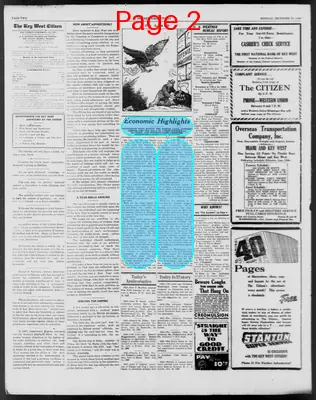
The Key West Citizen
Key West, Monroe County, Florida
What is this article about?
Commentary on delays in the US defense program, including lower aircraft production forecasts, bottlenecks blamed on business fears, lack of centralized leadership, labor-industry unpreparedness, peacetime industry limitations, and public confusion. Calls for presidential action to reorganize efforts.
Merged-components note: Merged section title with following article on national defense as they form a single logical economic/domestic news component.
Clipping
OCR Quality
Full Text
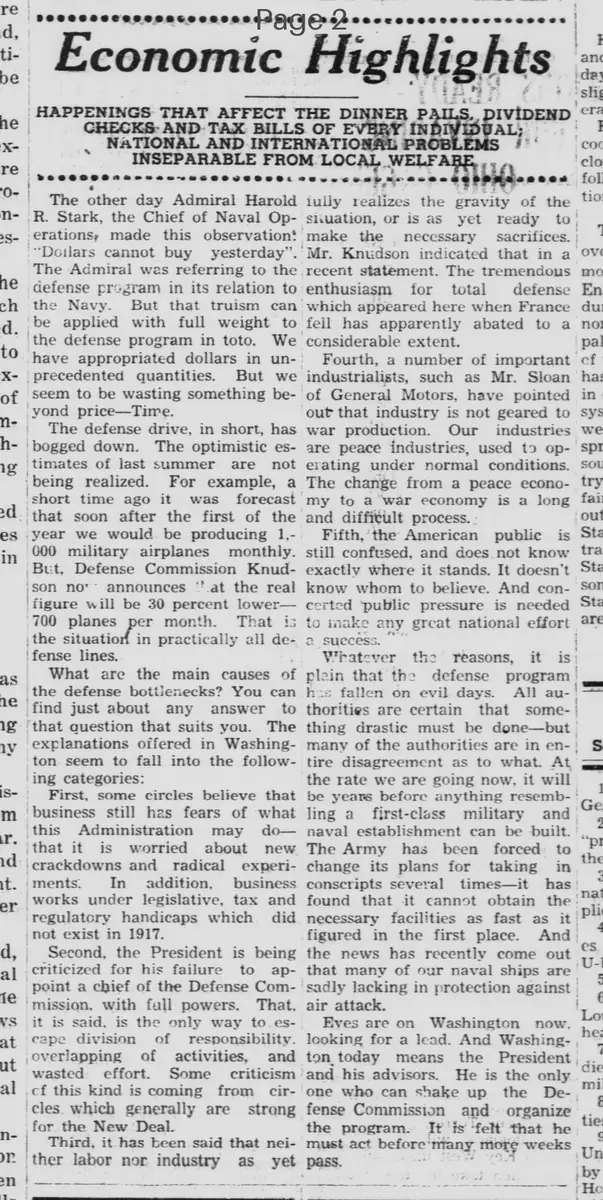
HAPPENINGS THAT AFFECT THE DINNER PAILS, DIVIDEND
CHECKS—AND—TAX BILLS OF EVERY INDIVIDUAL;
NATIONAL AND INTERNATIONAL PROBLEMS
INSEPARABLE FROM LOCAL WELFARE
The other day Admiral Harold R. Stark, the Chief of Naval Operations, made this observation:
"Dollars cannot buy yesterday".
The Admiral was referring to the defense program in its relation to the Navy. But that truism can be applied with full weight to the defense program in toto. We have appropriated dollars in unprecedented quantities. But we seem to be wasting something beyond price—Time.
The defense drive, in short, has bogged down. The optimistic estimates of last summer are not being realized. For example, a short time ago it was forecast that soon after the first of the year we would be producing 1,000 military airplanes monthly. But, Defense Commission Knudson now announces that the real figure will be 30 percent lower—700 planes per month. That is the situation in practically all defense lines.
What are the main causes of the defense bottlenecks? You can find just about any answer to that question that suits you. The explanations offered in Washington seem to fall into the following categories:
First, some circles believe that business still has fears of what this Administration may do—that it is worried about new crackdowns and radical experiments. In addition, business works under legislative, tax and regulatory handicaps which did not exist in 1917.
Second, the President is being criticized for his failure to appoint a chief of the Defense Commission, with full powers. That, it is said, is the only way to escape division of responsibility, overlapping of activities, and wasted effort. Some criticism of this kind is coming from circles which generally are strong for the New Deal.
Third, it has been said that neither labor nor industry as yet fully realizes the gravity of the situation, or is as yet ready to make the necessary sacrifices. Mr. Knudson indicated that in a recent statement. The tremendous enthusiasm for total defense which appeared here when France fell has apparently abated to a considerable extent.
Fourth, a number of important industrialists, such as Mr. Sloan of General Motors, have pointed out that industry is not geared to war production. Our industries are peace industries, used to operating under normal conditions. The change from a peace economy to a war economy is a long and difficult process.
Fifth, the American public is still confused, and does not know exactly where it stands. It doesn't know whom to believe. And concerted public pressure is needed to make any great national effort a success.
Whatever the reasons, it is plain that the defense program has fallen on evil days. All authorities are certain that something drastic must be done—but many of the authorities are in entire disagreement as to what. At the rate we are going now, it will be years before anything resembling a first-class military and naval establishment can be built.
The Army has been forced to change its plans for taking in conscripts several times—it has found that it cannot obtain the necessary facilities as fast as it figured in the first place. And the news has recently come out that many of our naval ships are sadly lacking in protection against air attack.
Eyes are on Washington now, looking for a lead. And Washington today means the President and his advisors. He is the only one who can shake up the Defense Commission and organize the program. It is felt that he must act before many more weeks pass.
What sub-type of article is it?
What keywords are associated?
What entities or persons were involved?
Where did it happen?
Domestic News Details
Primary Location
Washington
Key Persons
Outcome
defense program bogged down with production 30% below forecasts (700 planes/month instead of 1000); army plans changed; naval ships lacking air protection; need for drastic action and presidential leadership.
Event Details
Analysis of US defense program delays due to business fears of administration policies, lack of centralized leadership in Defense Commission, insufficient realization of crisis by labor and industry, peacetime industry not geared for war production, and public confusion; optimistic summer estimates not met; calls for presidential reorganization.