Thank you for visiting SNEWPapers!
Sign up free
Story
September 29, 1880
New Ulm Weekly Review
New Ulm, Brown County, Minnesota
What is this article about?
In 1875, a Chinese man was buried in Philadelphia, and his countrymen perform a quarterly ritual to 'feed the dead' at his grave, involving invocations, burning symbolic papers, sharing a meal with the spirit, and lighting incense tapers.
Clipping
OCR Quality
95%
Excellent
Full Text
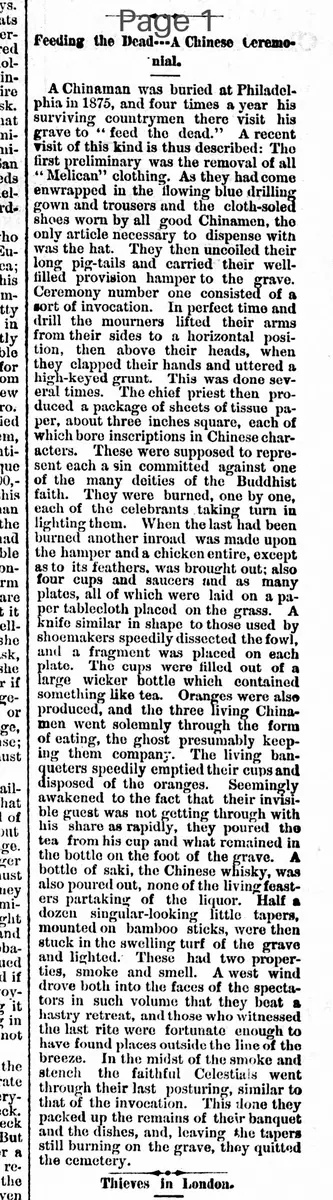
Feeding the Dead.—A Chinese Ceremonial.
A Chinaman was buried at Philadelphia in 1875, and four times a year his surviving countrymen there visit his grave to "feed the dead." A recent visit of this kind is thus described: The first preliminary was the removal of all "Melican" clothing. As they had come enwrapped in the flowing blue drilling gown and trousers and the cloth-soled shoes worn by all good Chinamen, the only article necessary to dispense with was the hat. They then uncoiled their long pig-tails and carried their well-filled provision hamper to the grave.
Ceremony number one consisted of a sort of invocation. In perfect time and drill the mourners lifted their arms from their sides to a horizontal position, then above their heads, when they clapped their hands and uttered a high-keyed grunt. This was done several times. The chief priest then produced a package of sheets of tissue paper, about three inches square, each of which bore inscriptions in Chinese characters. These were supposed to represent each a sin committed against one of the many deities of the Buddhist faith. They were burned, one by one, each of the celebrants taking turn in lighting them. When the last had been burned another inroad was made upon the hamper and a chicken entire, except as to its feathers, was brought out; also four cups and saucers and as many plates, all of which were laid on a paper tablecloth placed on the grass. A knife similar in shape to those used by shoemakers speedily dissected the fowl, and a fragment was placed on each plate. The cups were filled out of a large wicker bottle which contained something like tea. Oranges were also produced, and the three living Chinamen went solemnly through the form of eating, the ghost presumably keeping them company. The living banqueters speedily emptied their cups and disposed of the oranges. Seemingly awakened to the fact that their invisible guest was not getting through with his share as rapidly, they poured the tea from his cup and what remained in the bottle on the foot of the grave. A bottle of saki, the Chinese whisky, was also poured out, none of the living feasters partaking of the liquor. Half dozen singular-looking little tapers, mounted on bamboo sticks, were then stuck in the swelling turf of the grave and lighted. These had two properties, smoke and smell. A west wind drove both into the faces of the spectators in such volume that they beat a hasty retreat, and those who witnessed the last rite were fortunate enough to have found places outside the line of the breeze. In the midst of the smoke and stench the faithful Celestials went through their last posturing, similar to that of the invocation. This done they packed up the remains of their banquet and the dishes, and, leaving the tapers still burning on the grave, they quitted the cemetery.
A Chinaman was buried at Philadelphia in 1875, and four times a year his surviving countrymen there visit his grave to "feed the dead." A recent visit of this kind is thus described: The first preliminary was the removal of all "Melican" clothing. As they had come enwrapped in the flowing blue drilling gown and trousers and the cloth-soled shoes worn by all good Chinamen, the only article necessary to dispense with was the hat. They then uncoiled their long pig-tails and carried their well-filled provision hamper to the grave.
Ceremony number one consisted of a sort of invocation. In perfect time and drill the mourners lifted their arms from their sides to a horizontal position, then above their heads, when they clapped their hands and uttered a high-keyed grunt. This was done several times. The chief priest then produced a package of sheets of tissue paper, about three inches square, each of which bore inscriptions in Chinese characters. These were supposed to represent each a sin committed against one of the many deities of the Buddhist faith. They were burned, one by one, each of the celebrants taking turn in lighting them. When the last had been burned another inroad was made upon the hamper and a chicken entire, except as to its feathers, was brought out; also four cups and saucers and as many plates, all of which were laid on a paper tablecloth placed on the grass. A knife similar in shape to those used by shoemakers speedily dissected the fowl, and a fragment was placed on each plate. The cups were filled out of a large wicker bottle which contained something like tea. Oranges were also produced, and the three living Chinamen went solemnly through the form of eating, the ghost presumably keeping them company. The living banqueters speedily emptied their cups and disposed of the oranges. Seemingly awakened to the fact that their invisible guest was not getting through with his share as rapidly, they poured the tea from his cup and what remained in the bottle on the foot of the grave. A bottle of saki, the Chinese whisky, was also poured out, none of the living feasters partaking of the liquor. Half dozen singular-looking little tapers, mounted on bamboo sticks, were then stuck in the swelling turf of the grave and lighted. These had two properties, smoke and smell. A west wind drove both into the faces of the spectators in such volume that they beat a hasty retreat, and those who witnessed the last rite were fortunate enough to have found places outside the line of the breeze. In the midst of the smoke and stench the faithful Celestials went through their last posturing, similar to that of the invocation. This done they packed up the remains of their banquet and the dishes, and, leaving the tapers still burning on the grave, they quitted the cemetery.
What sub-type of article is it?
Curiosity
Extraordinary Event
What themes does it cover?
Family
Moral Virtue
What keywords are associated?
Chinese Ritual
Feeding The Dead
Grave Ceremony
Buddhist Deities
Phadelphia Burial
Where did it happen?
Philadelphia
Story Details
Location
Philadelphia
Event Date
1875
Story Details
Description of a Chinese ritual at the grave of a buried Chinaman in Philadelphia, involving removal of Western clothing, invocations, burning symbolic papers of sins, sharing a meal with the spirit by pouring food and drink on the grave, and lighting incense tapers.