Thank you for visiting SNEWPapers!
Sign up free
Letter to Editor
May 24, 1776
The Virginia Gazette
Williamsburg, Virginia
What is this article about?
Samuel Harwood defends his actions as a committee member in investigating Mr. Murdoch for suspected opposition to American independence, citing reports of disloyal statements and actions witnessed by others, and asserts it was his duty to probe such suspicions to protect the country's liberties against tyranny.
Clipping
OCR Quality
98%
Excellent
Full Text
To Mr. PURDIE.
SIR,
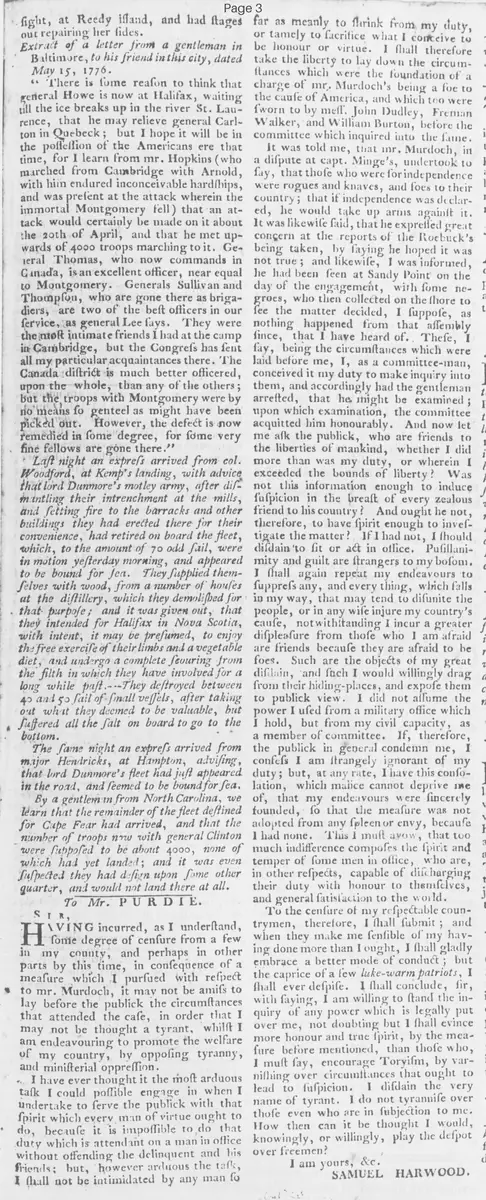
HAVING near understood, in my county; and perhaps in other parts by this time, in consequence of a measure which I pursued with respect to Mr. Murdoch, it may not be amiss to lay before the public the circumstances that attended the case, in order that I may not be thought a tyrant, whilst I am endeavouring to promote the welfare of my country, by opposing tyranny, and ministerial oppression.
I have ever thought it the most arduous task I could possibly engage in when I undertake to serve the public with that spirit which every man of virtue ought to do, because it is impossible to do that duty which is attendant on a man in office without offending the delinquent and his friends; but, however arduous the task, I shall not be intimidated by any man so far as meanly to shrink from my duty, or tamely to sacrifice what I conceive to be honour or virtue. I shall therefore take the liberty to lay down the circumstances which were the foundation of a charge of Mr. Murdoch's being a foe to the cause of America, and which too were sworn to by Messrs. John Dudley, Freeman Walker, and William Burton, before the committee which inquired into the same.
It was told me, that Mr. Murdoch, in a dispute at capt. Minge's, undertook to say, that those who were for independence were rogues and knaves, and foes to their country; that if independence was declared, he would take up arms against it. It was likewise said, that he expressed great concern at the reports of the Roebuck's being taken, by saying he hoped it was not true; and likewise, I was informed, he had been seen at Sandy Point on the day of the engagement, with some negroes, who then collected on the shore to see the matter decided, I suppose, as nothing happened from that assembly since, that I have heard of. These, I say, being the circumstances which were laid before me, I, as a committee-man, conceived it my duty to make inquiry into them, and accordingly had the gentleman arrested, that he might be examined; upon which examination, the committee acquitted him honourably. And now let me ask the public, who are friends to the liberties of mankind, whether I did more than was my duty, or wherein I exceeded the bounds of liberty! Was not this information enough to induce suspicion in the breast of every zealous friend to his country? And ought he not, therefore, to have spirit enough to investigate the matter? If I had not, I should disdain to sit or act in office. Pusillanimity and guilt are strangers to my bosom.
I shall again repeat my endeavours to suppress any, and every thing, which falls in my way, that may tend to disunite the people, or in any wise injure my country's cause, notwithstanding I incur a greater displeasure from those who I am afraid are friends because they are afraid to be foes. Such are the objects of my great disdain, and such I would willingly drag from their hiding-places, and expose them to public view. I did not assume the power I used from a military office which I hold, but from my civil capacity, as a member of committee. If, therefore, the public in general condemn me, I confess I am strangely ignorant of my duty; but, at any rate, I have this consolation, which malice cannot deprive me of, that my endeavours were sincerely founded, so that the measure was not adopted from any spleen or envy, because I had none. This I must avow, that too much indifference composes the spirit and temper of some men in office, who are, in other respects, capable of discharging their duty with honour to themselves, and general satisfaction to the world.
To the censure of my respectable countrymen, therefore, I shall submit; and when they make me sensible of my having done more than I ought, I shall gladly embrace a better mode of conduct; but the caprice of a few luke-warm patriots, I shall ever despise. I shall conclude, sir, with saying, I am willing to stand the inquiry of any power which is legally put over me, not doubting but I shall evince more honour and true spirit, by the measure before mentioned, than those who, I must say, encourage Toryism, by varnishing over circumstances that ought to lead to suspicion. I disdain the very name of tyrant. I do not tyrannise over those even who are in subjection to me. How then can it be thought I would, knowingly, or willingly, play the despot over freemen?
I am yours, &c.
SAMUEL HARWOOD.
SIR,
HAVING near understood, in my county; and perhaps in other parts by this time, in consequence of a measure which I pursued with respect to Mr. Murdoch, it may not be amiss to lay before the public the circumstances that attended the case, in order that I may not be thought a tyrant, whilst I am endeavouring to promote the welfare of my country, by opposing tyranny, and ministerial oppression.
I have ever thought it the most arduous task I could possibly engage in when I undertake to serve the public with that spirit which every man of virtue ought to do, because it is impossible to do that duty which is attendant on a man in office without offending the delinquent and his friends; but, however arduous the task, I shall not be intimidated by any man so far as meanly to shrink from my duty, or tamely to sacrifice what I conceive to be honour or virtue. I shall therefore take the liberty to lay down the circumstances which were the foundation of a charge of Mr. Murdoch's being a foe to the cause of America, and which too were sworn to by Messrs. John Dudley, Freeman Walker, and William Burton, before the committee which inquired into the same.
It was told me, that Mr. Murdoch, in a dispute at capt. Minge's, undertook to say, that those who were for independence were rogues and knaves, and foes to their country; that if independence was declared, he would take up arms against it. It was likewise said, that he expressed great concern at the reports of the Roebuck's being taken, by saying he hoped it was not true; and likewise, I was informed, he had been seen at Sandy Point on the day of the engagement, with some negroes, who then collected on the shore to see the matter decided, I suppose, as nothing happened from that assembly since, that I have heard of. These, I say, being the circumstances which were laid before me, I, as a committee-man, conceived it my duty to make inquiry into them, and accordingly had the gentleman arrested, that he might be examined; upon which examination, the committee acquitted him honourably. And now let me ask the public, who are friends to the liberties of mankind, whether I did more than was my duty, or wherein I exceeded the bounds of liberty! Was not this information enough to induce suspicion in the breast of every zealous friend to his country? And ought he not, therefore, to have spirit enough to investigate the matter? If I had not, I should disdain to sit or act in office. Pusillanimity and guilt are strangers to my bosom.
I shall again repeat my endeavours to suppress any, and every thing, which falls in my way, that may tend to disunite the people, or in any wise injure my country's cause, notwithstanding I incur a greater displeasure from those who I am afraid are friends because they are afraid to be foes. Such are the objects of my great disdain, and such I would willingly drag from their hiding-places, and expose them to public view. I did not assume the power I used from a military office which I hold, but from my civil capacity, as a member of committee. If, therefore, the public in general condemn me, I confess I am strangely ignorant of my duty; but, at any rate, I have this consolation, which malice cannot deprive me of, that my endeavours were sincerely founded, so that the measure was not adopted from any spleen or envy, because I had none. This I must avow, that too much indifference composes the spirit and temper of some men in office, who are, in other respects, capable of discharging their duty with honour to themselves, and general satisfaction to the world.
To the censure of my respectable countrymen, therefore, I shall submit; and when they make me sensible of my having done more than I ought, I shall gladly embrace a better mode of conduct; but the caprice of a few luke-warm patriots, I shall ever despise. I shall conclude, sir, with saying, I am willing to stand the inquiry of any power which is legally put over me, not doubting but I shall evince more honour and true spirit, by the measure before mentioned, than those who, I must say, encourage Toryism, by varnishing over circumstances that ought to lead to suspicion. I disdain the very name of tyrant. I do not tyrannise over those even who are in subjection to me. How then can it be thought I would, knowingly, or willingly, play the despot over freemen?
I am yours, &c.
SAMUEL HARWOOD.
What sub-type of article is it?
Persuasive
Political
Ethical Moral
What themes does it cover?
Politics
Constitutional Rights
What keywords are associated?
American Independence
Committee Investigation
Tory Suspicion
Public Duty
Mr Murdoch
Tyranny Opposition
What entities or persons were involved?
Samuel Harwood
Mr. Purdie
Letter to Editor Details
Author
Samuel Harwood
Recipient
Mr. Purdie
Main Argument
as a committee member, harwood investigated mr. murdoch based on reports of disloyalty to american independence, believing it his duty to probe suspicions of toryism to protect the country from tyranny, and the committee ultimately acquitted murdoch.
Notable Details
Sworn Testimony By John Dudley, Freeman Walker, William Burton
Dispute At Capt. Minge's Where Murdoch Allegedly Called Independence Supporters Rogues And Vowed To Take Arms Against It
Murdoch's Concern Over Roebuck's Capture
Murdoch Seen At Sandy Point With Negroes During Engagement