Thank you for visiting SNEWPapers!
Sign up free
The New Hampshire Gazette
Portsmouth, Rockingham County, New Hampshire
What is this article about?
Translation of Jean-Lambert Tallien's speech in the French Council of Five Hundred on February 16, criticizing England's Machiavellian policies against French commerce, neutrals, and proposing laws to counter fraud in maritime captures and armed neutral vessels.
Merged-components note: Merged the introductory letter, full text of Tallien's speech, and immediate commentary on the speech into a single coherent foreign news article.
Clipping
OCR Quality
Full Text
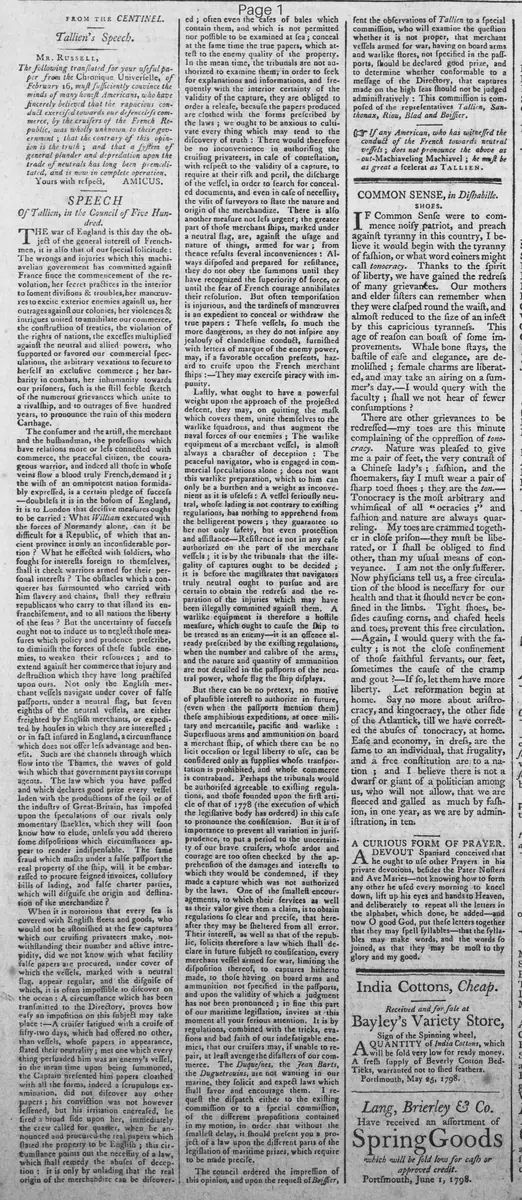
Tallien's Speech.
MR. RUSSELL,
The following translated for your useful paper from the Chronique Universelle, of February 16, must sufficiently convince the minds of many honest Americans, who have sincerely believed that the rapacious conduct exercised towards our defenceless commerce, by the cruisers of the French Republic, was wholly unknown to their government; that the contrary of this opinion is the truth; and that a system of general plunder and depredation upon the trade of neutrals has long been premeditated, and is now in complete operation.
Yours with respect,
AMICUS.
SPEECH
Of Tallien, in the Council of Five Hundred.
THE [rights of] men, it is also that of our special solicitude: The wrongs and injuries which this Machiavellian government has committed against France since the commencement of the revolution, her secret practices in the interior to foment divisions & troubles, her manoeuvres to excite exterior enemies against us, her outrages against our colonies, her violences & intrigues united to annihilate our commerce, the construction of treaties, the violation of the rights of nations, the excesses multiplied against the neutral and allied powers, who supported or favored our commercial speculations, the arbitrary vexations to secure to herself an exclusive commerce; her barbarity in combats, her inhumanity towards our prisoners, such is the still feeble sketch of the numerous grievances which unite to a rivalry, and to outrages of five hundred years, to pronounce the ruin of this modern Carthage.
The consumer and the artist, the merchant and the husbandman, the professions which have relations more or less connected with commerce, the peaceful citizen, the courageous warrior, and indeed all those in whose veins flow a blood truly French, demand it; the wish of an omnipotent nation formidably expressed, is a certain pledge of success—doubtless it is in the bosom of England. it is to London that decisive measures ought to be carried: What William executed with the forces of Normandy alone, can it be difficult for a Republic, of which that ancient province is only an inconsiderable portion? What he effected with soldiers, who fought for interests foreign to themselves, shall it check warriors armed for their personal interests? The obstacles which a conqueror has surmounted who carried with him slavery and chains, shall they restrain republicans who carry to that island its enfranchisement, and to all nations the liberty of the seas? But the uncertainty of success ought not to induce us to neglect those measures which policy and prudence prescribe, to diminish the forces of these subtle enemies, to weaken their resources; and to extend against her commerce that injury and destruction which they have long practised upon ours. Not only the English merchant vessels navigate under cover of false passports, under a neutral flag, but even eightths of the neutral vessels, are either freighted by English merchants, or expedited by houses in which they are interested; or in fact insured in England, a circumstance which does not offer less advantage and benefit. Such are the channels through which flow into the Thames, the waves of gold with which that government pays its corrupt agents. The law which you have passed and which declares good prize every vessel laden with the productions of the soil or of the industry of Great-Britain, has imposed upon the speculations of our rivals only momentary shackles, which they will soon know how to elude, unless you add thereto some dispositions which circumstances appear to render indispensable. The same fraud which masks under a false passport the real property of the ship, will it be embarrassed to procure feigned invoices, collusory bills of lading, and false charter parties, which will disguise the origin and destination of the merchandize? When it is notorious that every sea is covered with English fleets and goods, who would not be astonished at the few captures which our cruising privateers make, notwithstanding their number and active intrepidity, did we not know with what facility false papers are procured, under cover of which the vessels, marked with a neutral flag, appear regular, and the disguise of which, it is often impossible to discover on the ocean: A circumstance which has been transmitted to the Directory, proves how easy an imposition on this subject may take place:—A cruiser fatigued with a cruise of fifty-two days, which had offered no other than vessels, whose papers in appearance, stated their neutrality; met one which every thing persuaded him was an enemy's vessel, in the mean time upon being summoned, the Captain presented him papers clothed with all the forms, indeed a scrupulous examination, did not discover any other papers; his conviction was not however lessened, but his irritation increased, he fired a broadside upon her, immediately the crew called for quarter, when he announced and procured the real papers which stated the property to be English; this circumstance points out the necessity of a law, which shall remedy the abuses of deception: it is only by unlading that the real origin of the merchandize can be discovered; often even the cases of bales which contain them, and which is not permitted nor possible to be examined at sea; conceal at the same time the true papers, which attest to the enemy quality of the property. In the mean time, the tribunals are not authorized to examine them, in order to seek for explanations and informations, and frequently with the interior certainty of the validity of the capture, they are obliged to order a release, because the papers produced are clothed with the forms prescribed by the laws; we ought to be anxious to cultivate every thing which may tend to the discovery of truth: There would therefore be no inconvenience in authorizing the cruising privateers, in case of contestation, with respect to the validity of a capture, to require at their risk and peril, the discharge of the vessel, in order to search for concealed documents, and even in case of necessity, the visit of surveyors to state the nature and origin of the merchandize. There is also another measure not less urgent; the greater part of those merchant ships, marked under a neutral flag, are, against the usage and nature of things, armed for war; from thence results several inconveniences: Always disposed and prepared for resistance, they do not obey the summons until they have recognized the superiority of force, or until the fear of French courage annihilates their resolution. But often temporization is injurious, and the tardiness of manoeuvres is an expedient to conceal or withdraw the true papers: These vessels, so much the more dangerous, as they do not inspire any jealousy of clandestine conduct, furnished with letters of marque of the enemy power, may, if a favorable occasion presents, hazard to cruise upon the French merchant ships:—They may exercise piracy with impunity. Lastly, what ought to have a powerful weight upon the approach of the projected descent, they may, on quitting the mask which covers them, unite themselves to the warlike squadrons, and thus augment the naval forces of our enemies; The warlike equipment of a merchant vessel, is almost always a character of deception: The peaceful navigator, who is engaged in commercial speculations alone; does not want this warlike preparation, which to him can only be a burthen and a weight as inconvenient as it is useless: A vessel seriously neutral, whose lading is not contrary to existing regulations, has nothing to apprehend from the belligerent powers; they guarantee to her not only safety, but even protection and assistance. Resistance is not in any case authorized on the part of the merchant vessels; it is by the tribunals that the illegality of captures ought to be decided; it is before the magistrates that navigators truly neutral ought to pursue and are certain to obtain the redress and the reparation of the injuries which may have been illegally committed against them. A warlike equipment is therefore a hostile measure, which ought to cause the ship to be treated as an enemy--it is an offence already prescribed by the existing regulations, when the number and calibre of the arms, and the nature and quantity of ammunition are not detailed in the passports of the neutral power, whose flag the ship displays. But there can be no pretext, no motive of plausible interest to authorize in future, (even when the passports mention them) these amphibious expeditions, at once military and mercantile, pacific and warlike: Superfluous arms and ammunition on board a merchant ship, of which there can be no licit occasion or legal liberty to use, can be considered only as supplies whose transportation is prohibited, and whose commerce is contraband. Perhaps the tribunals would be authorized agreeable to existing regulations, and those founded upon the first article of that of 1778 (the execution of which the legislative body has ordered) in this case to pronounce the confiscation. But it is of importance to prevent all variation in jurisprudence, to put a period to the uncertainty of our brave cruisers, whose ardor and courage are too often checked by the apprehension of the damages and interests to which they would be condemned, if they made a capture which was not authorized by the laws. One of the smallest encouragements, to which their services as well as their valor give them a claim, is to obtain regulations so clear and precise, that hereafter they may be sheltered from all error. Their interest, as well as that of the republic, solicits therefore a law which shall declare in future subject to confiscation, every merchant vessel armed for war, limiting the disposition thereof, to captures hitherto made, to those having on board arms and ammunition not specified in the passports, and upon the validity of which a judgment has not been pronounced; in fine this part of our maritime legislation, invites at this moment all your serious attention. It is by regulations, combined with the tricks, evasions and bad faith of our indefatigable enemies, that our cruisers may, if unable to repair, at least avenge the disasters of our commerce. The Duquesnes, the Jean Barts, the Duguay-Trouins, are not wanting in our marine, they solicit and expect laws which shall favor and encourage them. I request the dispatch either to the existing commission or to a special commission, of the different propositions contained in my motion, in order that without the smallest delay, it should present you a project of a law upon the different parts of the legislation of maritime prizes, which require to be made precise. The council ordered the impression of this opinion, and upon the request of Boissier, sent the observations of Tallien to a special commission, who will examine the question whether it is not proper, that merchant vessels armed for war, having on board arms and warlike stores, not specified in the passports, should be declared good prize, and to determine whether conformable to a message of the Directory, that captures made on the high seas should not be judged administratively: This commission is composed of the representatives Tallien, Santhonax, Riou, Blad and Boissier.
If any American, who has witnessed the conduct of the French towards neutral vessels; does not pronounce the above as out-Machiavelling Machiavel; he must be as great a celocrat as TALLIEN.
What sub-type of article is it?
What keywords are associated?
What entities or persons were involved?
Where did it happen?
Foreign News Details
Primary Location
France
Event Date
February 16
Key Persons
Outcome
council orders printing of speech and refers to special commission including tallien, santhonax, riou, blad, and boissier to examine proposals on armed merchant vessels and maritime prizes.
Event Details
Tallien's speech in the Council of Five Hundred denounces England's violations of neutral rights, use of false papers and armed neutral ships to protect commerce, and calls for laws allowing unlading of vessels for inspection, treating armed merchant ships as prizes, and clarifying maritime prize legislation to aid French privateers.