Thank you for visiting SNEWPapers!
Sign up free
Rhode Island American And Gazette
Providence, Providence County, Rhode Island
What is this article about?
The National Republican Convention in Baltimore on December 13-14, 1831, organized leadership, nominated Henry Clay unanimously as presidential candidate against Andrew Jackson's re-election, received his acceptance, and began vice presidential nominations. Included letters from Clay and Charles Carroll.
Clipping
OCR Quality
Full Text
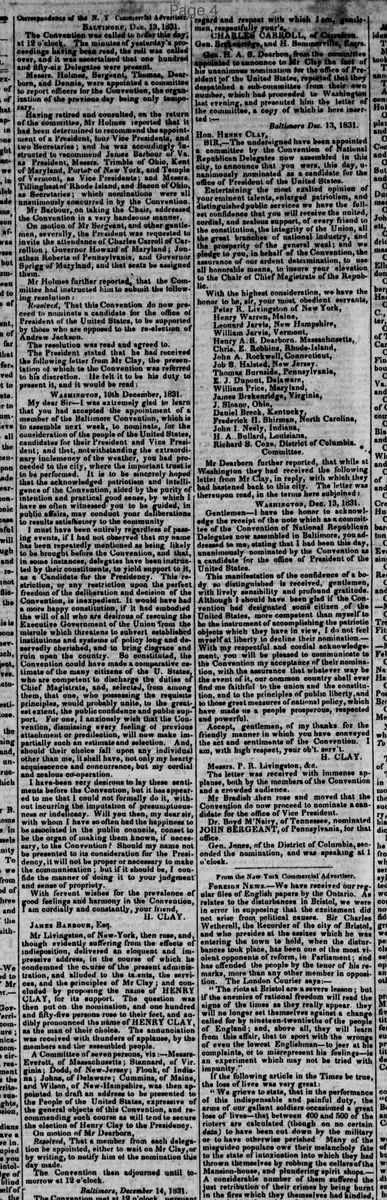
Having retired and consulted, on the return of the committee, Mr. Holmes reported that it had been determined to recommend the appointment of a President, four Vice Presidents, and two Secretaries; and he was accordingly instructed to recommend James Barbour of Va. as President, Messrs. Trimble of Ohio, Kent of Maryland, Porter of New York, and Temple of Vermont, as Vice Presidents; and Messrs. Tillinghast of Rhode Island, and Bacon of Ohio as Secretaries; which nominations were all unanimously concurred in by the Convention.
Mr. Barbour, on taking the Chair, addressed the Convention in a very handsome manner.
On motion of Mr. Sergeant, and other gentlemen, severally, the President was requested to invite the attendance of Charles Carroll of Carrollton; Governor Howard of Maryland; Jonathan Roberts of Pennsylvania, and Governor Sprigg of Maryland, and that seats be assigned them.
Mr. Holmes further reported that the Committee had instructed him to submit the following resolution:
Resolved, That this Convention do now proceed to nominate a candidate for the office of President of the United States, to be supported by those who are opposed to the re-election of Andrew Jackson.
The resolution was read and agreed to.
The President stated that he had received the following letter from Mr. Clay, the presentation of which to the Convention was referred to his discretion. He felt it to be his duty to present it, and it would be read:
Washington, 10th December, 1831.
My dear Sir—I was extremely glad to learn that you had accepted the appointment of a member of the Baltimore Convention, which is to assemble next week, to nominate, or the consideration of the people of the United States, candidates for their President and Vice President; and that, notwithstanding the extraordinary inclemency of the weather, you had proceeded to the city, where the important trust is to be performed. It is to be sincerely hoped that the acknowledged patriotism and intelligence of the Convention, aided by the purity of intention and practical good sense, by which I have so often witnessed you to be guided, in public affairs, may conduct your deliberations to results satisfactory to the community at large, and promotive of the welfare and honor of our common country.
I must have been entirely regardless of passing events, if I had not observed that my name has been repeatedly mentioned as being likely to be brought before the Convention, and that, in some instances, delegates have been instructed by their constituents, to yield support to it, as a Candidate for the Presidency. This restriction, or any restriction upon the perfect freedom of the deliberation and decision of the Convention, is inexpedient. It would have had a more happy constitution, if it had embodied the will of all who are desirous of rescuing the Executive Government of the Union from the misrule which threatens to subvert established institutions and systems of policy long and deservedly cherished, and to bring disgrace and ruin upon the country. So constituted, the Convention could have made a comparative estimate of the many citizens of the U. States, who are competent to discharge the duties of Chief Magistrate, and, selected, from among them, that one, who possessing the requisite principles, would probably unite, to the greatest extent, the public confidence and public support. For one, I anxiously wish that the Convention, dismissing every feeling of previous attachment or predilection, will now make impartially such an estimate and selection. And, should their choice fall upon any individual other than me, it shall have, not only my hearty acquiescence and concurrence, but my cordial and zealous co-operation.
I have been very desirous to lay these sentiments before the Convention, but it has appeared to me that I could not formally do it, without incurring the imputation of presumptuousness or indelicacy. Will you then, my dear sir, with whom I have often had the happiness to be associated in the public councils, consent to be the organ of making them known, if necessary, to the Convention? Should my name not be presented to its consideration for the Presidency, it will not be proper or necessary to make the communication; but if it should be, I confide the manner of doing it to your judgment and sense of propriety.
With fervent wishes for the prevalence of good feelings and harmony in the Convention, I am cordially and constantly, your friend,
H. CLAY.
James Barbour, Esq.
Mr. Livingston, of New-York, then rose, and, though evidently suffering from the effects of indisposition, delivered an eloquent and impressive address, in the course of which he condemned the course of the present administration, and alluded to the talents, the services, and the principles of Mr. Clay; and concluded by proposing the name of HENRY CLAY, for its support. The question was then put on the nomination, and one hundred and fifty-five persons rose to their feet, and audibly pronounced the name of HENRY CLAY, as the man of their choice. The annunciation was received with thunders of applause, by the members and the assembled people.
A Committee of seven persons, viz:—Messrs. Everett, of Massachusetts; Stannard, of Virginia; Dodd, of New-Jersey; Flook, of Indiana; Johns, of Delaware; Cummins, of Maine, and Wilson, of New-Hampshire, was then appointed to draft an address to be presented to the People of the United States, expressive of the general objects of this Convention, and recommending such course as will tend to secure the election of Henry Clay to the Presidency.
On motion of Mr. Dearborn,
Resolved, That a member from each delegation be appointed, either to wait on Mr. Clay, or by writing, to notify him of the nomination this day made.
The Convention then adjourned until to-morrow at 12 o'clock.
Baltimore, December 14, 1831.
The Convention met at 12 o'clock, pursuant to adjournment. The credentials of a number of delegates were presented and accepted. On taking their seats, they were respectfully called by name and on rising unanimously concurred in the nomination of Henry Clay for the office of President of the United States.
The committee appointed to wait on the venerable Charles Carroll, of Carrollton, the only surviving signer of the Declaration of Independence, reported that they had performed their duty, and begged leave to introduce the following letter, which was thereupon read:-
Wednesday Morning, December 14.
Gentlemen—The severity of the weather and the apprehensions of my family on that account, admonish me to be cautious in venturing abroad at this season. I must therefore claim the privilege of my advanced age, and apologise for not accompanying you this morning to the Athenæum, agreeably to my promise of yesterday. I request, gentlemen, that you will have the goodness to convey my apology, to the distinguished individuals by whom you were deputed to propose to me so flattering a compliment, and to accept on their behalf and for yourselves, an assurance of the regard and respect with which I am, gentlemen, respectfully your
CHARLES CARROLL, of Carrollton.
Gen. Breckenridge, and H. Somerville, Esqs.
Gen. H. A. S. Dearborn, from the committee appointed to announce to Mr. Clay the fact of his unanimous nomination for the office of President of the United States, reported that they despatched a sub-committee from their own number, which had proceeded to Washington last evening, and presented him the letter of the committee, a copy of which is here inserted:
Baltimore Dec. 13, 1831.
Hon. Henry Clay
SIR, The undersigned have been appointed a committee by the Convention of National Republican Delegates now assembled in this city, to announce that you were, this day, unanimously nominated as a candidate for the office of President of the United States.
Entertaining the most exalted opinion of your eminent talents, enlarged patriotism, and distinguished public services we have the fullest confidence that you will receive the united, cordial, and zealous support, of every friend to the constitution, the integrity of the Union, all the great branches of national industry, and the prosperity of the general weal; and we pledge to you, in behalf of the Convention, the assurance of our ardent determination, to use all honorable means, to insure your elevation to the Chair of Chief Magistrate of the Republic.
With the highest consideration, we have the honor to be, sir, your most obedient servants,
[Long list of committee members: Peter R. Livingston of New York, Henry Warren, Maine, etc.]
Committee.
Mr. Dearborn further reported, that while at Washington they had received the following letter from Mr. Clay, in reply, with which they had hastened back to this city. The letter was thereupon read, in the terms here subjoined:
Washington, Dec. 13, 1831.
Gentlemen—I have the honor to acknowledge the receipt of the note which as a committee of the Convention of National Republican Delegates now assembled in Baltimore, you addressed to me, stating that I had been this day, unanimously nominated by the Convention a candidate for the office of President of the United States.
This manifestation of the confidence of a body so distinguished is received, gentlemen, with lively sensibility and profound gratitude. Although I should have been glad if the Convention had designated some citizen of the United States, more competent than myself to be the instrument of accomplishing the patriotic objects which they have in view, I do not feel myself at liberty to decline their nomination.—
With my respectful and cordial acknowledgement, you will be pleased to communicate to the Convention my acceptance of their nomination, with the assurance that whatever may be the event of it, our common country shall ever find me faithful to the union and the constitution, and to the principles of public liberty, and to those great measures of national policy, which have made us a people prosperous, respected and powerful.
Accept, gentlemen, of my thanks for the friendly manner in which you have conveyed the act and sentiments of the Convention. I am, with high respect, your ob't. serv't.
H. CLAY.
Messrs. P. R. Livingston, &c.
The letter was received with immense applause, both by the members of the Convention and a crowded audience.
Mr. Bradish then rose and moved that the Convention do now proceed to nominate a candidate for the office of Vice President.
Dr. Boyd M'Nairy, of Tennessee, nominated JOHN SERGEANT, of Pennsylvania, for that office.
Gen. Jones, of the District of Columbia, seconded the nomination, and was speaking at 1 o'clock.
What sub-type of article is it?
What themes does it cover?
What keywords are associated?
What entities or persons were involved?
Where did it happen?
Story Details
Key Persons
Location
Baltimore
Event Date
December 13 14, 1831
Story Details
The National Republican Convention organized, nominated Henry Clay unanimously as presidential candidate opposing Andrew Jackson's re-election, received letters from Clay accepting and from Charles Carroll declining attendance due to age and weather, appointed committees, and began vice presidential nominations with John Sergeant.