Thank you for visiting SNEWPapers!
Sign up free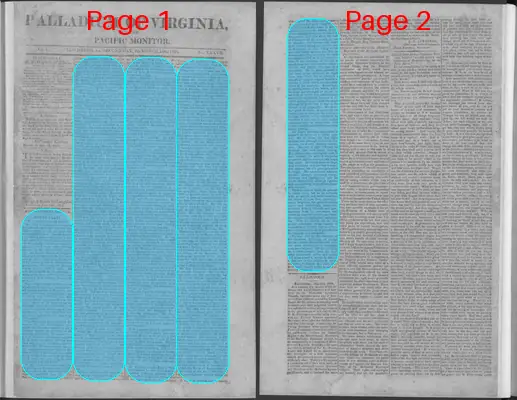
Literary
July 26, 1824
Palladium Of Virginia And The Pacific Monitor
Lewisburg, Greenbrier County, West Virginia
What is this article about?
This biographical sketch continues the life of Henry Clay, detailing his entry into Congress in 1811 as Speaker, his role in the War of 1812, key speeches, advocacy for navy, internal improvements, tariffs, Spanish American independence, Missouri Compromise, and personal description as an orator and statesman.
Merged-components note: Continuation of the biographical sketch of Henry Clay across pages 1 and 2; relabeled from 'story' to 'literary' to match the serialized nature and original label.
Clippings
1 of 2
OCR Quality
95%
Excellent
Full Text
BIOGRAPHICAL SKETCH
OF
HENRY CLAY.
(Continued from our last.)
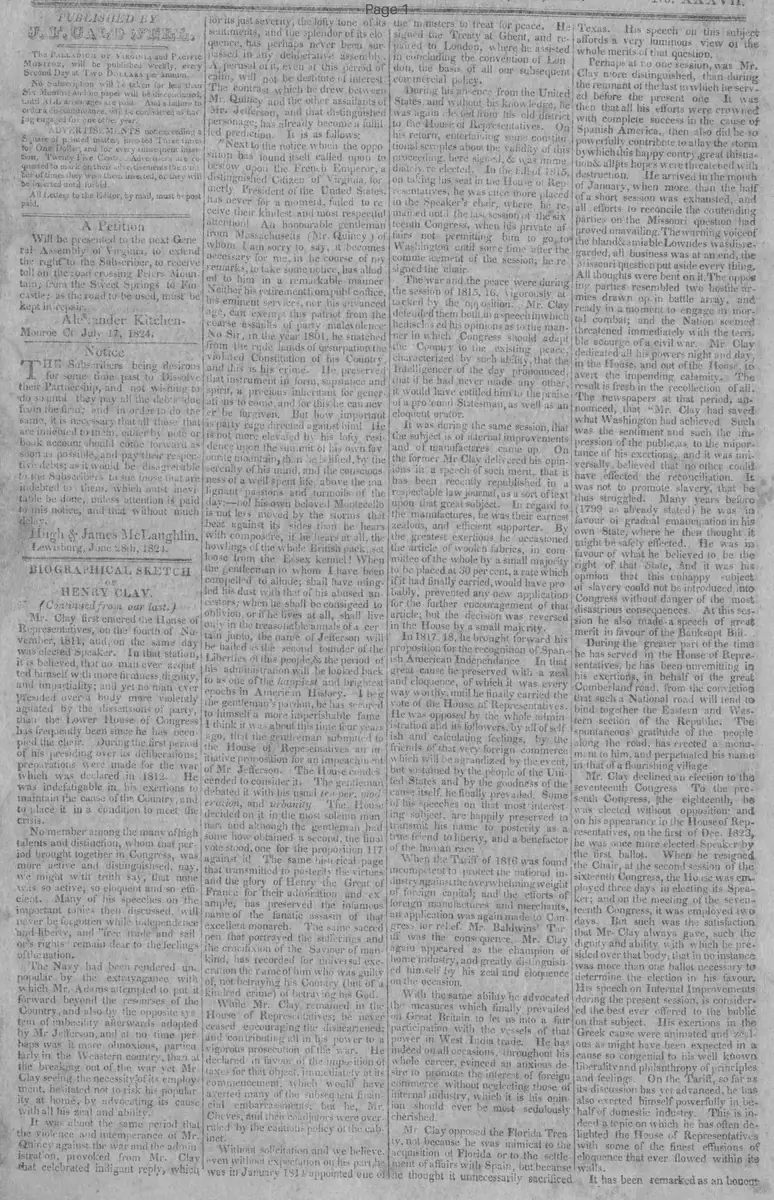
Mr. Clay first entered the House of Representatives, on the fourth of November, 1811, and, on the same day was elected Speaker. In that station, it is believed, that no man ever acquitted himself with more firmness, dignity, and impartiality; and yet no man ever Presided over a body more violently agitated by the dissensions of party, than the Lower House of Congress has frequently been since he has occupied the chair. During the first period of his presiding over its deliberations; preparations were made for the war which was declared in 1812. He was indefatigable in his exertions to maintain the cause of the Country, and to place it in a condition to meet the crisis.
No member among the many of high talents and distinction, whom that period brought together in Congress, was more active and distinguished, nay, we might with truth say, that none was so active, so eloquent and so efficient. Many of his speeches on the important topics then discussed, will never be forgotten while independence and liberty, and "free trade and sailor's rights" remain dear to the feelings of the nation.
The Navy had been rendered unpopular by the extravagance with which Mr. Adams attempted to put it forward beyond the resources of the Country, and also by the opposite system of imbecility afterwards adopted by Mr Jefferson, and at no time perhaps was it more obnoxious, particularly in the Western country, than at the breaking out of the war yet Mr. Clay seeing the necessity of its employment, hesitated not to risk his popularity at home, by advocating its cause with all his zeal and ability.
It was about the same period that the violence and intemperance of Mr. Quincy against the war and the administration, provoked from Mr. Clay that celebrated indignant reply, which for its just severity, the lofty tone of its sentiments, and the splendor of its eloquence, has perhaps never been surpassed in any deliberative assembly. A perusal of it, even at this period of calm, will not be destitute of interest. The contrast which he drew between Mr. Quincy and the other assailants of Mr. Jefferson, and that distinguished personage, has already become a fulfilled prediction. It is as follows:
"Next to the notice which the opposition has found itself called upon to bestow upon the French Emperor, a distinguished Citizen of Virginia, formerly President of the United States, has never for a moment, failed to receive their kindest and most respectful attention! An honourable gentleman from Massachusetts (Mr. Quincy) of whom I am sorry to say, it becomes necessary for me, in the course of my remarks, to take some notice, has alluded to him in a remarkable manner. Neither his retirement from public office, his eminent services, nor his advanced age, can exempt this patriot from the coarse assaults of party malevolence. No Sir, in the year 1801, he snatched from the rude hands of usurpation the violated Constitution of his Country, and this is his crime. He preserved that instrument in form, substance and spirit, a precious inheritance for generations to come, and for this he can never be forgiven. But how important is party rage directed against him! He is not more elevated by his lofty residence upon the summit of his own favourite mountain, than he is lifted, by the serenity of his mind, and the consciousness of a well spent life, above the malignant passions and turmoils of the day:--his own beloved Monticello is not less moved by the storms that beat against its sides than he hears with composure, if he hears at all, the howlings of the whole British pack, set loose from the Essex kennel! When the gentleman to whom I have been compelled to allude; shall have mingled his dust with that of his abused ancestors; when he shall be consigned to oblivion, or if he lives at all, shall live only in the treasureable annals of a certain junto, the name of Jefferson will be hailed as the second founder of the Liberties of this people & the period of his administration will be looked back to as one of the happiest and brightest epochs in American History. I beg the gentleman's pardon, he has secured to himself a more imperishable fame I think it was about this time four years ago, that the gentleman submitted to the House of Representatives an initiative proposition for an impeachment of Mr Jefferson. The House condescended to consider it. The gentleman debated it with his usual temperation, and urbanity The House decided on it in the most solemn manner, and although the gentleman had some how obtained a second, the final vote stood, one for the proposition 117 against it! The same historical page that transmitted to posterity the virtues and the glory of Henry the Great of France for their admiration and example, has preserved the infamous name of the fanatic assassin of that excellent monarch. The same sacred pen that portrayed the sufferings and the crucifixion of the Saviour of mankind, has recorded for universal execration the name of him who was guilty of, not betraying his Country (but of a kindred crime) of betraying his God.
While Mr. Clay remained in the House of Representatives; he never ceased encouraging the disheartened; and contributing all in his power to a vigorous prosecution of the war. He declared in favour of the imposition of taxes for that object, immediately at its commencement, which would have averted many of the subsequent financial embarrassments; but he. Mr. Cheves, and their coadjutors were over. ruled by the cautious policy of the cabinet.
Without solicitation and we believe, even without expectation on his part, he was in January 1814 appointed one of the ministers to treat for peace. He signed the Treaty at Ghent, and repaired to London, where he assisted in concluding the convention of London, the basis of all our subsequent commercial policy.
During his absence from the United States, and without his knowledge, he was again elected from his old district to the House of Representatives. On his return, entertaining some constitutional scruples about the validity of this proceeding, he resigned, & was immediately re-elected. In the fall of 1815, on taking his seat in the House of Representatives, he was once more placed in the Speaker's chair, where he remained until the last session of the sixteenth Congress, when his private affairs not permitting him to go to Washington until some time after the commencement of the session; he resigned the chair The war and the peace were during the session of 1815, 16, vigorously attacked by the opposition. Mr. Clay defended them both, in a speech in which he disclosed his opinions as to the manner in which Congress should adapt the Country to the existing peace, characterized by such ability, that the Intelligencer of the day pronounced, that if he had never made any other, it would have entitled him to the praise of a profound Statesman, as well as an eloquent orator.
It was during the same session, that the subject of internal improvements and of manufactures came up On the former Mr Clay delivered his opinions in a speech of such merit, that it has been recently republished in a respectable law journal, as a sort of text upon that great subject. In regard to the manufactures, he was their earnest zealous, and efficient supporter. By the greatest exertions he occasioned the article of woolen fabrics, in committee of the whole by a small majority to be placed at 30 per cent, a rate which if it had finally carried, would have probably, prevented any new application for the further encouragement of that article; but the decision was reversed in the House by a small majority.
In 1817. 18. he brought forward his proposition for the recognition of Spanish American Independence In that great cause he persevered with a zeal and eloquence, of which it was every way worthy, until he finally carried the vote of the House of Representatives. He was opposed by the whole administration and its followers, by all of selfish and calculating feelings, by the friends of that very foreign commerce which will be aggrandized by the event, but sustained by the people of the United States and by the goodness of the cause itself. he finally prevailed. Some of his speeches on that most interesting subject, are happily preserved to transmit his name to posterity as a true friend to liberty, and a benefactor of the human race When the Tariff of 1816 was found incompetent to protect the national industry against the overwhelming weight of foreign capital; and the efforts of foreign manufactures and merchants, an application was again made to Congress for relief. Mr. Baldwin's Tariff was the consequence. Mr. Clay again appeared as the champion of home industry, and greatly distinguished himself by his zeal and eloquence on the occasion.
With the same ability he advocated the measures which finally prevailed on Great Britain to let us into a fair participation with the vessels of that power in West India trade. He has indeed on all occasions, throughout his whole career, evinced an anxious desire to promote the interest of foreign commerce without neglecting those of internal industry, which it is his opinion should ever be most sedulously cherished.
Mr Clay opposed the Florida Treaty, not because he was inimical to the acquisition of Florida or to the settlement of affairs with Spain, but because The thought it unnecessarily sacrificed Texas. His speech on this subject affords a very luminous view of the whole merits of that question. Perhaps at no one session, was Mr. Clay more distinguished, than during the remnant of the last in which he served before the present one It was then that all his efforts were crowned with complete success in the cause of Spanish America. then also did he so powerfully contribute to allay the storm by which this happy country, great this nation & all its hopes were threatened with destruction. He arrived in the month of January, when more than the half of a short session was exhausted, and all efforts to reconcile the contending parties on the Missouri question had proved unavailing. The warning voice of the bland & amiable Lowndes was disregarded, all business was at an end, the Missouri question put aside every thing. All thoughts were bent on it. The opposing parties resembled two hostile armies drawn up in battle array, and ready in a moment to engage in mortal combat: and the Nation seemed threatened immediately with the terrible scourge of a civil war. Mr Clay dedicated all his powers night and day, in the House, and out of the House, to avert the impending calamity. The result is fresh in the recollection of all. The newspapers at that period, announced, that "Mr. Clay had saved what Washington had achieved Such was the sentiment and such the impression of the public, as, to the importance of his exertions: and it was universally, believed that no other could have effected the reconciliation. It was not to promote slavery, that he thus struggled. Many years before (1819 as already stated) he was in favour of gradual emancipation in his own State, where he then thought it might be safely effected. He was in favour of what he believed to be the right of that State. and it was his opinion that this unhappy subject of slavery could not be introduced into Congress without danger of the most disastrous consequences. At this session he also made a speech of great merit in favour of the Bankruptcy Bill.
During the greater part of the time he has served in the House of Representatives, he has been unremitting in his exertions, in behalf of the great Cumberland road. from the conviction that such a National road will tend to bind together the Eastern and Western section of the Republic. The spontaneous gratitude of the people along the road, has erected a monument to him, and perpetuated his name in that of a flourishing village Mr. Clay declined an election to the seventeenth Congress To the present the eighteenth, he was elected without opposition: and on his appearance in the House of Representatives, on the first of Dec. 1823. he was once more elected Speaker by the first ballot. When he resigned the Chair, at the second session of the sixteenth Congress. the House was employed three days in electing its Speaker; and on the meeting of the seventeenth Congress. it was employed two days. But such was the satisfaction that Mr. Clay always gave, such the dignity and ability with which he presided over that body: that in no instance was more than one ballot necessary to determine the election in his favour.
His speech on Internal Improvements during the present session. is considered the best ever offered to the public on that subject. His exertions in the Greek cause were animated and zealous as might have been expected in a cause so congenial to his well known liberality and philanthropy of principles and feelings. On the Tariff, so far as its discussion has yet advanced. he has also exerted himself powerfully in behalf of domestic industry. This is indeed a topic on which he has often delighted the House of Representatives with some of the finest effusions of eloquence that ever flowed within its walls.
It has been remarked as an honour
able proof of Mr. Clay's independence of spirit, that during the whole time he has had a seat in the House of Representatives, except the second Session of the sixteenth Congress, in which he was present only from about the 10th of January to the 4th of March, he was its Speaker, and consequently might have avoided taking any decisive part in its debates, or even voting on the questions which agitated the Nation, without subjecting himself to the slightest censure. But he is too conscientious in the discharge of his duty to shrink from any responsibility which a zealous and faithful adherence to it may incur. On the Bank question, as has been before observed, he might have been silent: but to entertain a change of opinion without frankly avowing it, never suited the open manliness of his character. Accordingly in the committee of the whole, where he alone had the right to debate, he not only promptly and unhesitatingly avowed his sentiments, but took a decided and leading part in the discussion although he knew that it was at the hazard of his popularity. His Country's good, its liberty, its prosperity, its honour, and its fame, are the great and binding objects which command his warmest wishes, and his most zealous exertions; and in competition with which personal considerations are with him as nothing.
Mr. Clay's personal appearance is much in his favour as a public speaker. He is about six feet high, straight, and although inclined to slenderness, yet of very pleasing proportions. His hair is light coloured, his forehead high and rather retiring. His eyes are blue, and slightly sunk in their sockets; his nose is somewhat prominent, and his mouth a little larger than usual. His cheek bones are high, and his cheeks thin: his face is therefore narrow, but of a good proportion in length. His countenance taken altogether strongly expressed energy, firmness, and intelligence; and his whole deportment, although dignified and commanding, is yet affable, agreeable and easy:
When he rises to speak, he generally stands erect; but as he advances with his subject, and becomes animated, which he soon does, his countenance brightens, his gestures become active and exceedingly impressive, evidently flowing naturally and spontaneously from the earnestness with which he urges his opinions, and therefore are always appropriate, and pleasing. Over his voice he has the most perfect command, being capable of modulating it to every degree of force and emphasis necessary to give effect to his language and sentiments.
We may sum up the character of this illustrious American, by saying, that as a patriot no man has ever evinced more sincerity; as a statesman, none more sagacity and promptitude, as a philanthropist, none has been more importantly active and useful: and as an orator it would be difficult to find one in any country by whom soundness, brilliancy, and force, have been more happily united or more effectively displayed.
OF
HENRY CLAY.
(Continued from our last.)
Mr. Clay first entered the House of Representatives, on the fourth of November, 1811, and, on the same day was elected Speaker. In that station, it is believed, that no man ever acquitted himself with more firmness, dignity, and impartiality; and yet no man ever Presided over a body more violently agitated by the dissensions of party, than the Lower House of Congress has frequently been since he has occupied the chair. During the first period of his presiding over its deliberations; preparations were made for the war which was declared in 1812. He was indefatigable in his exertions to maintain the cause of the Country, and to place it in a condition to meet the crisis.
No member among the many of high talents and distinction, whom that period brought together in Congress, was more active and distinguished, nay, we might with truth say, that none was so active, so eloquent and so efficient. Many of his speeches on the important topics then discussed, will never be forgotten while independence and liberty, and "free trade and sailor's rights" remain dear to the feelings of the nation.
The Navy had been rendered unpopular by the extravagance with which Mr. Adams attempted to put it forward beyond the resources of the Country, and also by the opposite system of imbecility afterwards adopted by Mr Jefferson, and at no time perhaps was it more obnoxious, particularly in the Western country, than at the breaking out of the war yet Mr. Clay seeing the necessity of its employment, hesitated not to risk his popularity at home, by advocating its cause with all his zeal and ability.
It was about the same period that the violence and intemperance of Mr. Quincy against the war and the administration, provoked from Mr. Clay that celebrated indignant reply, which for its just severity, the lofty tone of its sentiments, and the splendor of its eloquence, has perhaps never been surpassed in any deliberative assembly. A perusal of it, even at this period of calm, will not be destitute of interest. The contrast which he drew between Mr. Quincy and the other assailants of Mr. Jefferson, and that distinguished personage, has already become a fulfilled prediction. It is as follows:
"Next to the notice which the opposition has found itself called upon to bestow upon the French Emperor, a distinguished Citizen of Virginia, formerly President of the United States, has never for a moment, failed to receive their kindest and most respectful attention! An honourable gentleman from Massachusetts (Mr. Quincy) of whom I am sorry to say, it becomes necessary for me, in the course of my remarks, to take some notice, has alluded to him in a remarkable manner. Neither his retirement from public office, his eminent services, nor his advanced age, can exempt this patriot from the coarse assaults of party malevolence. No Sir, in the year 1801, he snatched from the rude hands of usurpation the violated Constitution of his Country, and this is his crime. He preserved that instrument in form, substance and spirit, a precious inheritance for generations to come, and for this he can never be forgiven. But how important is party rage directed against him! He is not more elevated by his lofty residence upon the summit of his own favourite mountain, than he is lifted, by the serenity of his mind, and the consciousness of a well spent life, above the malignant passions and turmoils of the day:--his own beloved Monticello is not less moved by the storms that beat against its sides than he hears with composure, if he hears at all, the howlings of the whole British pack, set loose from the Essex kennel! When the gentleman to whom I have been compelled to allude; shall have mingled his dust with that of his abused ancestors; when he shall be consigned to oblivion, or if he lives at all, shall live only in the treasureable annals of a certain junto, the name of Jefferson will be hailed as the second founder of the Liberties of this people & the period of his administration will be looked back to as one of the happiest and brightest epochs in American History. I beg the gentleman's pardon, he has secured to himself a more imperishable fame I think it was about this time four years ago, that the gentleman submitted to the House of Representatives an initiative proposition for an impeachment of Mr Jefferson. The House condescended to consider it. The gentleman debated it with his usual temperation, and urbanity The House decided on it in the most solemn manner, and although the gentleman had some how obtained a second, the final vote stood, one for the proposition 117 against it! The same historical page that transmitted to posterity the virtues and the glory of Henry the Great of France for their admiration and example, has preserved the infamous name of the fanatic assassin of that excellent monarch. The same sacred pen that portrayed the sufferings and the crucifixion of the Saviour of mankind, has recorded for universal execration the name of him who was guilty of, not betraying his Country (but of a kindred crime) of betraying his God.
While Mr. Clay remained in the House of Representatives; he never ceased encouraging the disheartened; and contributing all in his power to a vigorous prosecution of the war. He declared in favour of the imposition of taxes for that object, immediately at its commencement, which would have averted many of the subsequent financial embarrassments; but he. Mr. Cheves, and their coadjutors were over. ruled by the cautious policy of the cabinet.
Without solicitation and we believe, even without expectation on his part, he was in January 1814 appointed one of the ministers to treat for peace. He signed the Treaty at Ghent, and repaired to London, where he assisted in concluding the convention of London, the basis of all our subsequent commercial policy.
During his absence from the United States, and without his knowledge, he was again elected from his old district to the House of Representatives. On his return, entertaining some constitutional scruples about the validity of this proceeding, he resigned, & was immediately re-elected. In the fall of 1815, on taking his seat in the House of Representatives, he was once more placed in the Speaker's chair, where he remained until the last session of the sixteenth Congress, when his private affairs not permitting him to go to Washington until some time after the commencement of the session; he resigned the chair The war and the peace were during the session of 1815, 16, vigorously attacked by the opposition. Mr. Clay defended them both, in a speech in which he disclosed his opinions as to the manner in which Congress should adapt the Country to the existing peace, characterized by such ability, that the Intelligencer of the day pronounced, that if he had never made any other, it would have entitled him to the praise of a profound Statesman, as well as an eloquent orator.
It was during the same session, that the subject of internal improvements and of manufactures came up On the former Mr Clay delivered his opinions in a speech of such merit, that it has been recently republished in a respectable law journal, as a sort of text upon that great subject. In regard to the manufactures, he was their earnest zealous, and efficient supporter. By the greatest exertions he occasioned the article of woolen fabrics, in committee of the whole by a small majority to be placed at 30 per cent, a rate which if it had finally carried, would have probably, prevented any new application for the further encouragement of that article; but the decision was reversed in the House by a small majority.
In 1817. 18. he brought forward his proposition for the recognition of Spanish American Independence In that great cause he persevered with a zeal and eloquence, of which it was every way worthy, until he finally carried the vote of the House of Representatives. He was opposed by the whole administration and its followers, by all of selfish and calculating feelings, by the friends of that very foreign commerce which will be aggrandized by the event, but sustained by the people of the United States and by the goodness of the cause itself. he finally prevailed. Some of his speeches on that most interesting subject, are happily preserved to transmit his name to posterity as a true friend to liberty, and a benefactor of the human race When the Tariff of 1816 was found incompetent to protect the national industry against the overwhelming weight of foreign capital; and the efforts of foreign manufactures and merchants, an application was again made to Congress for relief. Mr. Baldwin's Tariff was the consequence. Mr. Clay again appeared as the champion of home industry, and greatly distinguished himself by his zeal and eloquence on the occasion.
With the same ability he advocated the measures which finally prevailed on Great Britain to let us into a fair participation with the vessels of that power in West India trade. He has indeed on all occasions, throughout his whole career, evinced an anxious desire to promote the interest of foreign commerce without neglecting those of internal industry, which it is his opinion should ever be most sedulously cherished.
Mr Clay opposed the Florida Treaty, not because he was inimical to the acquisition of Florida or to the settlement of affairs with Spain, but because The thought it unnecessarily sacrificed Texas. His speech on this subject affords a very luminous view of the whole merits of that question. Perhaps at no one session, was Mr. Clay more distinguished, than during the remnant of the last in which he served before the present one It was then that all his efforts were crowned with complete success in the cause of Spanish America. then also did he so powerfully contribute to allay the storm by which this happy country, great this nation & all its hopes were threatened with destruction. He arrived in the month of January, when more than the half of a short session was exhausted, and all efforts to reconcile the contending parties on the Missouri question had proved unavailing. The warning voice of the bland & amiable Lowndes was disregarded, all business was at an end, the Missouri question put aside every thing. All thoughts were bent on it. The opposing parties resembled two hostile armies drawn up in battle array, and ready in a moment to engage in mortal combat: and the Nation seemed threatened immediately with the terrible scourge of a civil war. Mr Clay dedicated all his powers night and day, in the House, and out of the House, to avert the impending calamity. The result is fresh in the recollection of all. The newspapers at that period, announced, that "Mr. Clay had saved what Washington had achieved Such was the sentiment and such the impression of the public, as, to the importance of his exertions: and it was universally, believed that no other could have effected the reconciliation. It was not to promote slavery, that he thus struggled. Many years before (1819 as already stated) he was in favour of gradual emancipation in his own State, where he then thought it might be safely effected. He was in favour of what he believed to be the right of that State. and it was his opinion that this unhappy subject of slavery could not be introduced into Congress without danger of the most disastrous consequences. At this session he also made a speech of great merit in favour of the Bankruptcy Bill.
During the greater part of the time he has served in the House of Representatives, he has been unremitting in his exertions, in behalf of the great Cumberland road. from the conviction that such a National road will tend to bind together the Eastern and Western section of the Republic. The spontaneous gratitude of the people along the road, has erected a monument to him, and perpetuated his name in that of a flourishing village Mr. Clay declined an election to the seventeenth Congress To the present the eighteenth, he was elected without opposition: and on his appearance in the House of Representatives, on the first of Dec. 1823. he was once more elected Speaker by the first ballot. When he resigned the Chair, at the second session of the sixteenth Congress. the House was employed three days in electing its Speaker; and on the meeting of the seventeenth Congress. it was employed two days. But such was the satisfaction that Mr. Clay always gave, such the dignity and ability with which he presided over that body: that in no instance was more than one ballot necessary to determine the election in his favour.
His speech on Internal Improvements during the present session. is considered the best ever offered to the public on that subject. His exertions in the Greek cause were animated and zealous as might have been expected in a cause so congenial to his well known liberality and philanthropy of principles and feelings. On the Tariff, so far as its discussion has yet advanced. he has also exerted himself powerfully in behalf of domestic industry. This is indeed a topic on which he has often delighted the House of Representatives with some of the finest effusions of eloquence that ever flowed within its walls.
It has been remarked as an honour
able proof of Mr. Clay's independence of spirit, that during the whole time he has had a seat in the House of Representatives, except the second Session of the sixteenth Congress, in which he was present only from about the 10th of January to the 4th of March, he was its Speaker, and consequently might have avoided taking any decisive part in its debates, or even voting on the questions which agitated the Nation, without subjecting himself to the slightest censure. But he is too conscientious in the discharge of his duty to shrink from any responsibility which a zealous and faithful adherence to it may incur. On the Bank question, as has been before observed, he might have been silent: but to entertain a change of opinion without frankly avowing it, never suited the open manliness of his character. Accordingly in the committee of the whole, where he alone had the right to debate, he not only promptly and unhesitatingly avowed his sentiments, but took a decided and leading part in the discussion although he knew that it was at the hazard of his popularity. His Country's good, its liberty, its prosperity, its honour, and its fame, are the great and binding objects which command his warmest wishes, and his most zealous exertions; and in competition with which personal considerations are with him as nothing.
Mr. Clay's personal appearance is much in his favour as a public speaker. He is about six feet high, straight, and although inclined to slenderness, yet of very pleasing proportions. His hair is light coloured, his forehead high and rather retiring. His eyes are blue, and slightly sunk in their sockets; his nose is somewhat prominent, and his mouth a little larger than usual. His cheek bones are high, and his cheeks thin: his face is therefore narrow, but of a good proportion in length. His countenance taken altogether strongly expressed energy, firmness, and intelligence; and his whole deportment, although dignified and commanding, is yet affable, agreeable and easy:
When he rises to speak, he generally stands erect; but as he advances with his subject, and becomes animated, which he soon does, his countenance brightens, his gestures become active and exceedingly impressive, evidently flowing naturally and spontaneously from the earnestness with which he urges his opinions, and therefore are always appropriate, and pleasing. Over his voice he has the most perfect command, being capable of modulating it to every degree of force and emphasis necessary to give effect to his language and sentiments.
We may sum up the character of this illustrious American, by saying, that as a patriot no man has ever evinced more sincerity; as a statesman, none more sagacity and promptitude, as a philanthropist, none has been more importantly active and useful: and as an orator it would be difficult to find one in any country by whom soundness, brilliancy, and force, have been more happily united or more effectively displayed.
What sub-type of article is it?
Essay
What themes does it cover?
Political
Liberty Freedom
Patriotism
What keywords are associated?
Henry Clay
Biographical Sketch
House Of Representatives
War Of 1812
Speaker
Missouri Compromise
Internal Improvements
Tariff
Eloquence
Literary Details
Title
Biographical Sketch Of Henry Clay.
Key Lines
"Next To The Notice Which The Opposition Has Found Itself Called Upon To Bestow Upon The French Emperor, A Distinguished Citizen Of Virginia, Formerly President Of The United States, Has Never For A Moment, Failed To Receive Their Kindest And Most Respectful Attention!"
"Mr. Clay Had Saved What Washington Had Achieved"
We May Sum Up The Character Of This Illustrious American, By Saying, That As A Patriot No Man Has Ever Evinced More Sincerity; As A Statesman, None More Sagacity And Promptitude, As A Philanthropist, None Has Been More Importantly Active And Useful: And As An Orator It Would Be Difficult To Find One In Any Country By Whom Soundness, Brilliancy, And Force, Have Been More Happily United Or More Effectively Displayed.