Thank you for visiting SNEWPapers!
Sign up free
Editorial
November 21, 1787
The Daily Advertiser
New York, New York County, New York
What is this article about?
Federalist No. 7 by Publius warns that disunion of the American states would lead to frequent wars, predatory invasions, and the establishment of standing armies, eroding liberties and fostering despotism, similar to European continental powers. It urges ratification of the Constitution to preserve union and security.
Clipping
OCR Quality
98%
Excellent
Full Text
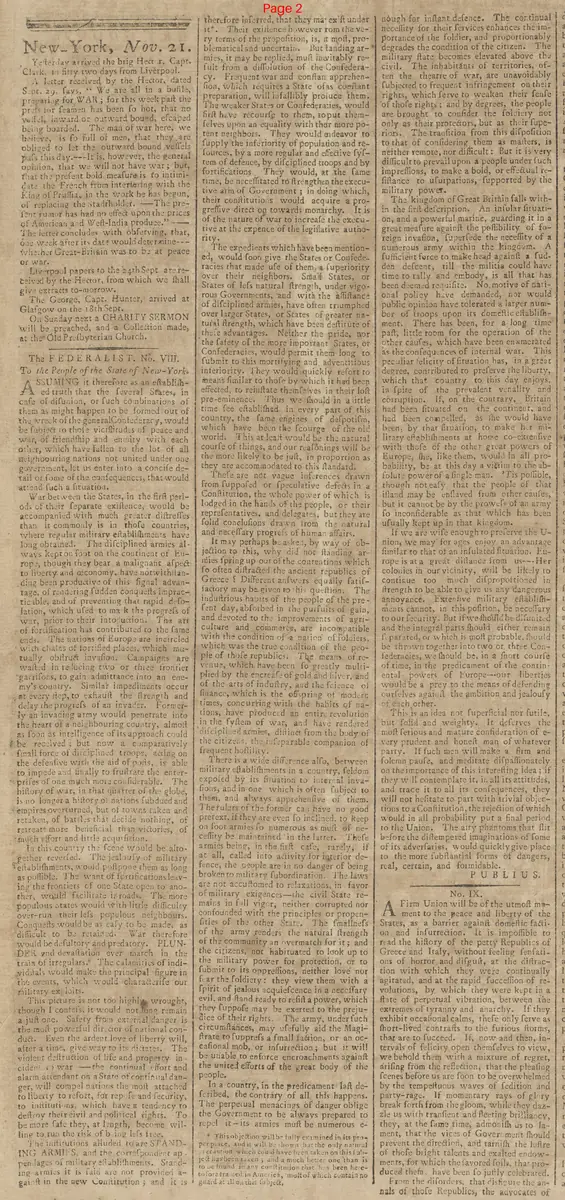
The FEDERALIST. No. VII.
To the People of the State of New-York:
Assuming it therefore as an established truth that the several States, in case of disunion, or such combinations of them as might happen to be formed out of the wreck of the general Confederacy, would be subject to those vicissitudes of peace and war, of friendship and enmity with each other, which have fallen to the lot of all neighboring nations not united under one government, let us enter into a concise detail of some of the consequences, that would attend such a situation.
War between the States, in the first periods of their separate existence, would be accompanied with much greater distress than it commonly is in those countries, where regular military establishments have long obtained. The disciplined armies always kept on foot on the continent of Europe, though they bear a malignant aspect to liberty and economy, have notwithstanding been productive of this signal advantage, of rendering sudden conquests impracticable, and of preventing that rapid desolation, which used to mark the progress of war, prior to their introduction. The art of fortification has contributed to the same ends. The nations of Europe are encircled with chains of fortified places, which mutually obstruct invasion. Campaigns are wasted in reducing two or three frontier garrisons, to gain admittance into an enemy's country. Similar impediments occur at every step, to exhaust the strength and delay the progress of an invader. Formerly an invading army would penetrate into the heart of a neighboring country, almost as soon as intelligence of its approach could be received; but now a comparatively small force of disciplined troops, acting on the defensive with the aid of posts, is able to impede and finally to frustrate the enterprises of one much more considerable. The history of war, in that quarter of the globe, is no longer a history of nations subdued and empires overturned, but of towns taken and retaken, of battles that decide nothing, of retreats more beneficial than victories, of much effort and little acquisition.
In this country the scene would be altogether reversed. The jealousy of military establishments, would postpone them as long as possible. The want of fortifications leaving the frontiers of one State open to another, would facilitate inroads. The more populous States would with little difficulty over-run their less populous neighbors. Conquests would be as easy to be made, as difficult to be retained. War therefore would be desultory and predatory. PLUNDER and devastation ever march in the train of irregulars. The calamities of individuals would make the principal figure in the events, which would characterize our military exploits.
This picture is not too highly wrought, though I confess it would not long remain a just one. Safety from external danger is the most powerful director of national conduct. Even the ardent love of liberty will, after a time, give way to its dictates. The violent destruction of life and property incident to war --- the continual effort and alarm attendant on a state of continual danger, will compel nations the most attached to liberty to resort, for repose and security, to institutions, which have a tendency to destroy their civil and political rights. To be more safe they, at length, become willing to run the risk of being less free.
The institutions alluded to are STANDING ARMIES, and the correspondent appendages of military establishments. Standing armies it is said are not provided against in the new Constitution; and it is therefore inferred, that they may exist under it*. Their existence however from the very terms of the proposition, is, at most, problematical and uncertain. But standing armies, it may be replied, must inevitably result from a dissolution of the Confederacy. Frequent war and constant apprehension, which requires a state of constant preparation, will infallibly produce them. The weaker States or Confederacies, would first have recourse to them, to put themselves upon an equality with their more potent neighbors. They would endeavor to supply the inferiority of population and resources, by a more regular and effective system of defense, by disciplined troops and by fortifications. They would, at the same time, be necessitated to strengthen the executive arm of Government; in doing which, their constitutions would acquire a progressive direction towards monarchy. It is of the nature of war to increase the executive at the expense of the legislative authority.
The expedients which have been mentioned, would soon give the States or Confederacies that made use of them, a superiority over their neighbors. Small States, or States of less natural strength, under vigorous Governments, and with the aid of disciplined armies, have often triumphed over larger States, or States of greater natural strength, which have been destitute of these advantages. Neither the pride, nor the safety of the more important States, or Confederacies, would permit them long to submit to this mortifying and adventitious inferiority. They would quickly resort to means similar to those by which it had been effected, to re-instate themselves in their lost pre-eminence. Thus we should, in a little time, see established in every part of this country, the same engines of despotism, which have been the scourge of the old world. This at least would be the natural course of things, and our reasonings will be the more likely to be just, in proportion as they are accommodated to this standard.
These are not vague inferences drawn from supposed or speculative defects in a Constitution, the whole power of which is lodged in the hands of the people, or their representatives and delegates, but they are solid conclusions drawn from the natural and necessary progress of human affairs.
It may perhaps be asked, by way of objection to this, why did not standing armies spring up out of the contentions which so often distracted the ancient republics of Greece? Different answers equally satisfactory may be given to this question. The industrious habits of the people of the present day, absorbed in the pursuits of gain, and devoted to the improvements of agriculture and commerce, are incompatible with the condition of a nation of soldiers, which was the true condition of the people of those republics. The means of revenue, which have been so greatly multiplied by the increase of gold and silver, and of the arts of industry, and the science of finance, which is the offspring of modern times, concurring with the habits of nations, have produced an entire revolution in the system of war, and have rendered disciplined armies, distinct from the body of the citizens, the inseparable companion of frequent hostility.
There is a wide difference also, between military establishments in a country seldom exposed by its situation to internal invasions, and in one which is often subject to them, and always apprehensive of them. The rulers of the former can have no good pretext, if they are even so inclined, to keep on foot armies so numerous as must of necessity be maintained in the latter. These armies being, in the first case, rarely, if at all, called into activity for interior defense, the people are in no danger of being broken to military subordination. The laws are not accustomed to relaxations, in favor of military exigencies-the civil state remains in full vigor, neither corrupted nor confounded with the principles or propensities of the other state. The smallness of the army renders the natural strength of the community an overmatch for it; and the citizens, not habituated to look up to the military power for protection, or to submit to its oppressions, neither love nor fear the soldiery: they view them with a spirit of jealous acquiescence in a necessary evil, and stand ready to resist a power, which they suppose may be exerted to the prejudice of their rights. The army, under such circumstances, may usefully aid the magistrate to suppress a small faction, or an occasional mob, or insurrection; but it will be unable to enforce encroachments against the united efforts of the great body of the people.
In a country, in the predicament last described, the contrary of all this happens. The perpetual menacings of danger oblige the Government to be always prepared to repel it -its armies must be numerous enough for instant defense. The continual necessity of their services enhances the importance of the soldier, and proportionably degrades the condition of the citizen. The military state becomes elevated above the civil. The inhabitants of territories, often the theatre of war, are unavoidably subjected to frequent infringement on their rights, which serve to weaken their sense of those rights; and by degrees, the people are brought to consider the soldiery not only as their protectors, but as their superiors. The transition from this disposition to that of considering them as masters, is neither remote, nor difficult: But it is very difficult to prevail upon a people under such impressions, to make a bold, or effectual resistance to usurpations, supported by the military power.
The kingdom of Great Britain falls within the first description. An insular situation, and a powerful marine, guarding it in a great measure against the possibility of foreign invasions, supersede the necessity of a numerous army within the kingdom. A sufficient force to make head against a sudden descent, till the militia could have time to rally and embody, is all that has been deemed requisite. No motive of national policy have demanded, nor would public opinion have tolerated a larger number of troops upon its domestic establishment. There has been, for a long time past, little room for the operation of the other causes, which have been enumerated as the consequences of internal war. This peculiar felicity of situation has, in a great degree, contributed to preserve the liberty, which that country to this day enjoys. In spite of the prevalent venality and corruption. If, on the contrary, Britain had been situated on the continent, and had been compelled, as she would have been, by that situation, to make her military establishments at home co-extensive with those of the other great powers of Europe, she, like them, would in all probability, be at this day a victim to the absolute power of a single man. 'Tis possible, though not easy that the people of that island may be enslaved from other causes, but it cannot be by the prowess of an army so inconsiderable as that which has been usually kept up in that kingdom.
If we are wise enough to preserve the Union, we may for ages enjoy an advantage similar to that of an insulated situation. Europe is at a great distance from us---Her colonies in our vicinity, will be likely to continue too much disproportion in strength to be able to give us any dangerous annoyance. Extensive military establishments cannot, in this position, be necessary to our security. But if we should be disunited, and the integral parts should either remain separated, or which is most probable, should be thrown together into two or three Confederacies, we should be, in a short course of time, in the predicament of the continental powers of Europe---our liberties would be a prey to the means of defending ourselves against the ambition and jealousy of each other.
This is an idea not superficial nor futile, but solid and weighty. It deserves the most serious and mature consideration of every prudent and honest man of whatever party. If such men will make a firm and solemn pause, and meditate dispassionately on the importance of this interesting idea; if they will contemplate it, in all its attitudes, and trace it to all its consequences, they will not hesitate to part with trivial objections to a Constitution, the rejection of which would in all probability put a final period to the Union. The airy phantoms that flit before the distempered imaginations of some of its adversaries, would quickly give place to the more substantial forms of dangers, real, certain, and formidable.
PUBLIUS.
To the People of the State of New-York:
Assuming it therefore as an established truth that the several States, in case of disunion, or such combinations of them as might happen to be formed out of the wreck of the general Confederacy, would be subject to those vicissitudes of peace and war, of friendship and enmity with each other, which have fallen to the lot of all neighboring nations not united under one government, let us enter into a concise detail of some of the consequences, that would attend such a situation.
War between the States, in the first periods of their separate existence, would be accompanied with much greater distress than it commonly is in those countries, where regular military establishments have long obtained. The disciplined armies always kept on foot on the continent of Europe, though they bear a malignant aspect to liberty and economy, have notwithstanding been productive of this signal advantage, of rendering sudden conquests impracticable, and of preventing that rapid desolation, which used to mark the progress of war, prior to their introduction. The art of fortification has contributed to the same ends. The nations of Europe are encircled with chains of fortified places, which mutually obstruct invasion. Campaigns are wasted in reducing two or three frontier garrisons, to gain admittance into an enemy's country. Similar impediments occur at every step, to exhaust the strength and delay the progress of an invader. Formerly an invading army would penetrate into the heart of a neighboring country, almost as soon as intelligence of its approach could be received; but now a comparatively small force of disciplined troops, acting on the defensive with the aid of posts, is able to impede and finally to frustrate the enterprises of one much more considerable. The history of war, in that quarter of the globe, is no longer a history of nations subdued and empires overturned, but of towns taken and retaken, of battles that decide nothing, of retreats more beneficial than victories, of much effort and little acquisition.
In this country the scene would be altogether reversed. The jealousy of military establishments, would postpone them as long as possible. The want of fortifications leaving the frontiers of one State open to another, would facilitate inroads. The more populous States would with little difficulty over-run their less populous neighbors. Conquests would be as easy to be made, as difficult to be retained. War therefore would be desultory and predatory. PLUNDER and devastation ever march in the train of irregulars. The calamities of individuals would make the principal figure in the events, which would characterize our military exploits.
This picture is not too highly wrought, though I confess it would not long remain a just one. Safety from external danger is the most powerful director of national conduct. Even the ardent love of liberty will, after a time, give way to its dictates. The violent destruction of life and property incident to war --- the continual effort and alarm attendant on a state of continual danger, will compel nations the most attached to liberty to resort, for repose and security, to institutions, which have a tendency to destroy their civil and political rights. To be more safe they, at length, become willing to run the risk of being less free.
The institutions alluded to are STANDING ARMIES, and the correspondent appendages of military establishments. Standing armies it is said are not provided against in the new Constitution; and it is therefore inferred, that they may exist under it*. Their existence however from the very terms of the proposition, is, at most, problematical and uncertain. But standing armies, it may be replied, must inevitably result from a dissolution of the Confederacy. Frequent war and constant apprehension, which requires a state of constant preparation, will infallibly produce them. The weaker States or Confederacies, would first have recourse to them, to put themselves upon an equality with their more potent neighbors. They would endeavor to supply the inferiority of population and resources, by a more regular and effective system of defense, by disciplined troops and by fortifications. They would, at the same time, be necessitated to strengthen the executive arm of Government; in doing which, their constitutions would acquire a progressive direction towards monarchy. It is of the nature of war to increase the executive at the expense of the legislative authority.
The expedients which have been mentioned, would soon give the States or Confederacies that made use of them, a superiority over their neighbors. Small States, or States of less natural strength, under vigorous Governments, and with the aid of disciplined armies, have often triumphed over larger States, or States of greater natural strength, which have been destitute of these advantages. Neither the pride, nor the safety of the more important States, or Confederacies, would permit them long to submit to this mortifying and adventitious inferiority. They would quickly resort to means similar to those by which it had been effected, to re-instate themselves in their lost pre-eminence. Thus we should, in a little time, see established in every part of this country, the same engines of despotism, which have been the scourge of the old world. This at least would be the natural course of things, and our reasonings will be the more likely to be just, in proportion as they are accommodated to this standard.
These are not vague inferences drawn from supposed or speculative defects in a Constitution, the whole power of which is lodged in the hands of the people, or their representatives and delegates, but they are solid conclusions drawn from the natural and necessary progress of human affairs.
It may perhaps be asked, by way of objection to this, why did not standing armies spring up out of the contentions which so often distracted the ancient republics of Greece? Different answers equally satisfactory may be given to this question. The industrious habits of the people of the present day, absorbed in the pursuits of gain, and devoted to the improvements of agriculture and commerce, are incompatible with the condition of a nation of soldiers, which was the true condition of the people of those republics. The means of revenue, which have been so greatly multiplied by the increase of gold and silver, and of the arts of industry, and the science of finance, which is the offspring of modern times, concurring with the habits of nations, have produced an entire revolution in the system of war, and have rendered disciplined armies, distinct from the body of the citizens, the inseparable companion of frequent hostility.
There is a wide difference also, between military establishments in a country seldom exposed by its situation to internal invasions, and in one which is often subject to them, and always apprehensive of them. The rulers of the former can have no good pretext, if they are even so inclined, to keep on foot armies so numerous as must of necessity be maintained in the latter. These armies being, in the first case, rarely, if at all, called into activity for interior defense, the people are in no danger of being broken to military subordination. The laws are not accustomed to relaxations, in favor of military exigencies-the civil state remains in full vigor, neither corrupted nor confounded with the principles or propensities of the other state. The smallness of the army renders the natural strength of the community an overmatch for it; and the citizens, not habituated to look up to the military power for protection, or to submit to its oppressions, neither love nor fear the soldiery: they view them with a spirit of jealous acquiescence in a necessary evil, and stand ready to resist a power, which they suppose may be exerted to the prejudice of their rights. The army, under such circumstances, may usefully aid the magistrate to suppress a small faction, or an occasional mob, or insurrection; but it will be unable to enforce encroachments against the united efforts of the great body of the people.
In a country, in the predicament last described, the contrary of all this happens. The perpetual menacings of danger oblige the Government to be always prepared to repel it -its armies must be numerous enough for instant defense. The continual necessity of their services enhances the importance of the soldier, and proportionably degrades the condition of the citizen. The military state becomes elevated above the civil. The inhabitants of territories, often the theatre of war, are unavoidably subjected to frequent infringement on their rights, which serve to weaken their sense of those rights; and by degrees, the people are brought to consider the soldiery not only as their protectors, but as their superiors. The transition from this disposition to that of considering them as masters, is neither remote, nor difficult: But it is very difficult to prevail upon a people under such impressions, to make a bold, or effectual resistance to usurpations, supported by the military power.
The kingdom of Great Britain falls within the first description. An insular situation, and a powerful marine, guarding it in a great measure against the possibility of foreign invasions, supersede the necessity of a numerous army within the kingdom. A sufficient force to make head against a sudden descent, till the militia could have time to rally and embody, is all that has been deemed requisite. No motive of national policy have demanded, nor would public opinion have tolerated a larger number of troops upon its domestic establishment. There has been, for a long time past, little room for the operation of the other causes, which have been enumerated as the consequences of internal war. This peculiar felicity of situation has, in a great degree, contributed to preserve the liberty, which that country to this day enjoys. In spite of the prevalent venality and corruption. If, on the contrary, Britain had been situated on the continent, and had been compelled, as she would have been, by that situation, to make her military establishments at home co-extensive with those of the other great powers of Europe, she, like them, would in all probability, be at this day a victim to the absolute power of a single man. 'Tis possible, though not easy that the people of that island may be enslaved from other causes, but it cannot be by the prowess of an army so inconsiderable as that which has been usually kept up in that kingdom.
If we are wise enough to preserve the Union, we may for ages enjoy an advantage similar to that of an insulated situation. Europe is at a great distance from us---Her colonies in our vicinity, will be likely to continue too much disproportion in strength to be able to give us any dangerous annoyance. Extensive military establishments cannot, in this position, be necessary to our security. But if we should be disunited, and the integral parts should either remain separated, or which is most probable, should be thrown together into two or three Confederacies, we should be, in a short course of time, in the predicament of the continental powers of Europe---our liberties would be a prey to the means of defending ourselves against the ambition and jealousy of each other.
This is an idea not superficial nor futile, but solid and weighty. It deserves the most serious and mature consideration of every prudent and honest man of whatever party. If such men will make a firm and solemn pause, and meditate dispassionately on the importance of this interesting idea; if they will contemplate it, in all its attitudes, and trace it to all its consequences, they will not hesitate to part with trivial objections to a Constitution, the rejection of which would in all probability put a final period to the Union. The airy phantoms that flit before the distempered imaginations of some of its adversaries, would quickly give place to the more substantial forms of dangers, real, certain, and formidable.
PUBLIUS.
What sub-type of article is it?
Constitutional
War Or Peace
Military Affairs
What keywords are associated?
Federalist
Disunion
Standing Armies
Interstate War
Liberty
Union
Constitution
Despotism
Europe
Britain
What entities or persons were involved?
Publius
States Of New York
Nations Of Europe
Kingdom Of Great Britain
Editorial Details
Primary Topic
Dangers Of Disunion Leading To Interstate Wars And Standing Armies
Stance / Tone
Advocacy For Union To Prevent Despotism And Preserve Liberty
Key Figures
Publius
States Of New York
Nations Of Europe
Kingdom Of Great Britain
Key Arguments
Disunion Would Cause Vicissitudes Of War And Enmity Among States
Lack Of Military Establishments And Fortifications Would Enable Easy Predatory Conquests
Frequent Wars Would Necessitate Standing Armies, Eroding Civil Liberties
War Strengthens Executive Power At Expense Of Legislative Authority
Smaller States Would Adopt Disciplined Armies To Compete, Leading To Superiority And Emulation
Historical Examples From Europe And Greece Illustrate Risks Of Internal Conflicts
Insular Situations Like Britain's Preserve Liberty By Limiting Army Needs
Union Provides Security Similar To Insulation, Avoiding European Style Despotism