Thank you for visiting SNEWPapers!
Sign up free
New Hampshire Statesman And State Journal
Concord, Merrimack County, New Hampshire
What is this article about?
A lawyer reluctantly pays a five-dollar bill to his shoemaker, initiating a chain of payments that relieves hardships for a sailor, a seamstress, and a destitute family, demonstrating the far-reaching benefits of settling small debts through providence.
Clipping
OCR Quality
Full Text
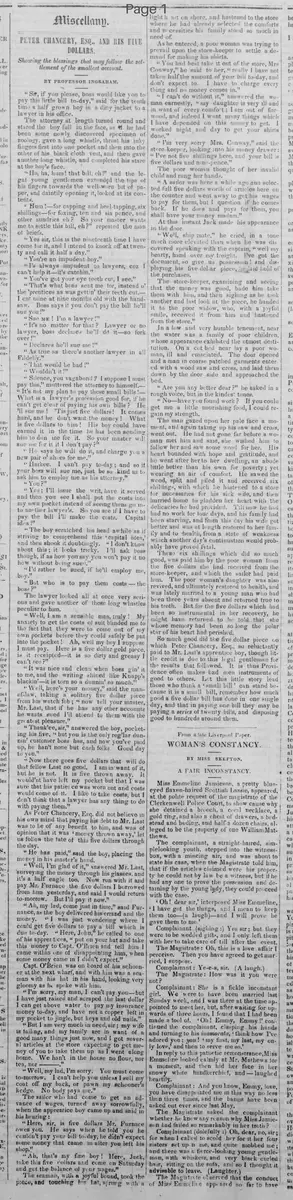
PETER CHANCERY, ESQ. AND HIS FIVE
DOLLARS.
Showing the blessings that may follow the set-
tlement of the smallest account.
BY PROFESSOR INGRAHAM.
"Sit, if you please, boss would like you to
pay this little bill to-day," said for the tenth
time a half grown boy in a dirty jacket to a
lawyer in his office.
The attorney at length turned round and
stared the boy full in the face, as if he had
been some newly discovered specimen of
zoology, gave a long whistle, thrust his inky
fingers first into one pocket and then into the
other of his black cloth vest, and then gave
another long whistle, and completed his stare
at the boy's face.
"Ho. ha. hum! that bill, eh!" and the le-
gal young gentleman extended the tips of
his fingers towards the well-worn bit of pa-
per, and daintily opening it, looked at its con-
tents.
Hum!—for capping and heel-tapping, six
shillings—for foxing, ten and six pence, and
other sundries eh? So your master wants
me to settle this bill, eh?" repeated the man
of briefs.
"Yes sir. this is the nineteenth time I have
come for it, and I intend to knock off at twen-
ty and call it half a day."
"You're an impudent boy."
"I'm always impudent to lawyers, coz I
can't help it—it's catchin."
"You've got your eye teeth cut. I see."
"That's what boss sent me for. instead o
the 'prentices as was gettin' their teeth cut.—
I cut mine at nine months old with the hand-
saw. Boss says if you don't pay the bill he'll
sue you!"
"Sue me! I'm a lawyer!"
"It's no matter for that? Lawyer or no
lawyer, boss declares he'll do it—so fork
over!"
"Declares he'll sue me!"
"As true as there's another lawyer in all
Fidelity."
"That would be bad!"
"Wouldn't it!"
Silence, you vagabond? I suppose I must
pay this," muttered the attorney to himself.—
"It's not my plan to pay these small bills!—
What is a lawyer's profession good for, if he
can't get clear of paying his own bills? He'll
sue me! 'Tis just five dollars! It comes
hard, and he don't want the money! What
is five dollars to him! His boy could have
earned it in the time he has been sending
him to dun me for it. So your master will
sue me for it if I don't pay?"
"He says he will do it, and charge you a
new pair o' shoes for me."
"Harkee. I can't pay to-day; and so if
your boss will sue me, just be so kind as to
ask him to employ me as his attorney."
"You?"
"Yes; I'll issue the writ, have it served
and then you see I shall put the costs into
my own pocket instead of seeing them go in-
to another lawyer's. So you see if I have to
pay the bill I'll make the costs. Capital
idea!"
"The boy scratched his head awhile as if
striving to comprehend this 'capital idea,
and then shook it doubtingly. "I don't know
about this; it looks tricky. I'll ask boss
though, if as how you say you won't pay it no
hew without being sued."
"I'd rather be sued, if he'll employ me,
boy."
"But who is to pay them costs—the
boss?"
The lawyer looked all at once very seri-
ous and gave another of those long whistles
peculiar to him.
"Well, I am a sensible man, truly! My
anxiety to get the costs of suit blinded me to
the fact that they were to come out of my
own pockets before they could safely be put
into the pocket! Ah, well my boy I suppose
I must pay. Here is a five dollar gold piece,
is it receipted—it is so dirty and greasy I
can't see?"
"It was nice and clean when boss gin' it
to me, and the writing shined like Knapp's
blackin'—it is torn so a dunnin' so much."
"Well, here's your money," said the man-
of-law, taking a solitary five dollar piece
from his watch fob; "now tell your master,
Mr. Last, that if he has any other accounts
he wants sued I'll attend to them with the
greatest pleasure."
"Thank'ee, sir," answered the boy, pocket-
ing his five, "but you is the only reg'lar dun-
ning customer boss has, and now you've paid
up, he han't none but cash folks Good day
to you."
Now there goes five dollars that will do
that fellow Last no good. I am in want of it,
but he is not. It is five thrown away. It
would'nt have left my pocket but that I was
sure that his patience was worn out and costs
would come of it. I like to take costs, but I
don't think that a lawyer has any thing to do
with paying them."
As Peter Chancery, Esq. did not believe in
his own mind that paying his debt to Mr. Last
was to be of any benefit to him, and was of
opinion that it was 'money thrown away,' let
us follow the fate of this five dollars through
the day.
"He has paid," said the boy, placing the
money in his master's hand.
"Well, I'm glad of it," answered Mr. Last,
surveying the money through his glasses. and
it's a half eagle too. Now run with it and
pay Mr. Furnace the five dollars I borrowed
from him yesterday, and said I would return
to-morrow. But I'll pay it now."
"Ah, my lad, come just in time." said Fur-
nace, as the boy delivered his errand and the
money. "I was just wondering where I
could get five dollars to pay a bill which is
due to-day." Here, John," he called to one
of his apprentices, "put on your hat and take
this money to Capt. O'Brien and tell him I
came within one of disappointing him, when
some money came in I didn't expect."
Capt. O'Brien was on board of his schoon-
er at the next wharf, and with him was a sea-
man with his hat in his hand, looking very
gloomy as he spoke with him.
"I'm sorry, my man, I can't pay you—but
I have just raised and scraped the last dollar
I can get above water to pay my insurance
money to-day, and have not a copper left in
my pocket to jingle, but keys and old nails."
"But I am very much in need, sir; my wife
is failing, and my family are in want of a
good many things just now, and I got sever-
al articles at the store expecting to get mo-
ney of you to take them up as I went along
home. We han't in the house no flour, nor
tea, nor
Well, my lad, I'm sorry. You must come
to-morrow. I can't help you unless I sell my
coat off my back, or pawn my schooner's
kedge. No body pays me."
The sailor who had come to get an ad-
vance of wages, turned away sorrowfully,
when the apprentice boy came up and said in
his hearing:
"Here, sir, is five dollars Mr. Furnace
owes you. He says when he told you he
couldn't pay your bill to-day, he didn't expect
some money that came in after you left his
shop."
"Ah, that's my fine boy! Here, Jack,
take this five dollars and come on Saturday
and get the balance of your wages."
The seaman, with a joyful bound, took the
piece, and touching his hat, sprung with a
light heart on shore, and hastened to the store
where he had already selected the comforts
and necessities his family stood so much in
need of.
As he entered, a poor woman was trying to
prevail upon the store-keeper to settle a de-
mand for making his shirts.
"You had best take it out of the store. Mrs
Conway," he said to her, "really I have not
taken half the amount of your bill to-day, and
don't expect to. I have to charge every
thing and no money comes in."
"I can't do without it," answered the wo-
man earnestly, "my daughter is very ill and
in want of every comfort; I am out of fire
wood, and indeed I want many things which
I have depended on this money to get. I
worked night and day to get your shirts
done."
"I'm very sorry Mrs. Conway," said the
store-keeper, looking into his money drawer:
"I've not five shillings here, and your bill is
five dollars and nine-pence."
The poor woman thought of her invalid
child and wrung her hands.
"A sailor was here a while ago and selec-
ted full five dollars worth of articles here on
the counter and went away to get his wages
to pay for them, but I question if he comes
back. If he does and pays for them, you
shall have your money madam."
At this instant Jack made his appearance
in the door
"Well, ship mate," he cried, in a tone
much more elevated than when he was dis-
covered speaking with the captain, "well my
hearty, hand over my freight. I've got the
document, so give us possession!" and dis-
playing his five dollar piece, he laid hold of
the purchases.
The store-keeper, examining and seeing
that the money was good, bade him take
them with him, and then sighing as he took
another and last look at the piece, he handed
it to the poor widow, who, with a joyful
smile, received it from him and hastened
from the store.
In a low and very humble tenement, near
the water was a family of poor children.
whose appearance exhibited the utmost desti-
tution. On a cot bed near lay a poor wo-
man, ill and emaciated. The door opened
and a man in coarse patched garments enter-
ed with a wood saw and cross, and laid them
down by the door side and approached the
bed.
"Are you any better dear?" he asked in a
rough voice, but in the kindest tones.
"No—have you found work? If you could
get me a little nourishing food, I could re-
gain my strength."
The man gazed upon her pale face a mo-
ment, and again taking up his saw and cross,
went out. He had not gone far before a wo-
man met him and said, she wished him to
follow her and saw some wood for her. His
heart bounded with hope and gratitude, and
he went after her to her dwelling, an abode
little better than his own for poverty; yet
wearing an air of comfort. He sawed the
wood, split and piled it and received six
shillings, with which he hastened to a store
for necessaries for his sick wife, and then
hurried home to gladden her heart with the
delicacies he had provided. Till now he had
had no work for four days, and his family had
been starving, and from this day his wife got
better and was at length restored to her fam-
ily and to health, from a state of weakness
which another day's continuation would prob-
ably have proved fatal.
These six shillings which did so much
good, was paid him by the poor woman from
the five dollars she had received from the
store-keeper, and which the sailor had paid
him. The poor woman's daughter was also
revived, and ultimately restored to health, and
was lately married to a young man who had
been three years absent and returned true to
his troth. But for the five dollars which had
been so instrumental in her recovery, he
might have returned to be told that she
whose memory had been so long the polar
star of his heart had perished.
So much good did the five dollar piece do
which Peter Chancery, Esq., so reluctantly
paid to Mr. Last's apprentice boy, though lit-
tle credit is due to this legal gentleman for
the results that followed. It is thus Provi-
dence often makes bad men instruments of
good to others. Let this little story lead
those who think a 'small bill' can stand be-
cause it is a small bill, remember how much
good a five dollar bill has done in one single
day, and that in paying one bill they may be
paying a series of twenty bills, and disposing
good to hundreds around them.
What sub-type of article is it?
What themes does it cover?
What keywords are associated?
What entities or persons were involved?
Where did it happen?
Story Details
Key Persons
Location
Fidelity, Near The Water, Wharfs And Stores
Story Details
Reluctant lawyer Peter Chancery pays five dollars to shoemaker Mr. Last, whose apprentice delivers it to repay Mr. Furnace, who pays Capt. O'Brien, enabling him to advance wages to seaman Jack, who buys family necessities, allowing storekeeper to pay seamstress Mrs. Conway, who hires a woodcutter to provide food saving his sick wife's life and aiding her daughter's recovery.