Thank you for visiting SNEWPapers!
Sign up free
Story
November 29, 1900
The Republican
Oakland, Garrett County, Maryland
What is this article about?
An article explains that a creeping gait in horses is unnatural, causes fatigue, and is typically due to idle grooms or drivers, advocating for faster paces to improve efficiency and health for both horse and human.
Clipping
OCR Quality
98%
Excellent
Full Text
Creeping Gait In Horses.
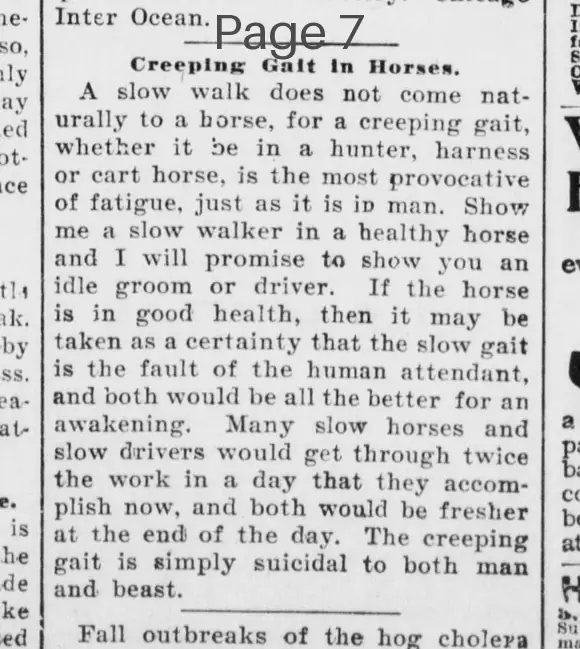
A slow walk does not come naturally to a horse, for a creeping gait, whether it be in a hunter, harness or cart horse, is the most provocative of fatigue, just as it is in man. Show me a slow walker in a healthy horse and I will promise to show you an idle groom or driver. If the horse is in good health, then it may be taken as a certainty that the slow gait is the fault of the human attendant, and both would be all the better for an awakening. Many slow horses and slow drivers would get through twice the work in a day that they accomplish now, and both would be fresher at the end of the day. The creeping gait is simply suicidal to both man and beast.
A slow walk does not come naturally to a horse, for a creeping gait, whether it be in a hunter, harness or cart horse, is the most provocative of fatigue, just as it is in man. Show me a slow walker in a healthy horse and I will promise to show you an idle groom or driver. If the horse is in good health, then it may be taken as a certainty that the slow gait is the fault of the human attendant, and both would be all the better for an awakening. Many slow horses and slow drivers would get through twice the work in a day that they accomplish now, and both would be fresher at the end of the day. The creeping gait is simply suicidal to both man and beast.
What sub-type of article is it?
Curiosity
Animal Story
What themes does it cover?
Moral Virtue
Misfortune
What keywords are associated?
Horse Gait
Creeping Walk
Fatigue
Idle Groom
Animal Care
Story Details
Story Details
A slow, creeping gait in horses is unnatural and fatiguing, caused by idle human attendants; faster paces would benefit both horse and driver by doubling work output and reducing exhaustion.