Thank you for visiting SNEWPapers!
Sign up free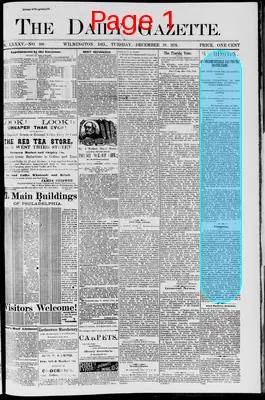
The Daily Gazette
Wilmington, New Castle County, Delaware
What is this article about?
Washington report on Dec. 18, 1876: Republicans disheartened by fraud discoveries in doubtful states (Louisiana, Florida, South Carolina) via congressional probes and Barlow's letter conceding Florida to Tilden; Hayes backers doubt his victory; Congress debates electoral count mechanisms and veto overrides.
Clipping

OCR Quality
Full Text
AN UNCOMFORTABLE DAY FOR THE REPUBLICANS.
BAD NEWS FROM THE DOUBTFUL STATES.
FRAUDS UNEARTHED BY THE CONGRESSIONAL INVESTIGATING COMMITTEES.
DEPRESSING EFFECT OF BARLOW'S LETTER.
HAYES' SUPPORTERS GROWING LESS CONFIDENT.
Washington, Dec. 18, 1876.
Bad News for the Republicans from the Three Doubtful States—too Palpable Frauds Discovered by the Congressional Committee—General Barlow's Letter a Damper on Hayes' Supporters—Feeling of the Moderate.
The republicans have had an uncomfortable day. On Saturday and Sunday there was private information in town and in the possession of republicans that matters did not promise so well in Louisiana. The conduct of the Returning Board in refusing to exhibit its records to the Congressional committee excited suspicions that all was not right, and that the State was not rightfully given to Mr. Hayes, and these suspicions were increased by private news, carefully kept secret, but which led to conclusions which were here and there spoken out. To-day came the letter of General Barlow, virtually conceding Florida to Mr. Tilden. This letter produced a decidedly blue sensation among the republican Senators. It was carefully read, and Senator Jones, of Florida, was asked what he knew of the precinct Jasper No. 2. of which General Barlow says that if the inspectors were republicans the vote ought to be counted, and would give the State to Tilden. Mr. Jones says the inspectors, who left the vote half counted, were republicans, and that this fact, as well as their abandonment of their duties, will be easily proved before the investigating committee, so that, if the vote of the State depends on that, it will have to be given to Tilden. There are also reports in town that the South Carolina committee have discovered irregularities there in the conduct of the Returning Board, which may show that the State was really carried by Tilden.
All these matters make a strong impression here upon fair-minded republicans, who though they want and mean to put Governor Hayes into the White House if he was honestly elected, do not for an instant think of acting unfairly and these are getting into a state of mind where they feel a strong and reasonable doubt of Mr. Hayes' election, which will have to be removed before they will consent to act with the extremists. "Governor Hayes' election is certainly not as sure as it was," admitted one of his most earnest supporters this evening; and another remarked: "The Congressional committees may, after all, settle this question, so that it will never come before the House.
Congress.
In the United States, Senate yesterday, the resolution of Mr. Edmunds referring the message of the House of Representatives in regard to devising means to count, the electoral vote to a select committee of seven Senators to act with a similar committee of the House. was agreed. The message of the President sent to the Senate last session. vetoing the bill reducing the salary of President of the United States from $50,000 to $25,000 per annum was taken up. and after debate the Senate refused to pass the bill over the veto—yeas 25, nays 19, not the required two-thirds voting in the affirmative." Mr. Wright, of Iowa, introduced a bill to establish a court for the trial of contested elections in the offices of President and Vice-President. The resolution in regard to the appointment of presidential electors in Oregon was further debated. In the House Mr. Knott, chairman of the judiciary committee, introduced a bill regulating the proceedings in the electoral count for President and Vice-President; the bill was referred to the select committee on that subject. A resolution of inquiry into the action of Judge Bond in South Carolina failed for want of the necessary two-thirds majority. A resolution instructing the judiciary committee to report an amendment to the constitution forbidding the payment of war claims to disloyal persons was adopted by a vote of 150 yeas to 53.
What sub-type of article is it?
What themes does it cover?
What keywords are associated?
What entities or persons were involved?
Where did it happen?
Story Details
Key Persons
Location
Washington
Event Date
Dec. 18, 1876
Story Details
Republicans face setbacks in the 1876 presidential election dispute with reports of fraud in Louisiana, Florida, and South Carolina; General Barlow's letter concedes Florida to Tilden; congressional committees investigate; Hayes supporters lose confidence; Senate and House debate electoral vote counting and related bills.