Thank you for visiting SNEWPapers!
Sign up free
Letter to Editor
July 29, 1836
Burlington Free Press
Burlington, Chittenden County, Vermont
What is this article about?
An Antimason from Huntington argues that one can consistently oppose Freemasonry while holding Whig political views, as these are separate from anti-Masonic principles. He criticizes Antimasons supporting Van Buren, a Mason, and defends alignment with Whigs like Harrison.
Clipping
OCR Quality
98%
Excellent
Full Text
For the Burlington Free Press.
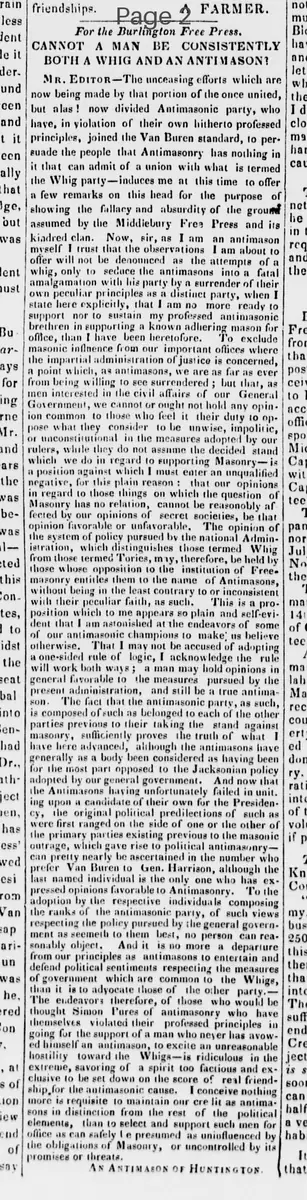
CANNOT A MAN BE CONSISTENTLY BOTH A WHIG AND AN ANTIMASON?
MR. EDITOR--The unceasing efforts which are now being made by that portion of the once united, but alas! now divided Antimasonic party, who have, in violation of their own hitherto professed principles, joined the Van Buren standard, to persuade the people that Antimasonry has nothing in it that can admit of a union with what is termed the Whig party--induces me at this time to offer a few remarks on this lead for the purpose of showing the fallacy and absurdity of the ground assumed by the Middlebury Free Press and its kindred clan. Now, sir, as I am an antimason myself I trust that the observations I am about to offer will not be denounced as the attempts of a whig, only to seduce the antimasons into a fatal amalgamation with his party by a surrender of their own peculiar principles as a distinct party, when I state here explicitly, that I am no more ready to support nor to sustain my professed antimasonic brethren in supporting a known adhering mason for office, than I have been heretofore. To exclude masonic influence from our important offices where the impartial administration of justice is concerned, a point which, as antimasons, we are as far as ever from being willing to see surrendered; but that, as men interested in the civil affairs of our General Government, we cannot or ought not hold any opinion common to those who feel it their duty to oppose what they consider to be unwise, impolitic, or unconstitutional in the measures adopted by our rulers, while they do not assume the decided stand which we do in regard to supporting Masonry--is a position against which I must enter an unqualified negative, for this plain reason: that our opinions in regard to those things on which the question of Masonry has no relation, cannot be reasonably affected by our opinions of secret societies, be that opinion favorable or unfavorable. The opinion of the system of policy pursued by the national Administration, which distinguishes those termed Whig from those termed Tories, may, therefore, be held by those whose opposition to the institution of Freemasonry entitles them to the name of Antimasons, without being in the least contrary to or inconsistent with their peculiar faith, as such. This is a proposition which to me appears so plain and self-evident that I am astonished at the endeavors of some of our antimasonic champions to make us believe otherwise. That I may not be accused of adopting a one-sided rule of logic, I acknowledge the rule will work both ways; a man may hold opinions in general favorable to the measures pursued by the present administration, and still be a true antimason. The fact that the antimasonic party, as such, is composed of such as belonged to each of the other parties previous to their taking the stand against masonry, sufficiently proves the truth of what I have here advanced, although the antimasons have generally as a body been considered as having been for the most part opposed to the Jacksonian policy adopted by our general government. And now that the Antimasons having unfortunately failed in uniting upon a candidate of their own for the Presidency, the original political predilections of such as were first ranged on the side of one or the other of the primary parties existing previous to the masonic outrage, which gave rise to political antimasonry-- can pretty nearly be ascertained in the number who prefer Van Buren to Gen. Harrison, although the last named individual is the only one who has expressed opinions favorable to Antimasonry. To the adoption by the respective individuals composing the ranks of the antimasonic party, of such views respecting the policy pursued by the general government as seemeth to them best, no person can reasonably object. And it is no more a departure from our principles as antimasons to entertain and defend political sentiments respecting the measures of government which are common to the Whigs, than it is to advocate those of the other party.-- The endeavors therefore, of those who would be thought Simon Pures of antimasonry who have themselves violated their professed principles in going for the support of a man who never has avowed himself an antimason, to excite an unreasonable hostility toward the Whigs--is ridiculous in the extreme, savoring of a spirit too factious and exclusive to be set down on the score of real friendship for the antimasonic cause. I conceive nothing more is requisite to maintain our credit as antimasons in distinction from the rest of the political elements, than to select and support such men for office as can safely be presumed as uninfluenced by the obligations of Masonry, or uncontrolled by its promises or threats.
An Antimason of Huntington.
CANNOT A MAN BE CONSISTENTLY BOTH A WHIG AND AN ANTIMASON?
MR. EDITOR--The unceasing efforts which are now being made by that portion of the once united, but alas! now divided Antimasonic party, who have, in violation of their own hitherto professed principles, joined the Van Buren standard, to persuade the people that Antimasonry has nothing in it that can admit of a union with what is termed the Whig party--induces me at this time to offer a few remarks on this lead for the purpose of showing the fallacy and absurdity of the ground assumed by the Middlebury Free Press and its kindred clan. Now, sir, as I am an antimason myself I trust that the observations I am about to offer will not be denounced as the attempts of a whig, only to seduce the antimasons into a fatal amalgamation with his party by a surrender of their own peculiar principles as a distinct party, when I state here explicitly, that I am no more ready to support nor to sustain my professed antimasonic brethren in supporting a known adhering mason for office, than I have been heretofore. To exclude masonic influence from our important offices where the impartial administration of justice is concerned, a point which, as antimasons, we are as far as ever from being willing to see surrendered; but that, as men interested in the civil affairs of our General Government, we cannot or ought not hold any opinion common to those who feel it their duty to oppose what they consider to be unwise, impolitic, or unconstitutional in the measures adopted by our rulers, while they do not assume the decided stand which we do in regard to supporting Masonry--is a position against which I must enter an unqualified negative, for this plain reason: that our opinions in regard to those things on which the question of Masonry has no relation, cannot be reasonably affected by our opinions of secret societies, be that opinion favorable or unfavorable. The opinion of the system of policy pursued by the national Administration, which distinguishes those termed Whig from those termed Tories, may, therefore, be held by those whose opposition to the institution of Freemasonry entitles them to the name of Antimasons, without being in the least contrary to or inconsistent with their peculiar faith, as such. This is a proposition which to me appears so plain and self-evident that I am astonished at the endeavors of some of our antimasonic champions to make us believe otherwise. That I may not be accused of adopting a one-sided rule of logic, I acknowledge the rule will work both ways; a man may hold opinions in general favorable to the measures pursued by the present administration, and still be a true antimason. The fact that the antimasonic party, as such, is composed of such as belonged to each of the other parties previous to their taking the stand against masonry, sufficiently proves the truth of what I have here advanced, although the antimasons have generally as a body been considered as having been for the most part opposed to the Jacksonian policy adopted by our general government. And now that the Antimasons having unfortunately failed in uniting upon a candidate of their own for the Presidency, the original political predilections of such as were first ranged on the side of one or the other of the primary parties existing previous to the masonic outrage, which gave rise to political antimasonry-- can pretty nearly be ascertained in the number who prefer Van Buren to Gen. Harrison, although the last named individual is the only one who has expressed opinions favorable to Antimasonry. To the adoption by the respective individuals composing the ranks of the antimasonic party, of such views respecting the policy pursued by the general government as seemeth to them best, no person can reasonably object. And it is no more a departure from our principles as antimasons to entertain and defend political sentiments respecting the measures of government which are common to the Whigs, than it is to advocate those of the other party.-- The endeavors therefore, of those who would be thought Simon Pures of antimasonry who have themselves violated their professed principles in going for the support of a man who never has avowed himself an antimason, to excite an unreasonable hostility toward the Whigs--is ridiculous in the extreme, savoring of a spirit too factious and exclusive to be set down on the score of real friendship for the antimasonic cause. I conceive nothing more is requisite to maintain our credit as antimasons in distinction from the rest of the political elements, than to select and support such men for office as can safely be presumed as uninfluenced by the obligations of Masonry, or uncontrolled by its promises or threats.
An Antimason of Huntington.
What sub-type of article is it?
Persuasive
Political
What themes does it cover?
Politics
Morality
What keywords are associated?
Antimasonry
Whig Party
Van Buren
Harrison
Political Principles
Freemasonry Opposition
Party Union
What entities or persons were involved?
An Antimason Of Huntington
Mr. Editor
Letter to Editor Details
Author
An Antimason Of Huntington
Recipient
Mr. Editor
Main Argument
a person can consistently be both an antimason and a whig, as opposition to freemasonry does not conflict with political opinions on government policies; antimasons should support non-masonic candidates regardless of party.
Notable Details
Criticizes Middlebury Free Press
References Van Buren As A Mason
Praises Gen. Harrison's Anti Masonic Views
Discusses Jacksonian Policy Opposition