Thank you for visiting SNEWPapers!
Sign up free
Editorial
August 4, 1807
The Enquirer
Richmond, Henrico County, Virginia
What is this article about?
Editorial from National Intelligencer asserts American resolve for war over submission to British indignities, predicting a naval conflict where U.S. privateers devastate British commerce, continental possessions fall, and allies like Russia and France join to challenge British naval supremacy, with minimal U.S. losses.
Clipping
OCR Quality
95%
Excellent
Full Text
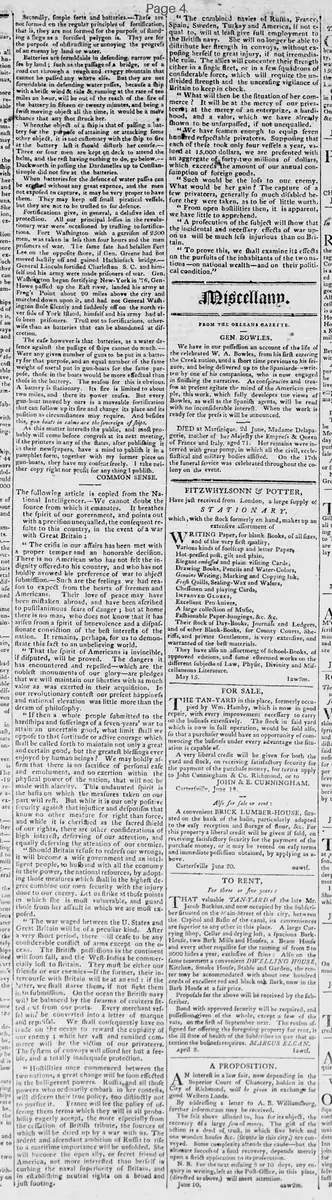
The following article is copied from the National Intelligencer.—We cannot doubt the source from which it emanates. It breathes the spirit of our government, and points out with a precision unequalled, the consequent results to this country, in the event of a war with Great Britain:
"The crisis in our affairs has been met with a proper temper and an honorable decision. There is no American who has not felt the indignity offered to his country, and who has not boldly avowed his preference of war to abject submission.—Such are the feelings we had reason to expect from the hearts of freemen and Americans. Their love of peace may have been mistaken abroad, and have been ascribed to pusillanimous fears of danger; but at home there is no man, who does not know that it has arisen from a spirit of benevolence and a dispassionate conviction of the best interests of the nation. It remains, perhaps, for us to demonstrate this fact to an unbelieving world.
"That the spirit of Americans is invincible, if disputed, will be proved. The dangers it has encountered and repelled—which are the noblest monuments of our glory—are pledges that we will maintain our liberties with as much valor as was exerted in their acquisition. In our revolutionary contest our present happiness and national elevation was little more than the dream of philosophy.
"If then a whole people submitted to the hardships and sufferings of a seven years' war to attain an uncertain good, what limit shall we oppose to that fortitude or active courage which shall be called forth to maintain not only a great and certain good, but the greatest blessings ever enjoyed by human beings? We may boldly affirm that there is no sacrifice of personal ease and emolument, and no exertion within the physical power of the nation, that will not be made with alacrity. This undaunted spirit is the basis on which the measures taken on our part will rest. But while it is our only positive security against that injustice and despotism that know no other measure for right than force, and while it is cherished as the sacred shield of our rights, there are other considerations of high interest, deserving of our attention, and equally deserving the attention of our enemies.
"Should Britain refuse to redress our wrongs, it will become a wise government and an intelligent people, to husband with all the economy in their power, the national resources, by adopting those measures which shall in the highest degree combine our own security with the injury done to our enemy. Let us strike at those points in which she is most vulnerable, and guard those from her assault in which we are most exposed.
"The war waged between the U. States and Great Britain will be of a peculiar kind. After a very short period, there will cease to be any considerable conflict of arms except on the ocean. The British possessions in the continent will soon fall, and the West-Indies be commercially lost to Britain. They must be either our friends or our enemies—If the former, their intercourse with Britain will be at an end: if the latter, we shall starve them, if not fight them into submission. On the ocean the British navy will be balanced by the swarms of cruizers fitted out from our ports. Every merchant vessel will be converted into a letter of marque and reprisal. We shall consequently have no trade on the ocean to reward the cupidity of our enemy; while her vast and ramified commerce will be the victim of our privateers. The system of convoys will afford her but a feeble, and a totally inadequate protection.
"Hostilities once commenced between the two nations, a great change will be soon effected in the belligerent powers. Russia, and all those powers who ordinarily embark in her contests, will discern their true policy, too distinctly not to pursue it. France will see the policy of offering them terms which they will in all probability eagerly accept, the more especially from the cessation of British tribute, the sources of which will be dried up by a war with us. The ardent and ascendant ambition of Russia to rise to a maritime importance will be unfolded. She will become the open ally, or secret friend of America, not more interested than herself in curbing the naval superiority of Britain, and in establishing neutral rights on a broad and just footing.
"The combined navies of Russia, France, Spain, Sweden, Turkey and America, if not equal to, will at least give full employment to the British navy. She will no longer be able to distribute her strength in convoys, without exposing herself to great injury, if not irremediable ruin. The allies will concenter their strength either in a single fleet, or in a few squadrons of considerable force, which will require the undivided strength and the unceasing vigilance of Britain to keep in check.
"What will then be the situation of her commerce? It will be at the mercy of our privateers; at the mercy of an enterprize, a hardihood, and a valor, which we have already shown to be unsurpassed, if not unequalled.
"We have seamen enough to equip even one hundred respectable privateers. Supposing that each of these took only four vessels a year, valued at 15,000 dollars, we are presented with an aggregate of forty-two millions of dollars, which exceeds the amount of our annual consumption of foreign goods.
"Such would be the loss to our enemy. What would be her gain? The capture of a few privateers, generally so much disabled before they were taken, as to be of little worth.
"From open hostilities then, it is apparent, we have little to apprehend.
"A prosecution of the subject will show that the incidental and necessary effects of war upon us will be much less injurious than on Britain.
"To prove this, we shall examine its effects on the pursuits of the inhabitants of the two nations—on national wealth—and on their political condition."
"The crisis in our affairs has been met with a proper temper and an honorable decision. There is no American who has not felt the indignity offered to his country, and who has not boldly avowed his preference of war to abject submission.—Such are the feelings we had reason to expect from the hearts of freemen and Americans. Their love of peace may have been mistaken abroad, and have been ascribed to pusillanimous fears of danger; but at home there is no man, who does not know that it has arisen from a spirit of benevolence and a dispassionate conviction of the best interests of the nation. It remains, perhaps, for us to demonstrate this fact to an unbelieving world.
"That the spirit of Americans is invincible, if disputed, will be proved. The dangers it has encountered and repelled—which are the noblest monuments of our glory—are pledges that we will maintain our liberties with as much valor as was exerted in their acquisition. In our revolutionary contest our present happiness and national elevation was little more than the dream of philosophy.
"If then a whole people submitted to the hardships and sufferings of a seven years' war to attain an uncertain good, what limit shall we oppose to that fortitude or active courage which shall be called forth to maintain not only a great and certain good, but the greatest blessings ever enjoyed by human beings? We may boldly affirm that there is no sacrifice of personal ease and emolument, and no exertion within the physical power of the nation, that will not be made with alacrity. This undaunted spirit is the basis on which the measures taken on our part will rest. But while it is our only positive security against that injustice and despotism that know no other measure for right than force, and while it is cherished as the sacred shield of our rights, there are other considerations of high interest, deserving of our attention, and equally deserving the attention of our enemies.
"Should Britain refuse to redress our wrongs, it will become a wise government and an intelligent people, to husband with all the economy in their power, the national resources, by adopting those measures which shall in the highest degree combine our own security with the injury done to our enemy. Let us strike at those points in which she is most vulnerable, and guard those from her assault in which we are most exposed.
"The war waged between the U. States and Great Britain will be of a peculiar kind. After a very short period, there will cease to be any considerable conflict of arms except on the ocean. The British possessions in the continent will soon fall, and the West-Indies be commercially lost to Britain. They must be either our friends or our enemies—If the former, their intercourse with Britain will be at an end: if the latter, we shall starve them, if not fight them into submission. On the ocean the British navy will be balanced by the swarms of cruizers fitted out from our ports. Every merchant vessel will be converted into a letter of marque and reprisal. We shall consequently have no trade on the ocean to reward the cupidity of our enemy; while her vast and ramified commerce will be the victim of our privateers. The system of convoys will afford her but a feeble, and a totally inadequate protection.
"Hostilities once commenced between the two nations, a great change will be soon effected in the belligerent powers. Russia, and all those powers who ordinarily embark in her contests, will discern their true policy, too distinctly not to pursue it. France will see the policy of offering them terms which they will in all probability eagerly accept, the more especially from the cessation of British tribute, the sources of which will be dried up by a war with us. The ardent and ascendant ambition of Russia to rise to a maritime importance will be unfolded. She will become the open ally, or secret friend of America, not more interested than herself in curbing the naval superiority of Britain, and in establishing neutral rights on a broad and just footing.
"The combined navies of Russia, France, Spain, Sweden, Turkey and America, if not equal to, will at least give full employment to the British navy. She will no longer be able to distribute her strength in convoys, without exposing herself to great injury, if not irremediable ruin. The allies will concenter their strength either in a single fleet, or in a few squadrons of considerable force, which will require the undivided strength and the unceasing vigilance of Britain to keep in check.
"What will then be the situation of her commerce? It will be at the mercy of our privateers; at the mercy of an enterprize, a hardihood, and a valor, which we have already shown to be unsurpassed, if not unequalled.
"We have seamen enough to equip even one hundred respectable privateers. Supposing that each of these took only four vessels a year, valued at 15,000 dollars, we are presented with an aggregate of forty-two millions of dollars, which exceeds the amount of our annual consumption of foreign goods.
"Such would be the loss to our enemy. What would be her gain? The capture of a few privateers, generally so much disabled before they were taken, as to be of little worth.
"From open hostilities then, it is apparent, we have little to apprehend.
"A prosecution of the subject will show that the incidental and necessary effects of war upon us will be much less injurious than on Britain.
"To prove this, we shall examine its effects on the pursuits of the inhabitants of the two nations—on national wealth—and on their political condition."
What sub-type of article is it?
War Or Peace
Foreign Affairs
Military Affairs
What keywords are associated?
War With Britain
American Resolve
Privateers
British Commerce
International Alliances
Naval Conflict
Neutral Rights
What entities or persons were involved?
Great Britain
United States
Russia
France
Spain
Sweden
Turkey
Editorial Details
Primary Topic
American Resolve And Strategic Advantages In War With Great Britain
Stance / Tone
Confident Advocacy For War To Defend National Honor And Predict U.S. Victory
Key Figures
Great Britain
United States
Russia
France
Spain
Sweden
Turkey
Key Arguments
Americans Prefer War To Submission Due To National Indignity
American Spirit Is Invincible, Proven By Revolutionary History
War Will Primarily Be Naval With U.S. Privateers Devastating British Commerce
British Continental Possessions And West Indies Will Be Lost Or Neutralized
Russia, France, And Other Powers Will Ally With Or Support America Against Britain
Combined Allied Navies Will Fully Engage British Fleet, Exposing Commerce To Privateers
U.S. Can Field 100 Privateers Capturing $42 Million In British Vessels Annually
Minimal Gains For Britain, Little Apprehension For U.S. From Hostilities