Thank you for visiting SNEWPapers!
Sign up free
Alexandria Advertiser And Commercial Intelligencer
Alexandria, Virginia
What is this article about?
Savannah newspaper editor faces political backlash for publishing anti-Federalist piece criticizing Gen. Gunn, leading to confrontation with Gen. Jackson, assault by his aides, mob threats, and a republican meeting proposing printing restrictions against the President.
Clipping
OCR Quality
Full Text
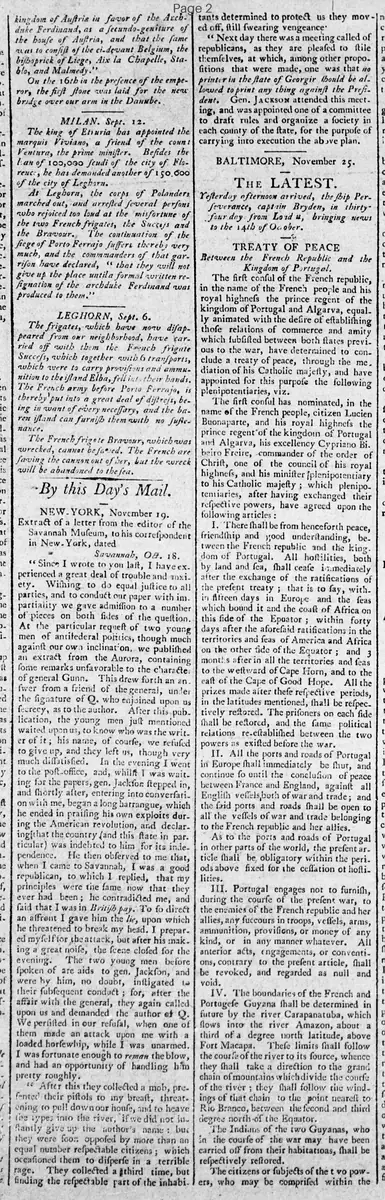
NEW-YORK, November 19.
Extract of a letter from the editor of the Savannah Museum, to his correspondent in New-York, dated Savannah, Oct. 18.
"Since I wrote to you last, I have experienced a great deal of trouble and anxiety. Wishing to do equal justice to all parties, and to conduct our paper with impartiality we gave admission to a number of pieces on both sides of the question. At the particular request of two young men of antifederal politics, though much against our own inclination, we published an extract from the Aurora, containing some remarks unfavorable to the character of general Gunn. This drew forth an answer from a friend of the general, under the signature of Q. who enjoined upon us secrecy, as to the author. After this publication, the young men just mentioned waited upon us, to know who was the writer of it; his name, of course, we refused to give up, and they left us, though very much dissatisfied. In the evening I went to the post-office, and, whilst I was waiting for the papers, gen. Jackson stepped in, and shortly after, entering into conversation with me, began a long harangue, which he ended in praising his own exploits during the American revolution, and declaring that the country (and this state in particular) was indebted to him for its independence. He then observed to me that, when I came to Savannah, I was a good republican, to which I replied, that my principles were the same now that they ever had been; he contradicted me, and said that I was in British pay. To so direct an affront I gave him the lie, upon which he threatened to break my head. I prepared myself for the attack, but after his making a great noise, the scene closed for the evening. The two young men before spoken of are aids to gen. Jackson, and were by him, no doubt, instigated to their subsequent conduct; for, after the affair with the general, they again called upon us and demanded the author of Q. We persisted in our refusal, when one of them made an attack upon me with a loaded horsewhip, while I was unarmed. I was fortunate enough to receive the blow, and had an opportunity of handling him pretty roughly.
"After this they collected a mob, presented their pistols to my breast, threatening to pull down our house, and to heave the types into the river, if we did not instantly give up the author's name: but they were soon opposed by more than an equal number respectable citizens: which occasioned them to disperse in a terrible rage. They collected a third time, but finding the respectable part of the inhabitants determined to protect us they moved off, till swearing vengeance:
"Next day there was a meeting called of republicans, as they are pleased to style themselves, at which, among other propositions that were made, one was that no printer in the state of Georgia should be allowed to print any thing against the President. Gen. Jackson attended this meeting, and was appointed one of a committee to draft rules and organize a society in each county of the state, for the purpose of carrying into execution the above plan."
What sub-type of article is it?
What keywords are associated?
What entities or persons were involved?
Where did it happen?
Domestic News Details
Primary Location
Savannah
Event Date
Oct. 18
Key Persons
Outcome
assault with horsewhip on editor; mob threats dispersed by citizens; republican meeting proposes restrictions on printing against the president; gen. jackson appointed to committee.
Event Details
Savannah Museum editor publishes anti-Federalist extract criticizing Gen. Gunn at request of two young men (aides to Gen. Jackson); receives response from 'Q' whose authorship is kept secret; aides demand name and assault editor with whip after refusal; Gen. Jackson confronts editor at post-office, accuses him of British pay, threatens violence; mob twice threatens to destroy press but is opposed by citizens; next day, republican meeting calls for no printing against President, organizes county societies.