Thank you for visiting SNEWPapers!
Sign up free
The Morning Star And Catholic Messenger
New Orleans, Orleans County, Louisiana
What is this article about?
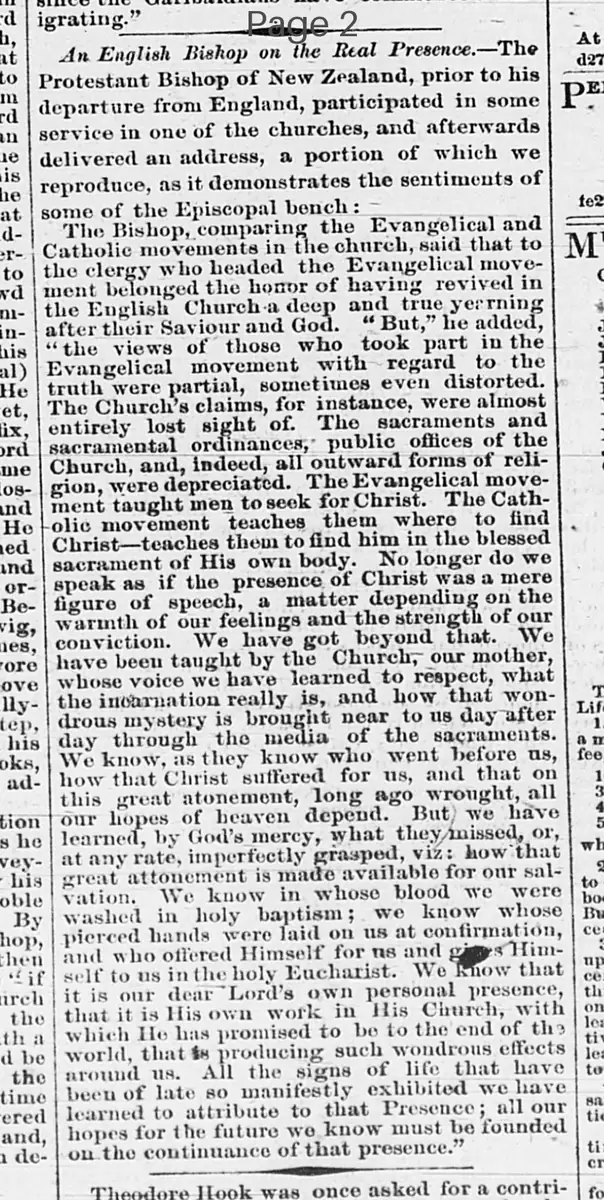
The Protestant Bishop of New Zealand, before leaving England, addressed a church service, contrasting Evangelical and Catholic movements. He praised Evangelicals for reviving yearning for Christ but criticized their partial views on sacraments. He emphasized finding Christ in the Eucharist as His real presence, central to salvation through Church ordinances.
Clipping
OCR Quality
Full Text
The Bishop, comparing the Evangelical and Catholic movements in the church, said that to the clergy who headed the Evangelical movement belonged the honor of having revived in the English Church a deep and true yearning after their Saviour and God. "But," he added, "the views of those who took part in the Evangelical movement with regard to the truth were partial, sometimes even distorted. The Church's claims, for instance, were almost entirely lost sight of. The sacraments and sacramental ordinances, public offices of the Church, and, indeed, all outward forms of religion, were depreciated. The Evangelical movement taught men to seek for Christ. The Catholic movement teaches them where to find Christ--teaches them to find him in the blessed sacrament of His own body. No longer do we speak as if the presence of Christ was a mere figure of speech, a matter depending on the warmth of our feelings and the strength of our conviction. We have got beyond that. We have been taught by the Church, our mother, whose voice we have learned to respect, what the incarnation really is, and how that wondrous mystery is brought near to us day after day through the media of the sacraments. We know, as they know who went before us, how that Christ suffered for us, and that on this great atonement, long ago wrought, all our hopes of heaven depend. But we have learned, by God's mercy, what they missed, or, at any rate, imperfectly grasped, viz: how that great atonement is made available for our salvation. We know in whose blood we were washed in holy baptism; we know whose pierced hands were laid on us at confirmation, and who offered Himself for us and gives Himself to us in the holy Eucharist. We know that it is our dear Lord's own personal presence, that it is His own work in His Church, with which He has promised to be to the end of the world, that is producing such wondrous effects around us. All the signs of life that have been of late so manifestly exhibited we have learned to attribute to that Presence; all our hopes for the future we know must be founded on the continuance of that presence."
What sub-type of article is it?
What themes does it cover?
What keywords are associated?
What entities or persons were involved?
Where did it happen?
Story Details
Key Persons
Location
One Of The Churches In England
Event Date
Prior To His Departure From England
Story Details
The Bishop contrasts Evangelical and Catholic movements, crediting Evangelicals with reviving devotion to Christ but faulting them for undervaluing sacraments. He asserts the Catholic view that Christ is truly present in the Eucharist, making atonement accessible through baptism, confirmation, and Holy Communion.