Thank you for visiting SNEWPapers!
Sign up free
Story
July 4, 1865
Daily Richmond Whig
Richmond, Virginia
What is this article about?
An 1865 Richmond Whig editorial argues that emancipated negroes in America will become a nuisance like England's freed white serfs, who descended into pauperism and crime, advocating separate governance codes for them to prevent social degradation.
Clipping
OCR Quality
95%
Excellent
Full Text
RICHMOND WHIG.
TUESDAY MORNING......JULY 4, 1865.
Effects of Emancipation of English Serfs.
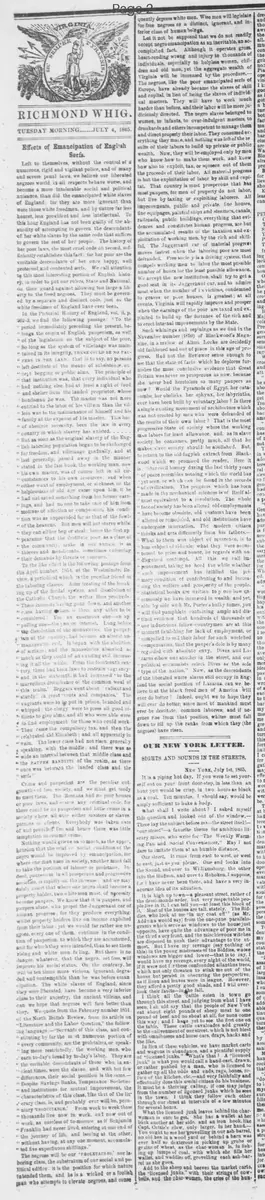
Left to themselves, without the control of a numerous, rigid and vigilant police, and of many and severe penal laws, we believe our liberated negroes would in all respects behave worse, and become a more intolerable social and political nuisance, than did the emancipated white slaves of England. For they are more ignorant than were those white freedmen, and by nature far less honest, less provident and less intellectual. To this hour England has not been guilty of the absurdity of attempting to govern the descendants of her white slaves by the same code that suffices to govern the rest of her people. The history of her poor laws, the most cruel code on record, sufficiently establishes this fact; for her poor are the veritable descendants of her once happy, well protected and contented serfs. We call attention to this most interesting portion of English history in order to put our rulers, State and National, on their guard against allowing too large a liberty to the freed negroes. They must be governed by a separate and distinct code just as the white freedmen of England have ever been.
In the Pictorial History of England, vol. ii. p. 262-3, we find the following passage: To the period immediately preceding the present, belongs the origin of English pauperism, as well as of the legislation on the subject of the poor. So long as the system of villeinage was maintained in its integrity, THERE COULD BE NO PAUPERS IN THE LAND; that is to say, no persons left destitute of the means of subsistence except begging or public alms. The principle of that institution was, that every individual who had nothing else had at least a right to food and shelter from the landed proprietor, whose bondsman he was. The master was not more entitled to the labor of his villein than the villein was to the maintenance of himself and his family at the expense of his master. This has, of absolute necessity, been the law in every country in which slavery has existed.
But as soon as the original slavery of the English laboring population began to be exchanged for freedom, and villeinage gradually, and at last generally, passed away in the manner stated in the last book, the working man now his own master, was of course left in all circumstances to his own resources; and when either want of employment or sickness, or the helplessness of old age came upon him, if he had not saved something from his former earnings, and had no one to take care of him from motives of affection or compassion, his condition was as unprovided for as that of the fowls of the heavens. But men will not starve whilst they can either beg or steal; hence the first appearance that the destitute poor as a class of the community make in our annals is as thieves and mendicants sometimes enforcing their demands by threats or violence.
To the like effect is the following passage from the April number, 1851, of the Westminster Review, a periodical which is the peculiar friend of the laboring classes. After treating of the breaking up of the feudal system, and dissolution of the Catholic Church, the writer thus proceeds: These interesting changes gone down, and another class having arisen then any other to be considered. Yes; an enormous one—an appalling one—the pauper or vagrant. Long before the dissolution of the monasteries the pauper throng of the country had become an almost unmanageable crowd. It began with the abolition of villeinage; and the monasteries absorbed as much as they could of an existing evil increasing it all the while. From the seventeenth century there had been laws to restrain vagrancy, and in the sixteenth, it had increased to the marvellous disturbance of the common weal of this realm. Beggars went about valiant and sturdy, in great 'routs and companies.' The vagrants were to be put in prison, branded and whipped; the clergy were to press all good citizens to give alms; and all who were able were to find employment for those who could work. Then came the compulsory tax, and then the celebrated 43d Elizabeth—and all apparently in vain. The lower class had not risen generally speaking, with the middle; and there was as wide an interval between that middle class and THE PAUPER BANDITTI OF THE REALM, as there once was between the landed class and the serfs.
Crime and pauperism are the peculiar outgrowths of free society, and we must get ready to meet them. The Romans had no poor houses or poor laws, and scarcely any criminal code; for there could be no pauperism and little crime in a society where all were either masters or slaves, patrons or clients. Everybody was taken care of and provided for, and hence there was little temptation to commit crime.
We mention that the recent social condition of the negro would be improved by emancipation, for indeed, paupers in all prosperous and progressive societies are compelled to take the position of laborer or proletarie. Indeed, where one man rises in society, another must fall; and we may safely assert that where one negro shall become a property holder, two white men must of necessity become paupers. We know that it is paupers, and paupers alone, who propel the Juggernaut car of human progress, for they produce everything whilst property holders live on income exploited from their labor; yet we would far rather see negroes, every one of them, continue in the condition of pauperism, to which they are accustomed, and for which they were intended, than to see them rising and white men falling. But there is no danger, whatever, that the negro, set free, will improve his social status. On the contrary, he will be ten times more vicious, ignorant, degraded and contemptible than he was before emancipation. The white slaves of England, since they were liberated, have become a very inferior class to their ancestry, the ancient villeins, and can we hope that negroes will fare better than they. We quote from the February number 1851 of the North British Review, from its article on 'Literature and the Labor Question,' the following language: Servants of this class, and constituting by far the most numerous portion of every community, are the proletaries, or speaking more restrictedly, the working men, who earn to-day's bread by to-day's labor. They are the veritable descendants of those who, in ancient times, were the slaves, and with but few differences, their social position is the same. Despite Savings Banks, Temperance Societies and institutions for mutual improvement, the characteristics of this class, like that of the literary class, is, and probably ever will be, pecuniary insouciance. From week to week these thousands live now in work, and now out of work, as careless of to-morrow as if Benjamin Franklin had never lived, entering at one end of the journey of life, and issuing at the other, without having, at any one moment, accumulated five superfluous shillings.
The negroes will be our 'Proletaries,' our laboring class, the substratum of our social and political edifice. It is the position for which nature intended them, and he is a wicked or a foolish man who attempts to elevate negroes, and consequently depress white men. Wise men will legislate for free negroes as a distinct, ignorant, and inferior class of human beings. Let it not be supposed that we do not readily accept negro emancipation as an inevitable, an accomplished fact. Although it operates grossly heart-rending wrong and injury to thousands of individuals, especially to helpless women, children and old men, yet the aggregate wealth of Virginia will be increased by the procedure. The negroes, like the poor emancipated serfs of Europe, have already become the slaves of skill and capital, in lieu of being the slaves of individual masters. They will have to work much harder than before, and their labor will be more judiciously directed. The negro slaves belonged to women, to infants, to over-indulgent masters, to drunkards and others incompetent to manage them and direct properly their labor. They consumed everything they made, and nothing was left of the results of their labors to build up private or public wealth. Now, they will be employed only by men who know how to make them work, and know how also to exploit, tax, or squeeze out of them the proceeds of their labor. All material progress is but the exploitation of labor by skill and capital. That country is most prosperous that has most paupers, for men of property do not labor, but live by taxing or exploiting laborers. All improvements, public and private, fine houses, fine equipages, palatial ships and steamers, canals, railroads, public buildings, everything that evidences and constitutes human progress, are but the accumulated results of the taxation and exploitation of working men, by the rich and skillful. The Juggernaut car of material progress moves fastest when the laboring poor are most defrauded. Free society is a driving system, that compels working men to labor the most possible number of hours for the least possible allowance. We accept the new institution, shall try to get a good seat in its Juggernaut car, and to admire most when the number of its victims, condemned to graves or poor houses, is greatest; at all events, Virginia will rapidly improve and prosper when the earnings of the poor are taxed and exploited to build up the fortunes of the rich and to erect internal improvements by the State.
Such whining and repinings as we find in the November number (1850) of Blackwood's Magazine, in a review of Alton Locke, are decidedly old fashioned and out of place in this age of progress. Had not the Reviewer sense enough to see that the state of facts which he deplores furnishes the most conclusive evidence that Great Britain was never so prosperous as now, because she never had heretofore so many paupers as now? Would the Pyramids of Egypt, her catacombs, her obelisks, her sphynx, her labyrinths, ever have been built by voluntary labor? Is there a single existing monument of architecture which was not erected by men who were defrauded of the results of their own labor? That is the most progressive State of society where the working man labors for least allowance, and, as in slave society he consumes, pretty much, all that he makes save society should be abolished. But, to return to the old fogyish extract from Blackwood which we promised the reader. Here it is: Our civil history during the last thirty years of peace resembles nothing which the world has yet seen or which can be found in the records of civilization. The progress which has been made in the mechanical sciences is of itself almost equivalent to a revolution. The whole face of society has been altered; old employments have become obsolete, old customs have been altered or remodelled, and old institutions have undergone innovation. The modern citizen thinks and acts differently from his fathers. What to them was object of reverence, is to him subject of ridicule; what they were accustomed to prize and honor, he regards with undisguised contempt. All this we call improvement, taking no heed the while whether such improvement has fulfilled the primary condition of contributing to and increasing the welfare and prosperity of the people. Statistical books are written to prove how enormously we have increased in wealth; and yet, side by side with Mr. Porter's bulky tomes, you will find pamphlets containing ample and distinct evidence that hundreds of thousands of our industrious fellow-countrymen are at this moment famishing for lack of employment, or compelled to sell their labor for such wretched compensation, that the pauper's dole is by many regarded with absolute envy. Dives and Lazarus elbow one another in the street, and our political economists select Dives as the sole 'type of the nation.' Now, as the descendants of the liberated white slaves still occupy in England the social position of Lazarus, can we believe that the black freedmen of America will ever do better? Indeed, ought we to hope they will ever do better; since most of mankind must ever be destitute, common laborers; and if negroes rise from that position, whites must fall down to fill up the ranks from which they (the negroes) have risen.
TUESDAY MORNING......JULY 4, 1865.
Effects of Emancipation of English Serfs.
Left to themselves, without the control of a numerous, rigid and vigilant police, and of many and severe penal laws, we believe our liberated negroes would in all respects behave worse, and become a more intolerable social and political nuisance, than did the emancipated white slaves of England. For they are more ignorant than were those white freedmen, and by nature far less honest, less provident and less intellectual. To this hour England has not been guilty of the absurdity of attempting to govern the descendants of her white slaves by the same code that suffices to govern the rest of her people. The history of her poor laws, the most cruel code on record, sufficiently establishes this fact; for her poor are the veritable descendants of her once happy, well protected and contented serfs. We call attention to this most interesting portion of English history in order to put our rulers, State and National, on their guard against allowing too large a liberty to the freed negroes. They must be governed by a separate and distinct code just as the white freedmen of England have ever been.
In the Pictorial History of England, vol. ii. p. 262-3, we find the following passage: To the period immediately preceding the present, belongs the origin of English pauperism, as well as of the legislation on the subject of the poor. So long as the system of villeinage was maintained in its integrity, THERE COULD BE NO PAUPERS IN THE LAND; that is to say, no persons left destitute of the means of subsistence except begging or public alms. The principle of that institution was, that every individual who had nothing else had at least a right to food and shelter from the landed proprietor, whose bondsman he was. The master was not more entitled to the labor of his villein than the villein was to the maintenance of himself and his family at the expense of his master. This has, of absolute necessity, been the law in every country in which slavery has existed.
But as soon as the original slavery of the English laboring population began to be exchanged for freedom, and villeinage gradually, and at last generally, passed away in the manner stated in the last book, the working man now his own master, was of course left in all circumstances to his own resources; and when either want of employment or sickness, or the helplessness of old age came upon him, if he had not saved something from his former earnings, and had no one to take care of him from motives of affection or compassion, his condition was as unprovided for as that of the fowls of the heavens. But men will not starve whilst they can either beg or steal; hence the first appearance that the destitute poor as a class of the community make in our annals is as thieves and mendicants sometimes enforcing their demands by threats or violence.
To the like effect is the following passage from the April number, 1851, of the Westminster Review, a periodical which is the peculiar friend of the laboring classes. After treating of the breaking up of the feudal system, and dissolution of the Catholic Church, the writer thus proceeds: These interesting changes gone down, and another class having arisen then any other to be considered. Yes; an enormous one—an appalling one—the pauper or vagrant. Long before the dissolution of the monasteries the pauper throng of the country had become an almost unmanageable crowd. It began with the abolition of villeinage; and the monasteries absorbed as much as they could of an existing evil increasing it all the while. From the seventeenth century there had been laws to restrain vagrancy, and in the sixteenth, it had increased to the marvellous disturbance of the common weal of this realm. Beggars went about valiant and sturdy, in great 'routs and companies.' The vagrants were to be put in prison, branded and whipped; the clergy were to press all good citizens to give alms; and all who were able were to find employment for those who could work. Then came the compulsory tax, and then the celebrated 43d Elizabeth—and all apparently in vain. The lower class had not risen generally speaking, with the middle; and there was as wide an interval between that middle class and THE PAUPER BANDITTI OF THE REALM, as there once was between the landed class and the serfs.
Crime and pauperism are the peculiar outgrowths of free society, and we must get ready to meet them. The Romans had no poor houses or poor laws, and scarcely any criminal code; for there could be no pauperism and little crime in a society where all were either masters or slaves, patrons or clients. Everybody was taken care of and provided for, and hence there was little temptation to commit crime.
We mention that the recent social condition of the negro would be improved by emancipation, for indeed, paupers in all prosperous and progressive societies are compelled to take the position of laborer or proletarie. Indeed, where one man rises in society, another must fall; and we may safely assert that where one negro shall become a property holder, two white men must of necessity become paupers. We know that it is paupers, and paupers alone, who propel the Juggernaut car of human progress, for they produce everything whilst property holders live on income exploited from their labor; yet we would far rather see negroes, every one of them, continue in the condition of pauperism, to which they are accustomed, and for which they were intended, than to see them rising and white men falling. But there is no danger, whatever, that the negro, set free, will improve his social status. On the contrary, he will be ten times more vicious, ignorant, degraded and contemptible than he was before emancipation. The white slaves of England, since they were liberated, have become a very inferior class to their ancestry, the ancient villeins, and can we hope that negroes will fare better than they. We quote from the February number 1851 of the North British Review, from its article on 'Literature and the Labor Question,' the following language: Servants of this class, and constituting by far the most numerous portion of every community, are the proletaries, or speaking more restrictedly, the working men, who earn to-day's bread by to-day's labor. They are the veritable descendants of those who, in ancient times, were the slaves, and with but few differences, their social position is the same. Despite Savings Banks, Temperance Societies and institutions for mutual improvement, the characteristics of this class, like that of the literary class, is, and probably ever will be, pecuniary insouciance. From week to week these thousands live now in work, and now out of work, as careless of to-morrow as if Benjamin Franklin had never lived, entering at one end of the journey of life, and issuing at the other, without having, at any one moment, accumulated five superfluous shillings.
The negroes will be our 'Proletaries,' our laboring class, the substratum of our social and political edifice. It is the position for which nature intended them, and he is a wicked or a foolish man who attempts to elevate negroes, and consequently depress white men. Wise men will legislate for free negroes as a distinct, ignorant, and inferior class of human beings. Let it not be supposed that we do not readily accept negro emancipation as an inevitable, an accomplished fact. Although it operates grossly heart-rending wrong and injury to thousands of individuals, especially to helpless women, children and old men, yet the aggregate wealth of Virginia will be increased by the procedure. The negroes, like the poor emancipated serfs of Europe, have already become the slaves of skill and capital, in lieu of being the slaves of individual masters. They will have to work much harder than before, and their labor will be more judiciously directed. The negro slaves belonged to women, to infants, to over-indulgent masters, to drunkards and others incompetent to manage them and direct properly their labor. They consumed everything they made, and nothing was left of the results of their labors to build up private or public wealth. Now, they will be employed only by men who know how to make them work, and know how also to exploit, tax, or squeeze out of them the proceeds of their labor. All material progress is but the exploitation of labor by skill and capital. That country is most prosperous that has most paupers, for men of property do not labor, but live by taxing or exploiting laborers. All improvements, public and private, fine houses, fine equipages, palatial ships and steamers, canals, railroads, public buildings, everything that evidences and constitutes human progress, are but the accumulated results of the taxation and exploitation of working men, by the rich and skillful. The Juggernaut car of material progress moves fastest when the laboring poor are most defrauded. Free society is a driving system, that compels working men to labor the most possible number of hours for the least possible allowance. We accept the new institution, shall try to get a good seat in its Juggernaut car, and to admire most when the number of its victims, condemned to graves or poor houses, is greatest; at all events, Virginia will rapidly improve and prosper when the earnings of the poor are taxed and exploited to build up the fortunes of the rich and to erect internal improvements by the State.
Such whining and repinings as we find in the November number (1850) of Blackwood's Magazine, in a review of Alton Locke, are decidedly old fashioned and out of place in this age of progress. Had not the Reviewer sense enough to see that the state of facts which he deplores furnishes the most conclusive evidence that Great Britain was never so prosperous as now, because she never had heretofore so many paupers as now? Would the Pyramids of Egypt, her catacombs, her obelisks, her sphynx, her labyrinths, ever have been built by voluntary labor? Is there a single existing monument of architecture which was not erected by men who were defrauded of the results of their own labor? That is the most progressive State of society where the working man labors for least allowance, and, as in slave society he consumes, pretty much, all that he makes save society should be abolished. But, to return to the old fogyish extract from Blackwood which we promised the reader. Here it is: Our civil history during the last thirty years of peace resembles nothing which the world has yet seen or which can be found in the records of civilization. The progress which has been made in the mechanical sciences is of itself almost equivalent to a revolution. The whole face of society has been altered; old employments have become obsolete, old customs have been altered or remodelled, and old institutions have undergone innovation. The modern citizen thinks and acts differently from his fathers. What to them was object of reverence, is to him subject of ridicule; what they were accustomed to prize and honor, he regards with undisguised contempt. All this we call improvement, taking no heed the while whether such improvement has fulfilled the primary condition of contributing to and increasing the welfare and prosperity of the people. Statistical books are written to prove how enormously we have increased in wealth; and yet, side by side with Mr. Porter's bulky tomes, you will find pamphlets containing ample and distinct evidence that hundreds of thousands of our industrious fellow-countrymen are at this moment famishing for lack of employment, or compelled to sell their labor for such wretched compensation, that the pauper's dole is by many regarded with absolute envy. Dives and Lazarus elbow one another in the street, and our political economists select Dives as the sole 'type of the nation.' Now, as the descendants of the liberated white slaves still occupy in England the social position of Lazarus, can we believe that the black freedmen of America will ever do better? Indeed, ought we to hope they will ever do better; since most of mankind must ever be destitute, common laborers; and if negroes rise from that position, whites must fall down to fill up the ranks from which they (the negroes) have risen.
What sub-type of article is it?
Historical Event
What themes does it cover?
Social Manners
Misfortune
Fortune Reversal
What keywords are associated?
Emancipation
English Serfs
Pauperism
Negroes
Social Degradation
Poor Laws
Labor Exploitation
Villeinage
Where did it happen?
England, Virginia
Story Details
Location
England, Virginia
Event Date
1865
Story Details
The article warns that freed negroes will degrade into pauperism and crime like England's emancipated serfs, advocating separate laws for them; it quotes historical sources on the rise of English pauperism post-villeinage and argues emancipation exploits labor for progress, benefiting Virginia's wealth despite individual harms.