Thank you for visiting SNEWPapers!
Sign up free
The Daily Worker
Chicago, Cook County, Illinois
What is this article about?
Analytical article on fascism's distinctions from military dictatorships and bourgeois democracy, emphasizing its use of mass organization, anti-capitalist rhetoric, demagogy, and terror to maintain finance capital's rule amid capitalist decline, posing dangers to the working class.
Clipping
OCR Quality
Full Text
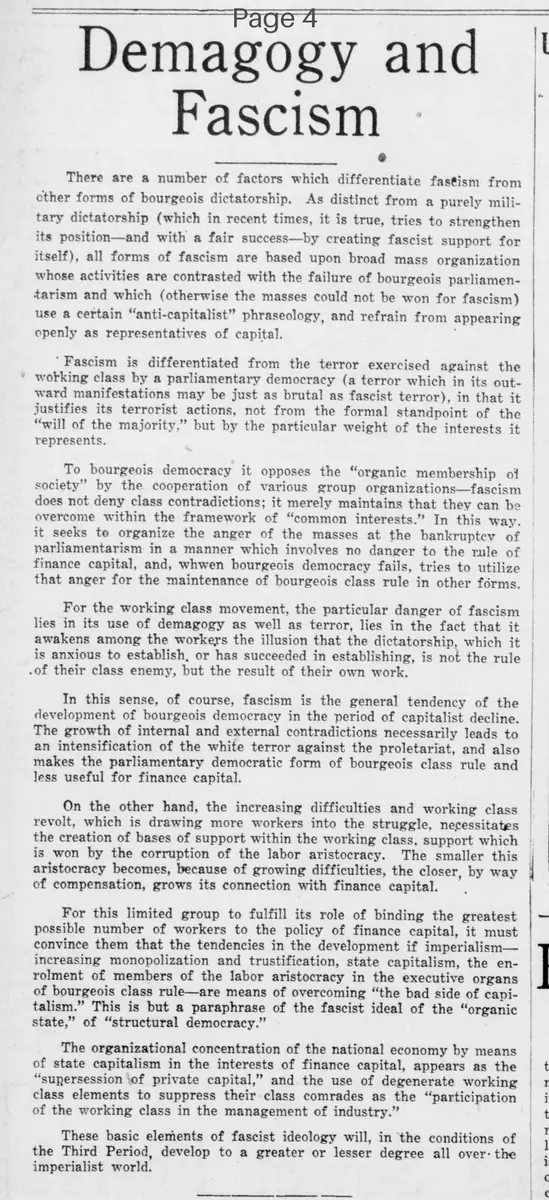
There are a number of factors which differentiate fascism from other forms of bourgeois dictatorship. As distinct from a purely military dictatorship (which in recent times, it is true, tries to strengthen its position—and with a fair success—by creating fascist support for itself), all forms of fascism are based upon broad mass organization whose activities are contrasted with the failure of bourgeois parliamentarism and which (otherwise the masses could not be won for fascism) use a certain "anti-capitalist" phraseology, and refrain from appearing openly as representatives of capital.
Fascism is differentiated from the terror exercised against the working class by a parliamentary democracy (a terror which in its outward manifestations may be just as brutal as fascist terror), in that it justifies its terrorist actions, not from the formal standpoint of the "will of the majority," but by the particular weight of the interests it represents.
To bourgeois democracy it opposes the "organic membership of society" by the cooperation of various group organizations—fascism does not deny class contradictions; it merely maintains that they can be overcome within the framework of "common interests." In this way, it seeks to organize the anger of the masses at the bankruptcy of parliamentarism in a manner which involves no danger to the rule of finance capital, and, when bourgeois democracy fails, tries to utilize that anger for the maintenance of bourgeois class rule in other forms.
For the working class movement, the particular danger of fascism lies in its use of demagogy as well as terror, lies in the fact that it awakens among the workers the illusion that the dictatorship, which it is anxious to establish, or has succeeded in establishing, is not the rule of their class enemy, but the result of their own work.
In this sense, of course, fascism is the general tendency of the development of bourgeois democracy in the period of capitalist decline. The growth of internal and external contradictions necessarily leads to an intensification of the white terror against the proletariat, and also makes the parliamentary democratic form of bourgeois class rule less useful for finance capital.
On the other hand, the increasing difficulties and working class revolt, which is drawing more workers into the struggle, necessitates the creation of bases of support within the working class, support which is won by the corruption of the labor aristocracy. The smaller this aristocracy becomes, because of growing difficulties, the closer, by way of compensation, grows its connection with finance capital.
For this limited group to fulfill its role of binding the greatest possible number of workers to the policy of finance capital, it must convince them that the tendencies in the development of imperialism—increasing monopolization and trustification, state capitalism, the enrolment of members of the labor aristocracy in the executive organs of bourgeois class rule—are means of overcoming "the bad side of capitalism." This is but a paraphrase of the fascist ideal of the "organic state," of "structural democracy."
The organizational concentration of the national economy by means of state capitalism in the interests of finance capital, appears as the "supersession of private capital," and the use of degenerate working class elements to suppress their class comrades as the "participation of the working class in the management of industry."
These basic elements of fascist ideology will, in the conditions of the Third Period, develop to a greater or lesser degree all over the imperialist world.
What sub-type of article is it?
What themes does it cover?
What keywords are associated?
Story Details
Story Details
The article differentiates fascism from military dictatorships and parliamentary terror by its mass organization, anti-capitalist rhetoric, and justification of terror through represented interests. It opposes bourgeois democracy with organic societal membership, organizes mass anger without threatening finance capital, and uses demagogy to illusion workers of their involvement in the dictatorship. Fascism emerges as a tendency in capitalist decline, intensifying terror and corrupting labor aristocracy to support imperialism's trends as overcoming capitalism's flaws, paralleling fascist ideals of organic state and structural democracy.