Thank you for visiting SNEWPapers!
Sign up free
Editorial
September 22, 1843
Holly Springs Gazette
Holly Springs, Marshall County, Mississippi
What is this article about?
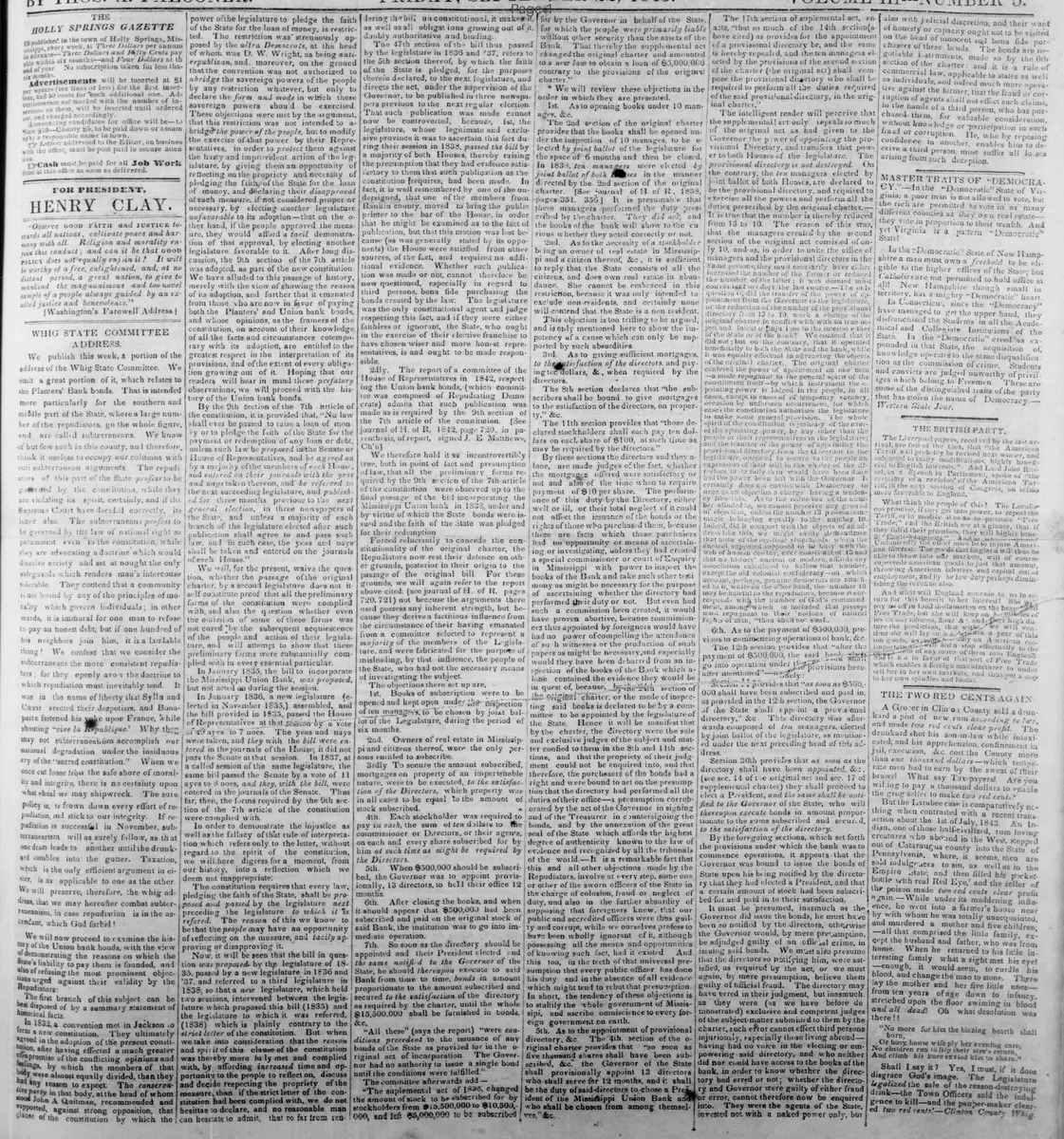
Editorial publishes and endorses Whig State Committee address opposing repudiation of Mississippi Union Bank bonds, detailing constitutional history from 1832-1838, refuting repudiators' claims on procedures, subscriptions, and state liability, warning of moral and societal dangers.
Clipping
OCR Quality
85%
Good
Full Text
WHIG STATE COMMITTEE
ADDRESS.
We publish this week, a portion of the address of the Whig State Committee. We omit a great portion of it, which relates to the Planters' Bank bonds. That is intended more particularly for the southern and middle part of the State, where a large number of the repudiators, go the whole figure, and are called subterraneans. We know of but few such in this county, and therefore think it useless to occupy our columns with anti-subterranean arguments. The repudiators of this part of the State profess to be governed by the constitution, while they are violating its spirit, certainly, and if the Supreme Court have decided correctly, its letter also. The subterraneans profess to be governed by the law of national right as paramount even to the constitution, while they are advocating a doctrine which would dissolve society and set at nought the only safeguards which renders man's intercourse tolerable. They contend that a community is not bound by any of the principles of morality which govern individuals: in other words, it is immoral for one man to refuse to pay an honest debt, but if one hundred of his neighbors join him, it is a laudable thing! We confess that we consider the subterraneans the more consistent repudiators, for they openly avow the doctrine to which repudiation must inevitably tend. It was in the name of liberty that Sylla and Cæsar erected their despotism, and Bonaparte fastened his yoke upon France, while shouting "Vive la Republique." Why then may not subterraneanism accomplish our national degradation under the insidious cry of the "sacred constitution." When we once cut loose from the safe shore of morality and integrity, there is no certainty upon what shoal we may shipwreck. The sure policy is, to frown down every effort of repudiation, and stick to our integrity. If repudiation is successful in November, subterraneanism will as surely follow, as that one dram leads to another until the drunkard tumbles into the gutter. Taxation, which is the only efficient argument in either, is as applicable to one as the other. We will preserve, therefore, the Whig address, that we may hereafter combat subterraneanism, in case repudiation is in the ascendant, which God forbid!
We will now proceed to examine the history of the Union bank bonds, with the view of demonstrating the reasons on which the State's liability to pay them is founded, and also of refuting the most prominent objections urged against their validity by the Repudiators.
The first branch of this subject can be best disposed of by a summary statement of historical facts.
In 1832, a convention met in Jackson to form a new constitution. They ultimately agreed in the adoption of the present constitution after having effected much greater compromise of the conflicting opinions and feelings, by which the members of that body were almost equally divided, than they had any reason to expect. The conservative party in that body, at the head of whom stood John A. Quitman, recommended and supported, against strong opposition, that clause of the constitution by which the power of the legislature to pledge the faith of the State for the loan of money, is restricted. The restriction was strenuously opposed by the ultra Democrats, at the head of whom was D. W. Wright, as being anti-republican, and moreover, on the ground that the convention was not authorized to abridge the sovereign powers of the people by any restriction whatever, but only to declare the form and mode in which these sovereign powers should be exercised. These objections were met by the argument, that this restriction was not intended to abridge the power of the people, but to modify the exercise of that power by their Representatives, in order to protect them against the hasty and improvident action of the legislature, by giving them an opportunity of reflecting on the propriety and necessity of pledging the faith of the State for the loan of money, and declaring their disapproval of such measure, if not considered proper or necessary, by electing another legislature unfavorable to its adoption—that on the other hand, if the people approved the measure, they would afford a tacit demonstration of that approval, by electing another legislature favorable to it. After long discussion, the 9th section of the 7th article was adopted as part of the new constitution.
We have alluded to this passage of history, merely with the view of showing the reason of its adoption, and further that it emanated from those who are now in favor of paying both the Planters' and Union bank bonds, and whose opinions, as the framers of the constitution, on account of their knowledge of all the facts and circumstances contemporary with its adoption, are entitled to the greatest respect in the interpretation of its provisions, and of the extent of every obligation growing out of it. Hoping that our readers will bear in mind these prefatory observations, we will proceed with the history of the Union bank bonds.
By the 9th section of the 7th article of the constitution, it is provided that, "No law shall ever be passed to raise a loan of money or to pledge the faith of the State for the payment or redemption of any loan or debt, unless such law be proposed in the Senate or House of Representatives, and be agreed on by a majority of the members of each House, and entered on their journals with the yeas and nays taken thereon, and be referred to the next succeeding legislature, and published for three months previous to the next general election, in three newspapers of the State, and unless a majority of each branch of the legislature elected after such publication shall agree to and pass such law, and in such case, the yeas and nays shall be taken and entered on the journals of each House."
We will, for the present, waive the question, whether the passage of the original charter, by a second legislature does not itself constitute proof that all the preliminary forms of the constitution were complied with, and also the question whether even the omission of some of these forms was not cured by the subsequent acquiescence of the people and action of their Legislature, and will attempt to show that these preliminary forms were substantially complied with in every essential particular.
In January 1835, the bill to incorporate the Mississippi Union Bank, was proposed, but not acted on during the session. In January 1836, a new legislature (elected in November 1835,) assembled, and the bill provided in 1835, passed the House of Representatives at that session by a vote of 48 ayes to 7 noes. The yeas and nays were taken, and they with the bill were entered in the journals of the House; it did not pass the Senate at that session. In 1837, at a called session of the same legislature, the same bill passed the Senate by a vote of 11 ayes to 8 noes, and they, with the bill, were entered in the journals of the Senate. Thus far, then, the forms required by the 9th section of the 7th article of the constitution were complied with.
In order to demonstrate the injustice as well as the fallacy of that rule of interpretation which refers only to the letter, without regard to the spirit of the constitution, we will here digress for a moment from our history, into a reflection which we deem not inappropriate.
The constitution requires that every law, pledging the faith of the State, shall be proposed and passed by the legislature next preceding the legislature to which it is referred. The reason of this we know to be that the people may have an opportunity of reflecting on the measure, and tacitly approving or disapproving it. Now, it will be seen that the bill in question was proposed by the legislature of 1835, passed by a new legislature in 1836 and '37, and referred to a third legislature in 1838; so that a new legislature, which held two sessions, intervened between the legislature which proposed this bill (1835) and the legislature to which it was referred (1838) which is plainly contrary to the strict letter of the constitution. But when we take into consideration that the reason and spirit of this clause of the constitution was thereby more fully met and complied with, by affording increased time and opportunity to the people to reflect on, discuss and decide respecting the propriety of the measure, than if the strict letter of the constitution had been complied with, we do not hesitate to declare, and no reasonable man can hesitate to admit, that so far from rendering the bill unconstitutional, it makes it, as well as all obligations growing out of it, doubly authoritative and binding.
The 47th section of the bill thus passed by the legislature in 1836 and '37, refers to the 5th section thereof, by which the faith of the State is pledged, for the purposes therein declared, to the next legislature, and directs the act, under the supervision of the Governor, to be published in three newspapers previous to the next regular election. That such publication was made cannot now be controverted, because, 1st, the legislature, whose legitimate and exclusive province it was to ascertain this fact during their session in 1838, passed the bill by a majority of both Houses, thereby raising the presumption that they had evidence satisfactory to them that such publication as the constitution requires, had been made. In fact, it is well remembered by one of the undersigned, that one of the members from Rankin county, moved to bring the public printer to the bar of the House, in order that he might be examined as to the fact of publication, but that this motion was lost because (as was generally stated by its opponents) the House were satisfied from other sources, of the fact, and required no additional evidence. Whether such publication was made or not, cannot therefore be now questioned, especially in regard to third persons, bona fide purchasing the bonds created by the law: The legislature was the only constitutional agent and judge respecting this fact, and if they were either faithless or ignorant, the State, who ought in the exercise of their elective franchise to have chosen wiser and more honest representatives, is and ought to be made responsible.
2dly. The report of a committee of the House of Representatives in 1842, respecting the Union bank bonds, (which committee was composed of Repudiating Democrats) admits that such publication was made as is required by the 9th section of the 7th article of the constitution. [See journal of H. of R, 1842, page 720, in parenthesis, of report, signed J. E. Matthews, Ch'n]
We therefore hold it as incontrovertibly true, both in point of fact and presumption of law, that all the preliminary forms required by the 9th section of the 7th article of the constitution were observed up to the final passage of the bill incorporating the Mississippi Union bank in 1838, under and by virtue of which the State bonds were issued and the faith of the state was pledged for their redemption.
Forced reluctantly to concede the constitutionality of the original charter, the Repudiators now rest their defence on other grounds, posterior in their origin to the passage of the original bill. For these grounds, we will again refer to the report above cited: (see journal of H. of R. pages 720,721) not because the arguments there used possess any inherent strength, but because they derive a factitious influence from the circumstance of their having emanated from a committee selected to represent a majority of the members of the Legislature, and were fabricated for the purpose of misleading, by that influence, the people of the State, who had not the necessary means of investigating the subject.
The objections there set up are,
1st, Books of subscription were to be opened and kept open under the inspection of ten managers, to be chosen by joint ballot of the Legislature, during the period of six months.
2d. Owners of real estate in Mississippi and citizens thereof, were the only persons entitled to subscribe.
3dly. To secure the amount subscribed, mortgages on property of an imperishable nature, were to be executed, to the satisfaction of the Directors, which property was in all cases to be equal to the amount of stock subscribed.
4th. Each stockholder was required to pay in cash, the sum of ten dollars to the commissioner or Directors, or their agents, on each and every share subscribed for by him at such time as might be required by the Directors.
5th. When $500,000 should be subscribed, the Governor was to appoint provisionally, 13 directors, to hold their office 12 months.
6th. After closing the books, and when it should appear that $500,000 had been subscribed and paid on the original stock of said Bank, the institution was to go into immediate operation.
7th. So soon as the directory should be appointed and their President elected and the same notified to the Governor of the State, he should thereupon execute to said Bank from time to time, bonds in amount proportionate to the amount subscribed and secured to the satisfaction of the directory as required by the charter, until the whole $5,000,000 shall be furnished in bonds, &c.
"All these" (says the report) "were conditions precedent to the issuance of any bonds of the State as provided for in the original act of incorporation. The Governor had no authority to issue a single bond until the conditions were fulfilled."
The committee afterwards add—"The supplemental act of 1838, changed the amount of stock to be subscribed for by stockholders from $5,000,000 to $500,000, and left $5,000,000 to be subscribed for by the Governor in behalf of the State, for which the people were primarily liable without other security than the assets of the Bank. That thereby the supplemental act changed the original charter and amounted to a new law to obtain a loan of $5,000,000 contrary to the provisions of the original charter."
* We will review these objections in the order in which they are presented.
Ist. As to opening books under 10 managers, &c.
The 2nd section of the original charter provides that the books shall be opened under the inspection of 10 managers, to be elected by joint ballot of the legislature for the space of 6 months and then be closed. In 1838, ten managers were elected by joint ballot of both Houses in the manner directed by the 2nd section of the original charter. [See journal of H of R. 1838, pages 351, 356] It is presumable that these managers performed the duty prescribed by the charter. They did act; and the books of the bank will show to the curious whether they acted correctly or not.
2nd. As to the necessity of a stockholder being an owner of real estate in Mississippi and a citizen thereof. &c, it is sufficient to reply that the State consists of all the citizens, and does own real estate in abundance. She cannot be embraced in this restriction, because it was only intended to exclude non-residents, and certainly none will contend that the State is a non-resident. This objection is too trifling to be argued, and is only mentioned here to show the impotency of a cause which can only be supported by such absurdities.
3rd. As to giving sufficient mortgages, to the satisfaction of the directors, and paying ten dollars, &c, when required by the directors.
The 5th section declares that "the subscribers shall be bound to give mortgages to the satisfaction of the directors, on property," &c.
The 11th section provides that "those declared stockholders shall each pay ten dollars on each share of $100, at such time as may be required by the directors."
By these sections the directors and they alone, are made judges of the fact, whether the mortgages offered were satisfactory or not and also of the time when to require payment of $10 per share. The performance of this duty by the Directory, either well or ill, or their total neglect of it could not affect the issuance of the bonds or the rights of those who purchased them, because these are facts which these purchasers had no opportunity or means of ascertaining or investigating, unless they had created a special commissioner or court of Enquiry in Mississippi with power to inspect the books of the Bank and take such other testimony as might be necessary for the purpose of ascertaining whether the directory had performed their duty or not. But even had such a commission been created, it would have proven abortive, because commissioners thus appointed by foreigners would have had no power of compelling the attendance of such witnesses or the production of such papers as might be necessary, and especially would they have been debarred from an inspection of the books of the Bank which alone contained the evidence they would be in quest of, because, by the 24th section of the original charter, the mode of inspecting said books is declared to be by a committee to be appointed by the legislature of the State. Hence it will be manifest that by the charter, the directory were the sole and exclusive judges of the subject and matter confided to them in the 5th and 11th sections, and that the propriety of their judgment could not be enquired into, and that therefore, the purchasers of the bonds had a right and were bound to act on the presumption that the directory had performed all the duties of their office—a presumption corroborated by the act of the Governor in signing and of the Treasurer in countersigning the bonds, and by the annexation of the great seal of the State which affords the highest degree of authenticity known to the law of evidence and recognized by all the tribunals of the world. It is a remarkable fact that this and all other objections made by the Repudiators, involve at every step, some one or other of the sworn officers of the State in the charge of collusion, fraud or neglect of duty, and also in the further absurdity of supposing that foreigners knew, that our public and accredited officers were thus guilty and corrupt, while we ourselves profess to have been wholly ignorant of it, although possessing all the means and opportunities of knowing such fact, had it existed. And this too, in the teeth of that universal presumption that every public officer has done his duty and in the absence of all evidence which might tend to rebut that presumption. In short, the tendency of these objections is to stultify the whole government of Mississippi, and ascribe omniscience to every foreign government on earth.
5th. As to the appointment of provisional directory. &c. The 4th. section of the original charter provides that "so soon as five thousand shares shall have been subscribed, &c. the Governor of the State shall provisionally appoint 13 directors who shall serve for 12 months. and it shall be the duty of said directors to chose a President of the Mississippi Union Bank and who shall be chosen from among themselves,"&c.
e.
The 17th section of supplemental act, enacts. "that so much of the 14th section (above cited) as provides for the appointment of a provisional directory be, and the same is hereby repealed, and the ten managers elected by the provisions of the second section of the charter (the original act) shall compose the provisional directory who shall be required to perform all the duties required of the said provisional directory, in the original charter."
The intelligent reader will perceive that the supplemental act only repeals so much of the original act as had given to the Governor the power of appointing the provisional Directory, and transfers that power to both Houses of the legislature. The provisional directory is not destroyed. On the contrary, the ten managers elected by joint ballot of both Houses, are declared to be the provisional directory, and required to exercise all the powers and perform all the duties prescribed by the original charter. It is true that the number is thereby reduced from 13 to 10. The reason of this was, that the managers created by the second section of the original act consisted of only 10, and as, in order to unite the office of managers and the provisional directors in the same persons, they must necessarily have either increased the number of the former or reduced the number of the latter; it was deemed most convenient to adopt the last course. The only question is, did the transfer of the power of appointment from the Governor to the legislature, or the reduction of the number of the provisional directory from 13 to 10, work a change of the original charter in conflict with its true object and intent or injurious to the interest either of the State or of the bank? We contend that it did not; but on the contrary, that it operated beneficially to both the State and the bank, while it was equally effectual in advancing the objects of the original charter. The original charter conferred the power of appointment on one man—a mode repugnant to the general spirit of the constitution itself—by which instrument the appointing power is lodged in the people, in all cases, except in cases of temporary vacancy, occasioned by unforeseen occurrences, for which cases the constitution authorizes the legislature to make some general provision. The whole spirit of the constitution is jealousy of the exercise of the appointing power, by any other than the people or their representatives in the legislature; and the transfer of the power of appointing the provisional directory from the Governor to the legislature, operated to secure to the people an expression of their will in the choice of the directors more fully than would have been done had the power been left with the Governor. It certainly does not consist with Democracy to urge as an objection a change having a tendency like this. As to the reduction of the number alluded to, we cannot perceive any ground of objection, unless the number 13 possesses some magic belonging equally to the number 10. Indeed, did it comport with the objects of an address like this, we might easily demonstrate that none of the mystical sisterhoods whom the ancient supposed to be busy with the web of human destiny, ever consisted of 13 and that no history ancient or modern, affords any association calculated to hallow that number, except the old colonial confederacy—on which account, perhaps, genuine democrats are attached to it, while on the other hand, the number 10 may be hateful to the repudiators, because it corresponds with the number of God's commandments, among which is included that precept most repugnant to their notions of natural rights of man, "thou shalt not steal."
6th. As to the payment of $500,000, previous to commencing operations of bank, &c.
The 12th section provides that "after the payment of $500,000, the said bank shall go into operation under the provisions here mentioned"—unless provisions here.
Section 6 provides that "as soon as $500,000 shall have been subscribed and paid in, as provided in the 12th section, the Governor of the State shall appoint a provisional directory," &c. This directory was afterwards composed of ten managers, elected by joint ballot of the legislature, as mentioned under the next preceding head of this address.
Section 30th provides that as soon as the directory shall have been appointed, &c. (see sec. 14 of the original act and sec. 17 of supplemental charter) they shall proceed to elect a President, and the same shall be notified to the Governor of the State, who will thereupon execute bonds in amount proportionate to the sums subscribed and secured to the satisfaction of the directory.
By the foregoing sections, which set forth the provisions under which the bank was to commence operations, it appears that the Governor was bound to issue the bonds of State upon his being notified by the directory that they had elected a President, and that a certain amount of stock had been subscribed for and paid in to their satisfaction. It must be presumed, inasmuch as the Governor did issue the bonds, he must have been so notified by the directors, otherwise the Governor would, by mere presumption, be adjudged guilty of an official crime, in issuing said bonds. We must also presume that the directors so notifying him, were satisfied, as required by the act, or we must again, by mere presumption, believe them guilty of official fraud. The directory may have erred in their judgment, but inasmuch as they were (as we have before demonstrated) exclusive and competent judges of the subject-matter submitted to them by the charter, such error cannot affect third persons injuriously, especially those living abroad—having had no voice in the electing or empowering said directory, and who neither did nor could have access to the books of the bank, in order to know whether the directory had erred or not; whether the directory and Governor were guilty of either fraud or error, cannot therefore now be enquired into. They were the agents of the State, invested not with a naked power only, but also with judicial discretion, and their want of honesty or capacity ought not to be visited on the head of innocent and bona fide purchasers of these bonds. The bonds are negotiable instruments, made so by the 6th section of the charter: and it is a rule of commercial law, applicable to states as well as individuals, and indeed much more operative against the former, that the fraud or corruption of agents shall not affect such claims, in the hands of a third person, who has purchased them, for valuable consideration, without knowledge or participation in such fraud or corruption. He, who by reposing confidence in another, enables him to deceive a third person, must suffer all losses arising from such deception.
en- (a- ent me el- on m- be ig ed nt ch he o- v- ne On oy to to e d d
ADDRESS.
We publish this week, a portion of the address of the Whig State Committee. We omit a great portion of it, which relates to the Planters' Bank bonds. That is intended more particularly for the southern and middle part of the State, where a large number of the repudiators, go the whole figure, and are called subterraneans. We know of but few such in this county, and therefore think it useless to occupy our columns with anti-subterranean arguments. The repudiators of this part of the State profess to be governed by the constitution, while they are violating its spirit, certainly, and if the Supreme Court have decided correctly, its letter also. The subterraneans profess to be governed by the law of national right as paramount even to the constitution, while they are advocating a doctrine which would dissolve society and set at nought the only safeguards which renders man's intercourse tolerable. They contend that a community is not bound by any of the principles of morality which govern individuals: in other words, it is immoral for one man to refuse to pay an honest debt, but if one hundred of his neighbors join him, it is a laudable thing! We confess that we consider the subterraneans the more consistent repudiators, for they openly avow the doctrine to which repudiation must inevitably tend. It was in the name of liberty that Sylla and Cæsar erected their despotism, and Bonaparte fastened his yoke upon France, while shouting "Vive la Republique." Why then may not subterraneanism accomplish our national degradation under the insidious cry of the "sacred constitution." When we once cut loose from the safe shore of morality and integrity, there is no certainty upon what shoal we may shipwreck. The sure policy is, to frown down every effort of repudiation, and stick to our integrity. If repudiation is successful in November, subterraneanism will as surely follow, as that one dram leads to another until the drunkard tumbles into the gutter. Taxation, which is the only efficient argument in either, is as applicable to one as the other. We will preserve, therefore, the Whig address, that we may hereafter combat subterraneanism, in case repudiation is in the ascendant, which God forbid!
We will now proceed to examine the history of the Union bank bonds, with the view of demonstrating the reasons on which the State's liability to pay them is founded, and also of refuting the most prominent objections urged against their validity by the Repudiators.
The first branch of this subject can be best disposed of by a summary statement of historical facts.
In 1832, a convention met in Jackson to form a new constitution. They ultimately agreed in the adoption of the present constitution after having effected much greater compromise of the conflicting opinions and feelings, by which the members of that body were almost equally divided, than they had any reason to expect. The conservative party in that body, at the head of whom stood John A. Quitman, recommended and supported, against strong opposition, that clause of the constitution by which the power of the legislature to pledge the faith of the State for the loan of money, is restricted. The restriction was strenuously opposed by the ultra Democrats, at the head of whom was D. W. Wright, as being anti-republican, and moreover, on the ground that the convention was not authorized to abridge the sovereign powers of the people by any restriction whatever, but only to declare the form and mode in which these sovereign powers should be exercised. These objections were met by the argument, that this restriction was not intended to abridge the power of the people, but to modify the exercise of that power by their Representatives, in order to protect them against the hasty and improvident action of the legislature, by giving them an opportunity of reflecting on the propriety and necessity of pledging the faith of the State for the loan of money, and declaring their disapproval of such measure, if not considered proper or necessary, by electing another legislature unfavorable to its adoption—that on the other hand, if the people approved the measure, they would afford a tacit demonstration of that approval, by electing another legislature favorable to it. After long discussion, the 9th section of the 7th article was adopted as part of the new constitution.
We have alluded to this passage of history, merely with the view of showing the reason of its adoption, and further that it emanated from those who are now in favor of paying both the Planters' and Union bank bonds, and whose opinions, as the framers of the constitution, on account of their knowledge of all the facts and circumstances contemporary with its adoption, are entitled to the greatest respect in the interpretation of its provisions, and of the extent of every obligation growing out of it. Hoping that our readers will bear in mind these prefatory observations, we will proceed with the history of the Union bank bonds.
By the 9th section of the 7th article of the constitution, it is provided that, "No law shall ever be passed to raise a loan of money or to pledge the faith of the State for the payment or redemption of any loan or debt, unless such law be proposed in the Senate or House of Representatives, and be agreed on by a majority of the members of each House, and entered on their journals with the yeas and nays taken thereon, and be referred to the next succeeding legislature, and published for three months previous to the next general election, in three newspapers of the State, and unless a majority of each branch of the legislature elected after such publication shall agree to and pass such law, and in such case, the yeas and nays shall be taken and entered on the journals of each House."
We will, for the present, waive the question, whether the passage of the original charter, by a second legislature does not itself constitute proof that all the preliminary forms of the constitution were complied with, and also the question whether even the omission of some of these forms was not cured by the subsequent acquiescence of the people and action of their Legislature, and will attempt to show that these preliminary forms were substantially complied with in every essential particular.
In January 1835, the bill to incorporate the Mississippi Union Bank, was proposed, but not acted on during the session. In January 1836, a new legislature (elected in November 1835,) assembled, and the bill provided in 1835, passed the House of Representatives at that session by a vote of 48 ayes to 7 noes. The yeas and nays were taken, and they with the bill were entered in the journals of the House; it did not pass the Senate at that session. In 1837, at a called session of the same legislature, the same bill passed the Senate by a vote of 11 ayes to 8 noes, and they, with the bill, were entered in the journals of the Senate. Thus far, then, the forms required by the 9th section of the 7th article of the constitution were complied with.
In order to demonstrate the injustice as well as the fallacy of that rule of interpretation which refers only to the letter, without regard to the spirit of the constitution, we will here digress for a moment from our history, into a reflection which we deem not inappropriate.
The constitution requires that every law, pledging the faith of the State, shall be proposed and passed by the legislature next preceding the legislature to which it is referred. The reason of this we know to be that the people may have an opportunity of reflecting on the measure, and tacitly approving or disapproving it. Now, it will be seen that the bill in question was proposed by the legislature of 1835, passed by a new legislature in 1836 and '37, and referred to a third legislature in 1838; so that a new legislature, which held two sessions, intervened between the legislature which proposed this bill (1835) and the legislature to which it was referred (1838) which is plainly contrary to the strict letter of the constitution. But when we take into consideration that the reason and spirit of this clause of the constitution was thereby more fully met and complied with, by affording increased time and opportunity to the people to reflect on, discuss and decide respecting the propriety of the measure, than if the strict letter of the constitution had been complied with, we do not hesitate to declare, and no reasonable man can hesitate to admit, that so far from rendering the bill unconstitutional, it makes it, as well as all obligations growing out of it, doubly authoritative and binding.
The 47th section of the bill thus passed by the legislature in 1836 and '37, refers to the 5th section thereof, by which the faith of the State is pledged, for the purposes therein declared, to the next legislature, and directs the act, under the supervision of the Governor, to be published in three newspapers previous to the next regular election. That such publication was made cannot now be controverted, because, 1st, the legislature, whose legitimate and exclusive province it was to ascertain this fact during their session in 1838, passed the bill by a majority of both Houses, thereby raising the presumption that they had evidence satisfactory to them that such publication as the constitution requires, had been made. In fact, it is well remembered by one of the undersigned, that one of the members from Rankin county, moved to bring the public printer to the bar of the House, in order that he might be examined as to the fact of publication, but that this motion was lost because (as was generally stated by its opponents) the House were satisfied from other sources, of the fact, and required no additional evidence. Whether such publication was made or not, cannot therefore be now questioned, especially in regard to third persons, bona fide purchasing the bonds created by the law: The legislature was the only constitutional agent and judge respecting this fact, and if they were either faithless or ignorant, the State, who ought in the exercise of their elective franchise to have chosen wiser and more honest representatives, is and ought to be made responsible.
2dly. The report of a committee of the House of Representatives in 1842, respecting the Union bank bonds, (which committee was composed of Repudiating Democrats) admits that such publication was made as is required by the 9th section of the 7th article of the constitution. [See journal of H. of R, 1842, page 720, in parenthesis, of report, signed J. E. Matthews, Ch'n]
We therefore hold it as incontrovertibly true, both in point of fact and presumption of law, that all the preliminary forms required by the 9th section of the 7th article of the constitution were observed up to the final passage of the bill incorporating the Mississippi Union bank in 1838, under and by virtue of which the State bonds were issued and the faith of the state was pledged for their redemption.
Forced reluctantly to concede the constitutionality of the original charter, the Repudiators now rest their defence on other grounds, posterior in their origin to the passage of the original bill. For these grounds, we will again refer to the report above cited: (see journal of H. of R. pages 720,721) not because the arguments there used possess any inherent strength, but because they derive a factitious influence from the circumstance of their having emanated from a committee selected to represent a majority of the members of the Legislature, and were fabricated for the purpose of misleading, by that influence, the people of the State, who had not the necessary means of investigating the subject.
The objections there set up are,
1st, Books of subscription were to be opened and kept open under the inspection of ten managers, to be chosen by joint ballot of the Legislature, during the period of six months.
2d. Owners of real estate in Mississippi and citizens thereof, were the only persons entitled to subscribe.
3dly. To secure the amount subscribed, mortgages on property of an imperishable nature, were to be executed, to the satisfaction of the Directors, which property was in all cases to be equal to the amount of stock subscribed.
4th. Each stockholder was required to pay in cash, the sum of ten dollars to the commissioner or Directors, or their agents, on each and every share subscribed for by him at such time as might be required by the Directors.
5th. When $500,000 should be subscribed, the Governor was to appoint provisionally, 13 directors, to hold their office 12 months.
6th. After closing the books, and when it should appear that $500,000 had been subscribed and paid on the original stock of said Bank, the institution was to go into immediate operation.
7th. So soon as the directory should be appointed and their President elected and the same notified to the Governor of the State, he should thereupon execute to said Bank from time to time, bonds in amount proportionate to the amount subscribed and secured to the satisfaction of the directory as required by the charter, until the whole $5,000,000 shall be furnished in bonds, &c.
"All these" (says the report) "were conditions precedent to the issuance of any bonds of the State as provided for in the original act of incorporation. The Governor had no authority to issue a single bond until the conditions were fulfilled."
The committee afterwards add—"The supplemental act of 1838, changed the amount of stock to be subscribed for by stockholders from $5,000,000 to $500,000, and left $5,000,000 to be subscribed for by the Governor in behalf of the State, for which the people were primarily liable without other security than the assets of the Bank. That thereby the supplemental act changed the original charter and amounted to a new law to obtain a loan of $5,000,000 contrary to the provisions of the original charter."
* We will review these objections in the order in which they are presented.
Ist. As to opening books under 10 managers, &c.
The 2nd section of the original charter provides that the books shall be opened under the inspection of 10 managers, to be elected by joint ballot of the legislature for the space of 6 months and then be closed. In 1838, ten managers were elected by joint ballot of both Houses in the manner directed by the 2nd section of the original charter. [See journal of H of R. 1838, pages 351, 356] It is presumable that these managers performed the duty prescribed by the charter. They did act; and the books of the bank will show to the curious whether they acted correctly or not.
2nd. As to the necessity of a stockholder being an owner of real estate in Mississippi and a citizen thereof. &c, it is sufficient to reply that the State consists of all the citizens, and does own real estate in abundance. She cannot be embraced in this restriction, because it was only intended to exclude non-residents, and certainly none will contend that the State is a non-resident. This objection is too trifling to be argued, and is only mentioned here to show the impotency of a cause which can only be supported by such absurdities.
3rd. As to giving sufficient mortgages, to the satisfaction of the directors, and paying ten dollars, &c, when required by the directors.
The 5th section declares that "the subscribers shall be bound to give mortgages to the satisfaction of the directors, on property," &c.
The 11th section provides that "those declared stockholders shall each pay ten dollars on each share of $100, at such time as may be required by the directors."
By these sections the directors and they alone, are made judges of the fact, whether the mortgages offered were satisfactory or not and also of the time when to require payment of $10 per share. The performance of this duty by the Directory, either well or ill, or their total neglect of it could not affect the issuance of the bonds or the rights of those who purchased them, because these are facts which these purchasers had no opportunity or means of ascertaining or investigating, unless they had created a special commissioner or court of Enquiry in Mississippi with power to inspect the books of the Bank and take such other testimony as might be necessary for the purpose of ascertaining whether the directory had performed their duty or not. But even had such a commission been created, it would have proven abortive, because commissioners thus appointed by foreigners would have had no power of compelling the attendance of such witnesses or the production of such papers as might be necessary, and especially would they have been debarred from an inspection of the books of the Bank which alone contained the evidence they would be in quest of, because, by the 24th section of the original charter, the mode of inspecting said books is declared to be by a committee to be appointed by the legislature of the State. Hence it will be manifest that by the charter, the directory were the sole and exclusive judges of the subject and matter confided to them in the 5th and 11th sections, and that the propriety of their judgment could not be enquired into, and that therefore, the purchasers of the bonds had a right and were bound to act on the presumption that the directory had performed all the duties of their office—a presumption corroborated by the act of the Governor in signing and of the Treasurer in countersigning the bonds, and by the annexation of the great seal of the State which affords the highest degree of authenticity known to the law of evidence and recognized by all the tribunals of the world. It is a remarkable fact that this and all other objections made by the Repudiators, involve at every step, some one or other of the sworn officers of the State in the charge of collusion, fraud or neglect of duty, and also in the further absurdity of supposing that foreigners knew, that our public and accredited officers were thus guilty and corrupt, while we ourselves profess to have been wholly ignorant of it, although possessing all the means and opportunities of knowing such fact, had it existed. And this too, in the teeth of that universal presumption that every public officer has done his duty and in the absence of all evidence which might tend to rebut that presumption. In short, the tendency of these objections is to stultify the whole government of Mississippi, and ascribe omniscience to every foreign government on earth.
5th. As to the appointment of provisional directory. &c. The 4th. section of the original charter provides that "so soon as five thousand shares shall have been subscribed, &c. the Governor of the State shall provisionally appoint 13 directors who shall serve for 12 months. and it shall be the duty of said directors to chose a President of the Mississippi Union Bank and who shall be chosen from among themselves,"&c.
e.
The 17th section of supplemental act, enacts. "that so much of the 14th section (above cited) as provides for the appointment of a provisional directory be, and the same is hereby repealed, and the ten managers elected by the provisions of the second section of the charter (the original act) shall compose the provisional directory who shall be required to perform all the duties required of the said provisional directory, in the original charter."
The intelligent reader will perceive that the supplemental act only repeals so much of the original act as had given to the Governor the power of appointing the provisional Directory, and transfers that power to both Houses of the legislature. The provisional directory is not destroyed. On the contrary, the ten managers elected by joint ballot of both Houses, are declared to be the provisional directory, and required to exercise all the powers and perform all the duties prescribed by the original charter. It is true that the number is thereby reduced from 13 to 10. The reason of this was, that the managers created by the second section of the original act consisted of only 10, and as, in order to unite the office of managers and the provisional directors in the same persons, they must necessarily have either increased the number of the former or reduced the number of the latter; it was deemed most convenient to adopt the last course. The only question is, did the transfer of the power of appointment from the Governor to the legislature, or the reduction of the number of the provisional directory from 13 to 10, work a change of the original charter in conflict with its true object and intent or injurious to the interest either of the State or of the bank? We contend that it did not; but on the contrary, that it operated beneficially to both the State and the bank, while it was equally effectual in advancing the objects of the original charter. The original charter conferred the power of appointment on one man—a mode repugnant to the general spirit of the constitution itself—by which instrument the appointing power is lodged in the people, in all cases, except in cases of temporary vacancy, occasioned by unforeseen occurrences, for which cases the constitution authorizes the legislature to make some general provision. The whole spirit of the constitution is jealousy of the exercise of the appointing power, by any other than the people or their representatives in the legislature; and the transfer of the power of appointing the provisional directory from the Governor to the legislature, operated to secure to the people an expression of their will in the choice of the directors more fully than would have been done had the power been left with the Governor. It certainly does not consist with Democracy to urge as an objection a change having a tendency like this. As to the reduction of the number alluded to, we cannot perceive any ground of objection, unless the number 13 possesses some magic belonging equally to the number 10. Indeed, did it comport with the objects of an address like this, we might easily demonstrate that none of the mystical sisterhoods whom the ancient supposed to be busy with the web of human destiny, ever consisted of 13 and that no history ancient or modern, affords any association calculated to hallow that number, except the old colonial confederacy—on which account, perhaps, genuine democrats are attached to it, while on the other hand, the number 10 may be hateful to the repudiators, because it corresponds with the number of God's commandments, among which is included that precept most repugnant to their notions of natural rights of man, "thou shalt not steal."
6th. As to the payment of $500,000, previous to commencing operations of bank, &c.
The 12th section provides that "after the payment of $500,000, the said bank shall go into operation under the provisions here mentioned"—unless provisions here.
Section 6 provides that "as soon as $500,000 shall have been subscribed and paid in, as provided in the 12th section, the Governor of the State shall appoint a provisional directory," &c. This directory was afterwards composed of ten managers, elected by joint ballot of the legislature, as mentioned under the next preceding head of this address.
Section 30th provides that as soon as the directory shall have been appointed, &c. (see sec. 14 of the original act and sec. 17 of supplemental charter) they shall proceed to elect a President, and the same shall be notified to the Governor of the State, who will thereupon execute bonds in amount proportionate to the sums subscribed and secured to the satisfaction of the directory.
By the foregoing sections, which set forth the provisions under which the bank was to commence operations, it appears that the Governor was bound to issue the bonds of State upon his being notified by the directory that they had elected a President, and that a certain amount of stock had been subscribed for and paid in to their satisfaction. It must be presumed, inasmuch as the Governor did issue the bonds, he must have been so notified by the directors, otherwise the Governor would, by mere presumption, be adjudged guilty of an official crime, in issuing said bonds. We must also presume that the directors so notifying him, were satisfied, as required by the act, or we must again, by mere presumption, believe them guilty of official fraud. The directory may have erred in their judgment, but inasmuch as they were (as we have before demonstrated) exclusive and competent judges of the subject-matter submitted to them by the charter, such error cannot affect third persons injuriously, especially those living abroad—having had no voice in the electing or empowering said directory, and who neither did nor could have access to the books of the bank, in order to know whether the directory had erred or not; whether the directory and Governor were guilty of either fraud or error, cannot therefore now be enquired into. They were the agents of the State, invested not with a naked power only, but also with judicial discretion, and their want of honesty or capacity ought not to be visited on the head of innocent and bona fide purchasers of these bonds. The bonds are negotiable instruments, made so by the 6th section of the charter: and it is a rule of commercial law, applicable to states as well as individuals, and indeed much more operative against the former, that the fraud or corruption of agents shall not affect such claims, in the hands of a third person, who has purchased them, for valuable consideration, without knowledge or participation in such fraud or corruption. He, who by reposing confidence in another, enables him to deceive a third person, must suffer all losses arising from such deception.
en- (a- ent me el- on m- be ig ed nt ch he o- v- ne On oy to to e d d
What sub-type of article is it?
Economic Policy
Partisan Politics
Legal Reform
What keywords are associated?
Bank Bonds
Repudiation
State Debt
Mississippi Constitution
Whig Address
Subterraneans
Constitutional Compliance
What entities or persons were involved?
Whig State Committee
John A. Quitman
D. W. Wright
Repudiators
Subterraneans
Mississippi Union Bank
Planters' Bank
Editorial Details
Primary Topic
Defense Of State Liability For Union Bank Bonds Against Repudiation
Stance / Tone
Strongly Anti Repudiation And Pro Integrity
Key Figures
Whig State Committee
John A. Quitman
D. W. Wright
Repudiators
Subterraneans
Mississippi Union Bank
Planters' Bank
Key Arguments
Repudiators Violate The Spirit Of The Constitution
Subterraneans Advocate Immoral Doctrines Leading To Societal Dissolution
Constitutional Clause On Pledging State Faith Was Adopted To Protect Against Hasty Actions
Historical Compliance With Constitutional Procedures For Union Bank Charter
Refutation Of Objections To Bond Issuance Including Subscriptions, Mortgages, And Directory Appointments
Presumption Of Official Duty Performance Protects Bona Fide Bond Purchasers