Thank you for visiting SNEWPapers!
Sign up free
Letter to Editor
January 19, 1782
The New Hampshire Gazette And General Advertiser
Portsmouth, Exeter, Rockingham County, New Hampshire
What is this article about?
A letter to the New-Hampshire Gazette argues that absentees who fled American states and submitted to British rule forfeit their property by rejecting the civil constitution, making it public property to be confiscated for state use without retrospective laws.
Clipping
OCR Quality
98%
Excellent
Full Text
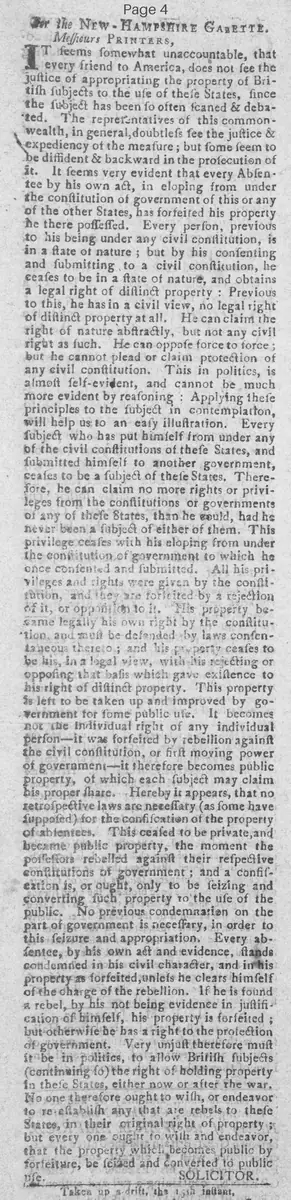
For the NEW-Hampshire GAZETTE.
Messieurs PRINTERS,
It seems somewhat unaccountable, that every friend to America, does not see the justice of appropriating the property of British subjects to the use of these States, since the subject has been so often scanned & debated. The representatives of this commonwealth, in general, doubtless see the justice & expediency of the measure; but some seem to be diffident & backward in the prosecution of it. It seems very evident that every Absentee by his own act, in eloping from under the constitution of government of this or any of the other States, has forfeited his property he there possessed. Every person, previous to his being under any civil constitution, is in a state of nature; but by his consenting and submitting to a civil constitution, he ceases to be in a state of nature, and obtains a legal right of distinct property: Previous to this, he has in a civil view, no legal right of distinct property at all. He can claim the right of nature abstractly, but not any civil right as such. He can oppose force to force; but he cannot plead or claim protection of any civil constitution. This in politics, is almost self-evident, and cannot be much more evident by reasoning: Applying these principles to the subject in contemplation, will help us to an easy illustration. Every subject who has put himself from under any of the civil constitutions of these States, and submitted himself to another government, ceases to be a subject of these States. Therefore, he can claim no more rights or privileges from the constitutions or governments of any of these States, than he should, had he never been a subject of either of them. This privilege ceases with his eloping from under the constitution of government to which he once consented and submitted. All his privileges and rights were given by the constitution, and they are forfeited by a rejection of it, or opposition to it. His property became legally his own right by the constitution, and must be defended by laws consonant thereto; and his property ceases to be his, in a legal view, with his rejecting or opposing that basis which gave existence to his right of distinct property. This property is left to be taken up and improved by government for some public use. It becomes not the individual right of any individual person; it was forfeited by rebellion against the civil constitution, or first moving power of government--it therefore becomes public property, of which each subject may claim his proper share. Hereby it appears, that no retrospective laws are necessary (as some have supposed) for the confiscation of the property of absentees. This ceased to be private, and became public property, the moment the possessors rebelled against their respective constitutions of government: and a confiscation is, or ought, only to be seizing and converting such property to the use of the public. No previous condemnation on the part of government is necessary, in order to this seizure and appropriation. Every absentee, by his own act and evidence, stands condemned in his civil character, and in his property as forfeited, unless he clears himself of the charge of the rebellion. If he is found a rebel, by his not being evidence in justification of himself, his property is forfeited: but otherwise he has a right to the protection of government. Very unjust therefore must it be in politics, to allow British subjects (continuing so) the right of holding property in these States, either now or after the war. No one therefore ought to wish, or endeavor to re-establish any that are rebels to these States, in their original right of property; but every one ought to wish and endeavor, that the property which becomes public by forfeiture, be seized and converted to public use.
SOLICITOR.
Messieurs PRINTERS,
It seems somewhat unaccountable, that every friend to America, does not see the justice of appropriating the property of British subjects to the use of these States, since the subject has been so often scanned & debated. The representatives of this commonwealth, in general, doubtless see the justice & expediency of the measure; but some seem to be diffident & backward in the prosecution of it. It seems very evident that every Absentee by his own act, in eloping from under the constitution of government of this or any of the other States, has forfeited his property he there possessed. Every person, previous to his being under any civil constitution, is in a state of nature; but by his consenting and submitting to a civil constitution, he ceases to be in a state of nature, and obtains a legal right of distinct property: Previous to this, he has in a civil view, no legal right of distinct property at all. He can claim the right of nature abstractly, but not any civil right as such. He can oppose force to force; but he cannot plead or claim protection of any civil constitution. This in politics, is almost self-evident, and cannot be much more evident by reasoning: Applying these principles to the subject in contemplation, will help us to an easy illustration. Every subject who has put himself from under any of the civil constitutions of these States, and submitted himself to another government, ceases to be a subject of these States. Therefore, he can claim no more rights or privileges from the constitutions or governments of any of these States, than he should, had he never been a subject of either of them. This privilege ceases with his eloping from under the constitution of government to which he once consented and submitted. All his privileges and rights were given by the constitution, and they are forfeited by a rejection of it, or opposition to it. His property became legally his own right by the constitution, and must be defended by laws consonant thereto; and his property ceases to be his, in a legal view, with his rejecting or opposing that basis which gave existence to his right of distinct property. This property is left to be taken up and improved by government for some public use. It becomes not the individual right of any individual person; it was forfeited by rebellion against the civil constitution, or first moving power of government--it therefore becomes public property, of which each subject may claim his proper share. Hereby it appears, that no retrospective laws are necessary (as some have supposed) for the confiscation of the property of absentees. This ceased to be private, and became public property, the moment the possessors rebelled against their respective constitutions of government: and a confiscation is, or ought, only to be seizing and converting such property to the use of the public. No previous condemnation on the part of government is necessary, in order to this seizure and appropriation. Every absentee, by his own act and evidence, stands condemned in his civil character, and in his property as forfeited, unless he clears himself of the charge of the rebellion. If he is found a rebel, by his not being evidence in justification of himself, his property is forfeited: but otherwise he has a right to the protection of government. Very unjust therefore must it be in politics, to allow British subjects (continuing so) the right of holding property in these States, either now or after the war. No one therefore ought to wish, or endeavor to re-establish any that are rebels to these States, in their original right of property; but every one ought to wish and endeavor, that the property which becomes public by forfeiture, be seized and converted to public use.
SOLICITOR.
What sub-type of article is it?
Persuasive
Political
Philosophical
What themes does it cover?
Politics
Constitutional Rights
What keywords are associated?
Property Forfeiture
Absentees
Civil Constitution
Rebellion
Public Property
Confiscation
American States
What entities or persons were involved?
Solicitor.
Messieurs Printers
Letter to Editor Details
Author
Solicitor.
Recipient
Messieurs Printers
Main Argument
absentees who elope from under the civil constitutions of american states forfeit their property by their own act of rebellion, making it public property that should be seized and appropriated for public use without need for retrospective laws or prior condemnation.
Notable Details
References State Of Nature And Civil Constitution Principles
Argues Forfeiture Occurs Automatically Upon Rejection Of Government
Opposes Allowing British Subjects To Retain Property In The States