Thank you for visiting SNEWPapers!
Sign up free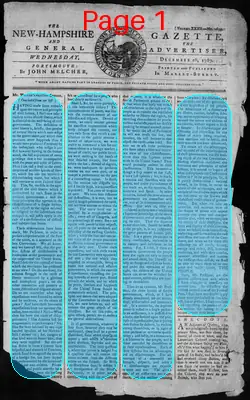
Story
December 26, 1787
The New Hampshire Gazette And General Advertiser
Portsmouth, Rockingham County, New Hampshire
What is this article about?
James Wilson's speech concluding remarks on civil and federal liberty, critiquing the weaknesses of the Articles of Confederation, and advocating for a strong democratic national government derived from the people, as discussed in the Constitutional Convention.
Clipping
OCR Quality
98%
Excellent
Full Text
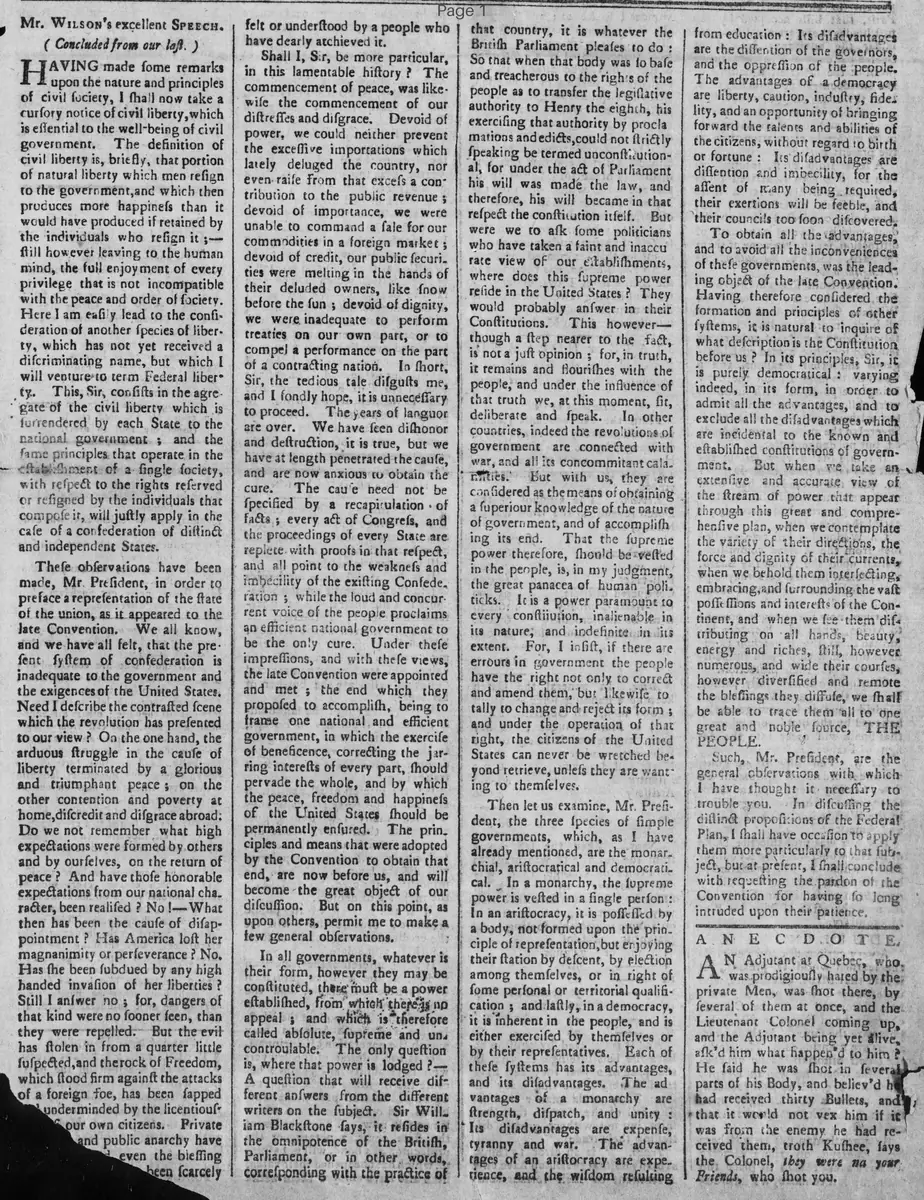
Mr. Wilson's excellent Speech.
(Concluded from our last.)
HAVING made some remarks upon the nature and principles of civil society, I shall now take a cursory notice of civil liberty, which is essential to the well-being of civil government. The definition of civil liberty is, briefly, that portion of natural liberty which men resign to the government, and which then produces more happiness than it would have produced if retained by the individuals who resign it ;-- still however leaving to the human mind, the full enjoyment of every privilege that is not incompatible with the peace and order of society.
Here I am easily lead to the consideration of another species of liberty, which has not yet received a discriminating name, but which I will venture to term Federal liberty.
This, Sir, consists in the aggregate of the civil liberty which is surrendered by each State to the national government ; and the same principles that operate in the establishment of a single society, with respect to the rights reserved or resigned by the individuals that compose it, will justly apply in the case of a confederation of distinct and independent States.
These observations have been made, Mr. President, in order to preface a representation of the state of the union, as it appeared to the late Convention. We all know, and we have all felt, that the present system of confederation is inadequate to the government and the exigencies of the United States.
Need I describe the contrasted scene which the revolution has presented to our view? On the one hand, the arduous struggle in the cause of liberty terminated by a glorious and triumphant peace ; on the other contention and poverty at home, discredit and disgrace abroad:
Do we not remember what high expectations were formed by others and by ourselves, on the return of peace? And have those honorable expectations from our national character, been realised? No! What then has been the cause of disappointment? Has America lost her magnanimity or perseverance? No.
Has she been subdued by any high handed invasion of her liberties? Still I answer no ; for, dangers of that kind were no sooner seen, than they were repelled.- But the evil has stolen in from a quarter little suspected, and the rock of Freedom, which stood firm against the attacks of a foreign foe, has been sapped undermined by the licentiousness of our own citizens. Private and public anarchy have even the blessings scarcely felt or understood by a people who have dearly achieved it.
Shall I, Sir, be more particular, in this lamentable history? The commencement of peace, was likewise the commencement of our distresses and disgrace. Devoid of power, we could neither prevent the excessive importations which lately deluged the country, nor even raise from that excess a contribution to the public revenue ; devoid of importance, we were unable to command a sale for our commodities in a foreign market ; devoid of credit, our public securities were melting in the hands of their deluded owners, like snow before the sun ; devoid of dignity, we were inadequate to perform treaties on our own part, or to compel a performance on the part of a contracting nation. In short, Sir, the tedious tale disgusts me, and I fondly hope, it is unnecessary to proceed. The years of languor are over. We have seen dishonor and destruction, it is true, but we have at length penetrated the cause, and are now anxious to obtain the cure. The cause need not be specified by a recapitulation of facts ; every act of Congress, and the proceedings of every State are replete with proofs in that respect, and all point to the weakness and imbecility of the existing Confederation ; while the loud and concurrent voice of the people proclaims an efficient national government to be the only cure. Under these impressions, and with these views, the late Convention were appointed and met ; the end which they proposed to accomplish, being to frame one national and efficient government, in which the exercise of beneficence, correcting the jarring interests of every part, should pervade the whole, and by which the peace, freedom and happiness of the United States should be permanently secured. The principles and means that were adopted by the Convention to obtain that end, are now before us, and will become the great object of our discussion. But on this point, as upon others, permit me to make a few general observations.
In all governments, whatever is their form, however they may be constituted, there must be a power established, from which there is no appeal ; and which is therefore called absolute, supreme and uncontrollable. The only question is, where that power is lodged ?- A question that will receive different answers from the different writers on the subject. Sir William Blackstone says, it resides in the omnipotence of the British Parliament, or in other words, corresponding with the practice of that country, it is whatever the British Parliament pleases to do :
So that when that body was so base and treacherous to the rights of the people as to transfer the legislative authority to Henry the eighth, his exercising that authority by proclamations and edicts, could not strictly speaking be termed unconstitutional. for under the act of Parliament his will was made the law, and therefore, his will became in that respect the constitution itself. But were we to ask some politicians who have taken a faint and inaccurate view of our establishments, where does this supreme power reside in the United States? They would probably answer in their Constitutions. This however-- though a step nearer to the fact, is not a just opinion ; for, in truth, it remains and flourishes with the people, and under the influence of that truth we, at this moment, sit, deliberate and speak. In other countries, indeed the revolutions of government are connected with war, and all its concomitant calamities. But with us, they are considered as the means of obtaining a superior knowledge of the nature of government, and of accomplishing its end. That the supreme power therefore, should be vested in the people, is, in my judgment, the great panacea of human politics. It is a power paramount to every constitution, inalienable in its nature, and indefinite in its extent. For, I insist, if there are errors in government the people have the right not only to correct and amend them, but likewise to totally change and reject its form ; and under the operation of that right, the citizens of the United States can never be wretched beyond retrieve, unless they are wanting to themselves.
Then let us examine, Mr. President, the three species of simple governments, which, as I have already mentioned, are the monarchical, aristocratical and democratical. In a monarchy, the supreme power is vested in a single person : In an aristocracy, it is poised by a body, not formed upon the principle of representation, but enjoying their station by descent, by election among themselves, or in right of some personal or territorial qualification ; and lastly, in a democracy, it is inherent in the people, and is either exercised by themselves or by their representatives. Each of these systems has its advantages, and its disadvantages. The advantages of a monarchy are strength, dispatch, and unity : Its disadvantages are expense, tyranny and war. The advantages of an aristocracy are experience, and the wisdom resulting from education : Its disadvantages are the dissension of the governors, and the oppression of the people.
The advantages of a democracy are liberty, caution, industry, fidelity, and an opportunity of bringing forward the talents and abilities of the citizens, without regard to birth or fortune : Its disadvantages are dissension and imbecility, for the assent of many being required, their exertions will be feeble, and their councils too soon discovered.
To obtain all the advantages, and to avoid all the inconveniences of these governments, was the leading object of the late Convention. Having therefore considered the formation and principles of other systems, it is natural to inquire of what description is the Constitution before us? In its principles, Sir, it is purely democratical : varying indeed, in its form, in order to admit all the advantages, and to exclude all the disadvantages which are incidental to the known and established constitutions of government. But when we take an extensive and accurate view of the stream of power that appears through this great and comprehensive plan, when we contemplate the variety of their directions, the force and dignity of their currents, when we behold them intersecting, embracing, and surrounding the vast possessions and interests of the Continent, and when we see them distributing on all hands, beauty, energy and riches, still, however numerous, and wide their courses, however diversified and remote the blessings they diffuse, we shall be able to trace them all to one great and noble source, THE PEOPLE.
Such, Mr. President, are the general observations with which I have thought it necessary to trouble you. In discussing the distinct propositions of the Federal Plan, I shall have occasion to apply them more particularly to that subject, but at present, I shall conclude with requesting the pardon of the Convention for having so long intruded upon their patience.
(Concluded from our last.)
HAVING made some remarks upon the nature and principles of civil society, I shall now take a cursory notice of civil liberty, which is essential to the well-being of civil government. The definition of civil liberty is, briefly, that portion of natural liberty which men resign to the government, and which then produces more happiness than it would have produced if retained by the individuals who resign it ;-- still however leaving to the human mind, the full enjoyment of every privilege that is not incompatible with the peace and order of society.
Here I am easily lead to the consideration of another species of liberty, which has not yet received a discriminating name, but which I will venture to term Federal liberty.
This, Sir, consists in the aggregate of the civil liberty which is surrendered by each State to the national government ; and the same principles that operate in the establishment of a single society, with respect to the rights reserved or resigned by the individuals that compose it, will justly apply in the case of a confederation of distinct and independent States.
These observations have been made, Mr. President, in order to preface a representation of the state of the union, as it appeared to the late Convention. We all know, and we have all felt, that the present system of confederation is inadequate to the government and the exigencies of the United States.
Need I describe the contrasted scene which the revolution has presented to our view? On the one hand, the arduous struggle in the cause of liberty terminated by a glorious and triumphant peace ; on the other contention and poverty at home, discredit and disgrace abroad:
Do we not remember what high expectations were formed by others and by ourselves, on the return of peace? And have those honorable expectations from our national character, been realised? No! What then has been the cause of disappointment? Has America lost her magnanimity or perseverance? No.
Has she been subdued by any high handed invasion of her liberties? Still I answer no ; for, dangers of that kind were no sooner seen, than they were repelled.- But the evil has stolen in from a quarter little suspected, and the rock of Freedom, which stood firm against the attacks of a foreign foe, has been sapped undermined by the licentiousness of our own citizens. Private and public anarchy have even the blessings scarcely felt or understood by a people who have dearly achieved it.
Shall I, Sir, be more particular, in this lamentable history? The commencement of peace, was likewise the commencement of our distresses and disgrace. Devoid of power, we could neither prevent the excessive importations which lately deluged the country, nor even raise from that excess a contribution to the public revenue ; devoid of importance, we were unable to command a sale for our commodities in a foreign market ; devoid of credit, our public securities were melting in the hands of their deluded owners, like snow before the sun ; devoid of dignity, we were inadequate to perform treaties on our own part, or to compel a performance on the part of a contracting nation. In short, Sir, the tedious tale disgusts me, and I fondly hope, it is unnecessary to proceed. The years of languor are over. We have seen dishonor and destruction, it is true, but we have at length penetrated the cause, and are now anxious to obtain the cure. The cause need not be specified by a recapitulation of facts ; every act of Congress, and the proceedings of every State are replete with proofs in that respect, and all point to the weakness and imbecility of the existing Confederation ; while the loud and concurrent voice of the people proclaims an efficient national government to be the only cure. Under these impressions, and with these views, the late Convention were appointed and met ; the end which they proposed to accomplish, being to frame one national and efficient government, in which the exercise of beneficence, correcting the jarring interests of every part, should pervade the whole, and by which the peace, freedom and happiness of the United States should be permanently secured. The principles and means that were adopted by the Convention to obtain that end, are now before us, and will become the great object of our discussion. But on this point, as upon others, permit me to make a few general observations.
In all governments, whatever is their form, however they may be constituted, there must be a power established, from which there is no appeal ; and which is therefore called absolute, supreme and uncontrollable. The only question is, where that power is lodged ?- A question that will receive different answers from the different writers on the subject. Sir William Blackstone says, it resides in the omnipotence of the British Parliament, or in other words, corresponding with the practice of that country, it is whatever the British Parliament pleases to do :
So that when that body was so base and treacherous to the rights of the people as to transfer the legislative authority to Henry the eighth, his exercising that authority by proclamations and edicts, could not strictly speaking be termed unconstitutional. for under the act of Parliament his will was made the law, and therefore, his will became in that respect the constitution itself. But were we to ask some politicians who have taken a faint and inaccurate view of our establishments, where does this supreme power reside in the United States? They would probably answer in their Constitutions. This however-- though a step nearer to the fact, is not a just opinion ; for, in truth, it remains and flourishes with the people, and under the influence of that truth we, at this moment, sit, deliberate and speak. In other countries, indeed the revolutions of government are connected with war, and all its concomitant calamities. But with us, they are considered as the means of obtaining a superior knowledge of the nature of government, and of accomplishing its end. That the supreme power therefore, should be vested in the people, is, in my judgment, the great panacea of human politics. It is a power paramount to every constitution, inalienable in its nature, and indefinite in its extent. For, I insist, if there are errors in government the people have the right not only to correct and amend them, but likewise to totally change and reject its form ; and under the operation of that right, the citizens of the United States can never be wretched beyond retrieve, unless they are wanting to themselves.
Then let us examine, Mr. President, the three species of simple governments, which, as I have already mentioned, are the monarchical, aristocratical and democratical. In a monarchy, the supreme power is vested in a single person : In an aristocracy, it is poised by a body, not formed upon the principle of representation, but enjoying their station by descent, by election among themselves, or in right of some personal or territorial qualification ; and lastly, in a democracy, it is inherent in the people, and is either exercised by themselves or by their representatives. Each of these systems has its advantages, and its disadvantages. The advantages of a monarchy are strength, dispatch, and unity : Its disadvantages are expense, tyranny and war. The advantages of an aristocracy are experience, and the wisdom resulting from education : Its disadvantages are the dissension of the governors, and the oppression of the people.
The advantages of a democracy are liberty, caution, industry, fidelity, and an opportunity of bringing forward the talents and abilities of the citizens, without regard to birth or fortune : Its disadvantages are dissension and imbecility, for the assent of many being required, their exertions will be feeble, and their councils too soon discovered.
To obtain all the advantages, and to avoid all the inconveniences of these governments, was the leading object of the late Convention. Having therefore considered the formation and principles of other systems, it is natural to inquire of what description is the Constitution before us? In its principles, Sir, it is purely democratical : varying indeed, in its form, in order to admit all the advantages, and to exclude all the disadvantages which are incidental to the known and established constitutions of government. But when we take an extensive and accurate view of the stream of power that appears through this great and comprehensive plan, when we contemplate the variety of their directions, the force and dignity of their currents, when we behold them intersecting, embracing, and surrounding the vast possessions and interests of the Continent, and when we see them distributing on all hands, beauty, energy and riches, still, however numerous, and wide their courses, however diversified and remote the blessings they diffuse, we shall be able to trace them all to one great and noble source, THE PEOPLE.
Such, Mr. President, are the general observations with which I have thought it necessary to trouble you. In discussing the distinct propositions of the Federal Plan, I shall have occasion to apply them more particularly to that subject, but at present, I shall conclude with requesting the pardon of the Convention for having so long intruded upon their patience.
What sub-type of article is it?
Historical Event
What themes does it cover?
Justice
Moral Virtue
What keywords are associated?
Civil Liberty
Federal Liberty
Confederation Weakness
National Government
Supreme Power
Democracy
Constitution
What entities or persons were involved?
Mr. Wilson
Sir William Blackstone
Henry The Eighth
Where did it happen?
The Late Convention
Story Details
Key Persons
Mr. Wilson
Sir William Blackstone
Henry The Eighth
Location
The Late Convention
Event Date
The Late Convention
Story Details
Mr. Wilson discusses civil and federal liberty, critiques the weaknesses of the Confederation leading to post-revolution distresses, advocates for supreme power in the people, examines forms of government, and praises the democratic principles of the proposed Constitution.