Thank you for visiting SNEWPapers!
Sign up free
Letter to Editor
June 24, 1841
The Ohio Democrat
New Philadelphia, Tuscarawas County, Ohio
What is this article about?
A letter arguing that Congress can constitutionally establish fiscal agents for taxes and debts without state approval, criticizing Secretary Ewing's Fiscal Bank proposal as unconstitutional for requiring state assent, implying Whig party support for an invalid measure.
Clipping
OCR Quality
95%
Excellent
Full Text
Communicated.
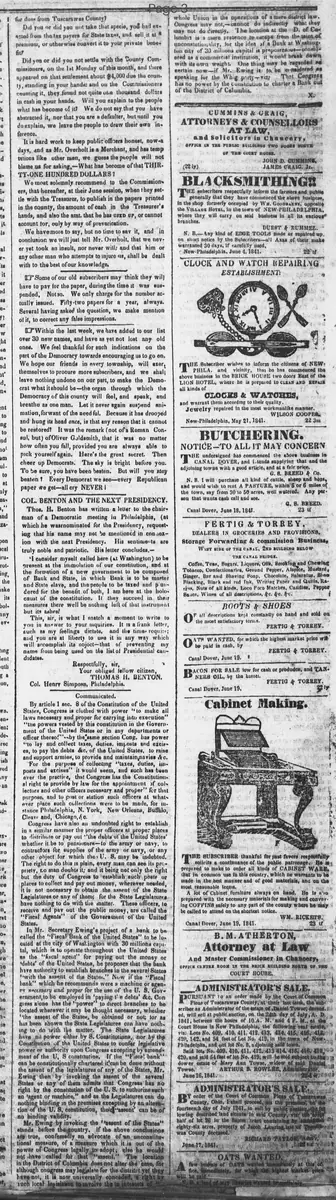
By article 1 sec. 8 of the Constitution of the United States, Congress is clothed with power "to make all laws necessary and proper for carrying into execution" "the powers vested by this constitution in the Government of the United States or in any departments or officer thereof?"—by the same section Cong. has power "to lay and collect taxes, duties, imposts and excises, to pay the debts &c. of the United States, to raise and support armies, to provide and maintain navies &c.
For the purpose of collecting "taxes, duties, imposts and excises" it would seem, and such has been ever the practice, that Congress has the Constitutional right to provide by law for the appointment of collectors and other officers necessary and proper for that purpose, and to post or station such officers at whatever place such collections were to be made, for instance Philadelphia, N. York, New Orleans, Buffalo, Cleveland and, Chicago, &c.
Congress have also an undoubted right to establish in a similar manner the proper officers at proper places to distribute or pay out "the debts of the United States whether it be to pensioners—to the army or navy. to contractors or supplies of the army or navy, or any other object for which the U. S. may be indebted.
The right to do this is plain, every man can see its propriety, no man doubts it; and it being not only the right but the duty of Congress to establish such posts or places to collect and pay out money, wherever needed, it is not necessary to obtain the assent of the State Legislatures or any of them; or the State Legislatures have nothing to do with the matter. These officers, to receive and pay out the public money, are called the "Fiscal Agents" of the Government of the United States.
In Mr. Secretary Ewing's project of a bank to be called the "Fiscal Bank of the United States" to be located at the city of Washington with 30 millions capital, which is to operate throughout the United States as the "Fiscal agent" for paying out the money or "debts of the United States, he proposes that the bank have authority to establish branches in the several States "with the assent of the States." Now if the "Fiscal bank" which he recommends were a machine or agency necessary and proper for the use of the U. S. Government, to be employed in 'paying the debts' &c. Congress alone has the "power" to direct branches to be located wherever it may be thought necessary, whether the assent of the States, be obtained or not; for as has been shown the State Legislatures can have nothing to do with the matter. The State Legislatures have no power either by State Constitutions, nor by the Constitution of the United States to confer legislative power or authority upon Congress excepting by amendment of the U. S constitution. If the "Fiscal bank" can be constitutionally chartered it can be done without the assent of the legislatures of any of the States, Mr. Ewing then by invoking the assent of the several States or any of them admits that Congress has no right by the constitution of the U. S. to authorize such an 'agent or machine," and as the Legislatures can do nothing binding in the premises excepting by an alteration of the U. S. constitution, their "assent" can be of no binding validity.
Mr. Ewing by invoking the "assent of the States" stands before the country, if the above conclusions are true, confessedly an advocate of an unconstitutional measure, of a measure which it is out of the power of Congress legally to adopt; else he would not have called for that assent." The location in the District of Columbia does not alter the case, or although congress may legislate for the district yet they have not, it is now universally conceded, a right by such local legislation to involve the interests of the whole Union in the operations of a mere district law.
Congress may not,—cannot do indirectly what they may not do directly. The location at the D. of Columbia is a mere pretence to escape from the taint of unconstitutionality, for the idea of a Bank at Washington city of 30 millions capital is preposterous—considered as a commercial institution, it would break down with its own weight. One thing may be regarded as certain now—if Mr. Ewing is to be considered speaking for the Whig party—Viz; That Congress has no power by the constitution to charter a Bank out of the District of Columbia.
X.
By article 1 sec. 8 of the Constitution of the United States, Congress is clothed with power "to make all laws necessary and proper for carrying into execution" "the powers vested by this constitution in the Government of the United States or in any departments or officer thereof?"—by the same section Cong. has power "to lay and collect taxes, duties, imposts and excises, to pay the debts &c. of the United States, to raise and support armies, to provide and maintain navies &c.
For the purpose of collecting "taxes, duties, imposts and excises" it would seem, and such has been ever the practice, that Congress has the Constitutional right to provide by law for the appointment of collectors and other officers necessary and proper for that purpose, and to post or station such officers at whatever place such collections were to be made, for instance Philadelphia, N. York, New Orleans, Buffalo, Cleveland and, Chicago, &c.
Congress have also an undoubted right to establish in a similar manner the proper officers at proper places to distribute or pay out "the debts of the United States whether it be to pensioners—to the army or navy. to contractors or supplies of the army or navy, or any other object for which the U. S. may be indebted.
The right to do this is plain, every man can see its propriety, no man doubts it; and it being not only the right but the duty of Congress to establish such posts or places to collect and pay out money, wherever needed, it is not necessary to obtain the assent of the State Legislatures or any of them; or the State Legislatures have nothing to do with the matter. These officers, to receive and pay out the public money, are called the "Fiscal Agents" of the Government of the United States.
In Mr. Secretary Ewing's project of a bank to be called the "Fiscal Bank of the United States" to be located at the city of Washington with 30 millions capital, which is to operate throughout the United States as the "Fiscal agent" for paying out the money or "debts of the United States, he proposes that the bank have authority to establish branches in the several States "with the assent of the States." Now if the "Fiscal bank" which he recommends were a machine or agency necessary and proper for the use of the U. S. Government, to be employed in 'paying the debts' &c. Congress alone has the "power" to direct branches to be located wherever it may be thought necessary, whether the assent of the States, be obtained or not; for as has been shown the State Legislatures can have nothing to do with the matter. The State Legislatures have no power either by State Constitutions, nor by the Constitution of the United States to confer legislative power or authority upon Congress excepting by amendment of the U. S constitution. If the "Fiscal bank" can be constitutionally chartered it can be done without the assent of the legislatures of any of the States, Mr. Ewing then by invoking the assent of the several States or any of them admits that Congress has no right by the constitution of the U. S. to authorize such an 'agent or machine," and as the Legislatures can do nothing binding in the premises excepting by an alteration of the U. S. constitution, their "assent" can be of no binding validity.
Mr. Ewing by invoking the "assent of the States" stands before the country, if the above conclusions are true, confessedly an advocate of an unconstitutional measure, of a measure which it is out of the power of Congress legally to adopt; else he would not have called for that assent." The location in the District of Columbia does not alter the case, or although congress may legislate for the district yet they have not, it is now universally conceded, a right by such local legislation to involve the interests of the whole Union in the operations of a mere district law.
Congress may not,—cannot do indirectly what they may not do directly. The location at the D. of Columbia is a mere pretence to escape from the taint of unconstitutionality, for the idea of a Bank at Washington city of 30 millions capital is preposterous—considered as a commercial institution, it would break down with its own weight. One thing may be regarded as certain now—if Mr. Ewing is to be considered speaking for the Whig party—Viz; That Congress has no power by the constitution to charter a Bank out of the District of Columbia.
X.
What sub-type of article is it?
Persuasive
Political
Philosophical
What themes does it cover?
Politics
Economic Policy
Constitutional Rights
What keywords are associated?
Fiscal Agents
Constitutional Power
Congress Authority
State Assent
Fiscal Bank
Thomas Ewing
Whig Party
District Of Columbia
What entities or persons were involved?
X.
Letter to Editor Details
Author
X.
Main Argument
congress has the constitutional power under article 1, section 8 to establish fiscal agents for collecting taxes and paying debts without needing assent from state legislatures. secretary ewing's proposal for a fiscal bank requiring state assent admits that congress lacks the authority to charter such a bank constitutionally.
Notable Details
References Article 1, Section 8 Of The U.S. Constitution
Mentions Cities Like Philadelphia, N. York, New Orleans, Buffalo, Cleveland, Chicago
Criticizes The Fiscal Bank Of The United States With 30 Millions Capital Located In Washington
Argues Location In District Of Columbia Does Not Alter Constitutionality
Implies Ewing Speaks For The Whig Party