Thank you for visiting SNEWPapers!
Sign up free
Story
February 9, 1924
The Daily Worker
Chicago, Cook County, Illinois
What is this article about?
Dr. Felix Halle recounts his visit to revolutionary Max Holz in Breslau prison, detailing Holz's physical and mental deterioration after two years since April 1921, harsh conditions, and pleads for his release to prevent despair.
Clipping
OCR Quality
98%
Excellent
Full Text
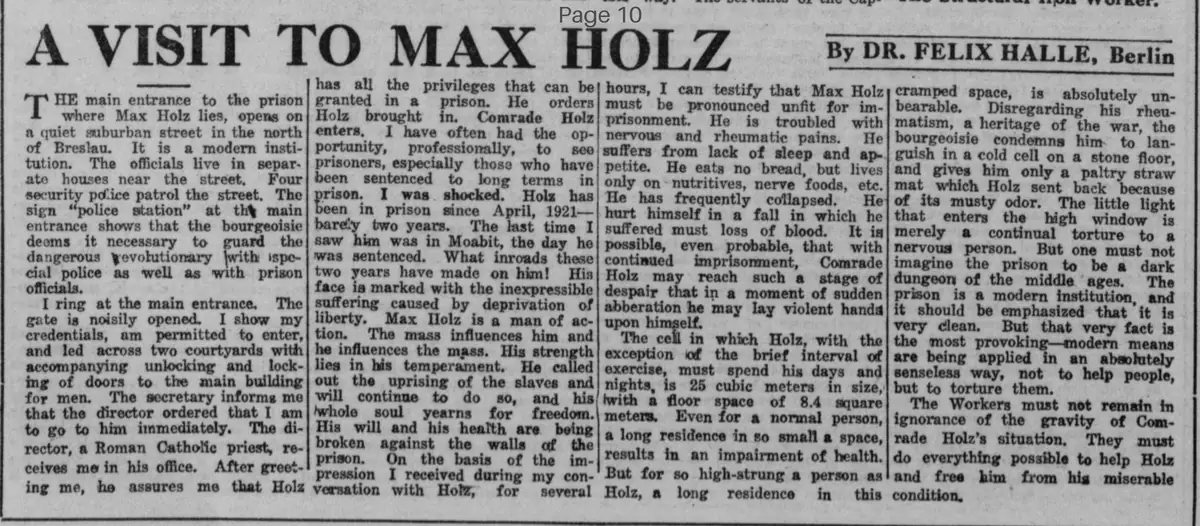
A VISIT TO MAX HOLZ
By DR. FELIX HALLE, Berlin
THE main entrance to the prison where Max Holz lies, opens on a quiet suburban street in the north of Breslau.
It is a modern institution.
The officials live in separate houses near the street. Four security police patrol the street.
The sign "police station" at the main entrance shows that the bourgeoisie deems it necessary to guard the dangerous revolutionary with special police as well as with prison officials.
I ring at the main entrance. The gate is noisily opened. I show my credentials, am permitted to enter, and led across two courtyards with accompanying unlocking and locking of doors to the main building for men.
The secretary informs me that the director ordered that I am to go to him immediately.
The director, a Roman Catholic priest, receives me in his office.
After greeting me, he assures me that Holz has all the privileges that can be granted in a prison.
He orders Holz brought in.
Comrade Holz enters.
I have often had the opportunity, professionally, to see prisoners, especially those who have been sentenced to long terms in prison. I was shocked.
Holz has been in prison since April, 1921—barely two years.
The last time I saw him was in Moabit, the day he was sentenced.
What inroads these two years have made on him!
His face is marked with the inexpressible suffering caused by deprivation of liberty.
Max Holz is a man of action.
The mass influences him and he influences the mass.
His strength lies in his temperament.
He called out the uprising of the slaves and will continue to do so, and his whole soul yearns for freedom.
His will and his health are being broken against the walls of the prison.
On the basis of the impression I received during my conversation with Holz, for several hours, I can testify that Max Holz must be pronounced unfit for imprisonment.
He is troubled with nervous and rheumatic pains.
He suffers from lack of sleep and appetite.
He eats no bread, but lives only on nutritives, nerve foods, etc.
He has frequently collapsed.
He hurt himself in a fall in which he suffered much loss of blood.
It is possible, even probable, that with continued imprisonment, Comrade Holz may reach such a stage of despair that in a moment of sudden aberration he may lay violent hands upon himself.
The cell in which Holz, with the exception of the brief interval of exercise, must spend his days and nights, is 25 cubic meters in size, with a floor space of 8.4 square meters.
Even for a normal person, a long residence in so small a space, results in an impairment of health.
But for so high-strung a person as Holz, a long residence in this cramped space, is absolutely unbearable.
Disregarding his rheumatism, a heritage of the war, the bourgeoisie condemns him to languish in a cold cell on a stone floor, and gives him only a paltry straw mat which Holz sent back because of its musty odor.
The little light that enters the high window is merely a continual torture to a nervous person.
But one must not imagine the prison to be a dark dungeon of the middle ages.
The prison is a modern institution, and it should be emphasized that it is very clean.
But that very fact is the most provoking—modern means are being applied in an absolutely senseless way, not to help people, but to torture them.
The Workers must not remain in ignorance of the gravity of Comrade Holz's situation.
They must do everything possible to help Holz and free him from his miserable condition.
By DR. FELIX HALLE, Berlin
THE main entrance to the prison where Max Holz lies, opens on a quiet suburban street in the north of Breslau.
It is a modern institution.
The officials live in separate houses near the street. Four security police patrol the street.
The sign "police station" at the main entrance shows that the bourgeoisie deems it necessary to guard the dangerous revolutionary with special police as well as with prison officials.
I ring at the main entrance. The gate is noisily opened. I show my credentials, am permitted to enter, and led across two courtyards with accompanying unlocking and locking of doors to the main building for men.
The secretary informs me that the director ordered that I am to go to him immediately.
The director, a Roman Catholic priest, receives me in his office.
After greeting me, he assures me that Holz has all the privileges that can be granted in a prison.
He orders Holz brought in.
Comrade Holz enters.
I have often had the opportunity, professionally, to see prisoners, especially those who have been sentenced to long terms in prison. I was shocked.
Holz has been in prison since April, 1921—barely two years.
The last time I saw him was in Moabit, the day he was sentenced.
What inroads these two years have made on him!
His face is marked with the inexpressible suffering caused by deprivation of liberty.
Max Holz is a man of action.
The mass influences him and he influences the mass.
His strength lies in his temperament.
He called out the uprising of the slaves and will continue to do so, and his whole soul yearns for freedom.
His will and his health are being broken against the walls of the prison.
On the basis of the impression I received during my conversation with Holz, for several hours, I can testify that Max Holz must be pronounced unfit for imprisonment.
He is troubled with nervous and rheumatic pains.
He suffers from lack of sleep and appetite.
He eats no bread, but lives only on nutritives, nerve foods, etc.
He has frequently collapsed.
He hurt himself in a fall in which he suffered much loss of blood.
It is possible, even probable, that with continued imprisonment, Comrade Holz may reach such a stage of despair that in a moment of sudden aberration he may lay violent hands upon himself.
The cell in which Holz, with the exception of the brief interval of exercise, must spend his days and nights, is 25 cubic meters in size, with a floor space of 8.4 square meters.
Even for a normal person, a long residence in so small a space, results in an impairment of health.
But for so high-strung a person as Holz, a long residence in this cramped space, is absolutely unbearable.
Disregarding his rheumatism, a heritage of the war, the bourgeoisie condemns him to languish in a cold cell on a stone floor, and gives him only a paltry straw mat which Holz sent back because of its musty odor.
The little light that enters the high window is merely a continual torture to a nervous person.
But one must not imagine the prison to be a dark dungeon of the middle ages.
The prison is a modern institution, and it should be emphasized that it is very clean.
But that very fact is the most provoking—modern means are being applied in an absolutely senseless way, not to help people, but to torture them.
The Workers must not remain in ignorance of the gravity of Comrade Holz's situation.
They must do everything possible to help Holz and free him from his miserable condition.
What sub-type of article is it?
Biography
Historical Event
What themes does it cover?
Misfortune
Justice
Bravery Heroism
What keywords are associated?
Max Holz
Prison Visit
Breslau Prison
Political Imprisonment
Health Deterioration
Revolutionary Suffering
What entities or persons were involved?
Max Holz
Dr. Felix Halle
Where did it happen?
Prison In North Of Breslau
Story Details
Key Persons
Max Holz
Dr. Felix Halle
Location
Prison In North Of Breslau
Event Date
Since April 1921
Story Details
Dr. Felix Halle visits Max Holz in Breslau prison, observes his severe suffering and health decline after two years of imprisonment, notes the inadequate cell conditions, and warns of potential suicide risk, urging workers to secure his release.