Thank you for visiting SNEWPapers!
Sign up free
Literary
December 29, 1926
The Manning Times
Manning, Clarendon County, South Carolina
What is this article about?
A Scottish poem titled 'THIS NEW YEAR OF OUR LORD' calls to let bygones be bygones, abandon past faults, and start 1927 with fresh friendship. English prose explains its meaning, emphasizing renewal and discarding old grievances.
Clipping
OCR Quality
98%
Excellent
Full Text
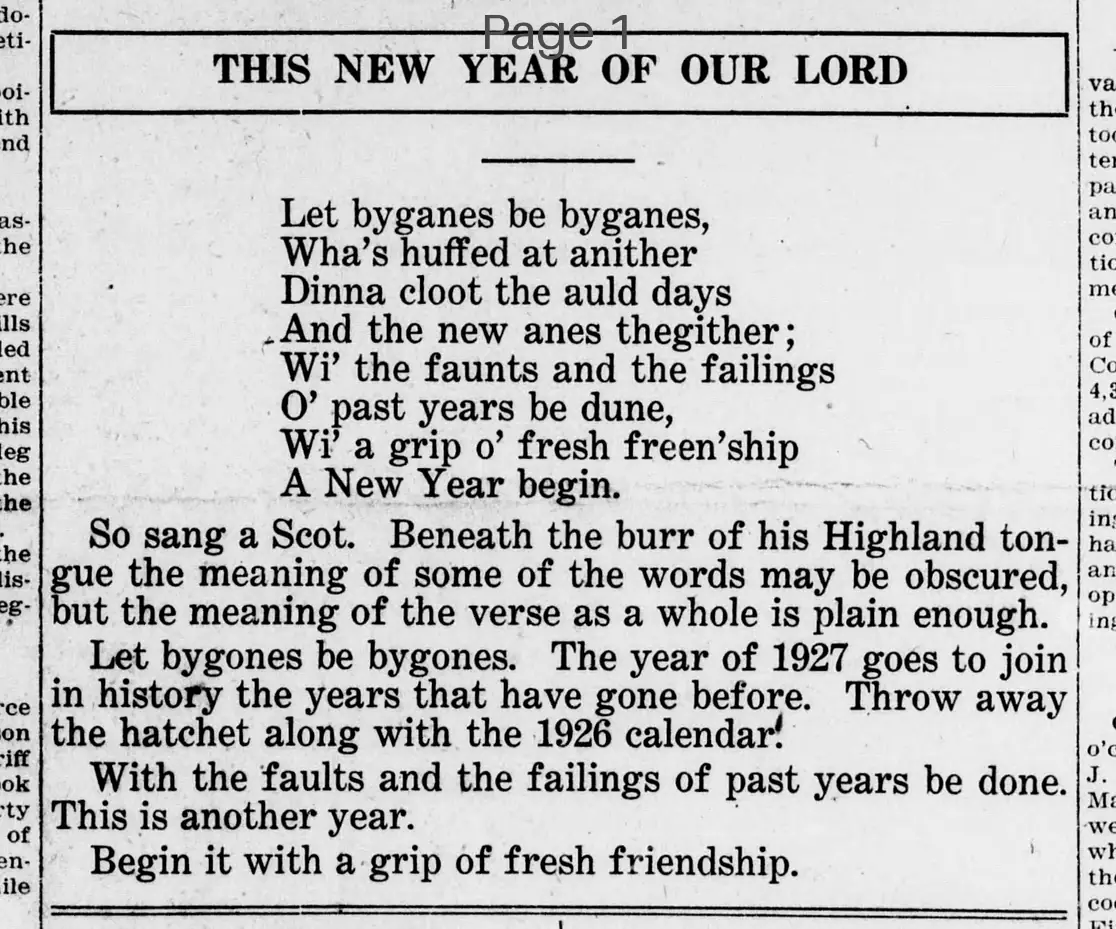
THIS NEW YEAR OF OUR LORD
Let bygones be bygones,
What's huffed at anither
Dinna cloot the auld days
And the new anes thegither;
Wi' the faunts and the failings
O' past years be dune,
Wi' a grip o' fresh freen'ship
A New Year begin.
So sang a Scot. Beneath the burr of his Highland tongue the meaning of some of the words may be obscured, but the meaning of the verse as a whole is plain enough.
Let bygones be bygones. The year of 1927 goes to join in history the years that have gone before. Throw away the hatchet along with the 1926 calendar!
With the faults and the failings of past years be done.
This is another year.
Begin it with a grip of fresh friendship.
Let bygones be bygones,
What's huffed at anither
Dinna cloot the auld days
And the new anes thegither;
Wi' the faunts and the failings
O' past years be dune,
Wi' a grip o' fresh freen'ship
A New Year begin.
So sang a Scot. Beneath the burr of his Highland tongue the meaning of some of the words may be obscured, but the meaning of the verse as a whole is plain enough.
Let bygones be bygones. The year of 1927 goes to join in history the years that have gone before. Throw away the hatchet along with the 1926 calendar!
With the faults and the failings of past years be done.
This is another year.
Begin it with a grip of fresh friendship.
What sub-type of article is it?
Poem
Essay
What themes does it cover?
Seasonal Cycle
Friendship
Moral Virtue
What keywords are associated?
New Year
Bygones
Scots Verse
Friendship
Renewal
1927
What entities or persons were involved?
A Scot
Literary Details
Title
This New Year Of Our Lord
Author
A Scot
Subject
New Year's Renewal And Fresh Friendship
Form / Style
Verse In Scots Dialect With English Prose Commentary
Key Lines
Let Bygones Be Bygones,
Wi' The Faunts And The Failings
O' Past Years Be Dune,
Wi' A Grip O' Fresh Freen'ship
A New Year Begin.