Thank you for visiting SNEWPapers!
Sign up free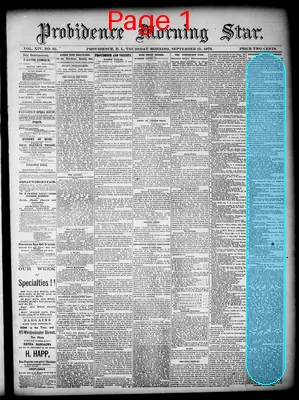
Providence Morning Star
Providence, Providence County, Rhode Island
What is this article about?
The Democratic State Convention in Rhode Island convened at the State House to nominate presidential electors. Delegates from various towns were listed, temporary and permanent officers elected, and Hon. Charles H. Page delivered a speech endorsing Samuel J. Tilden and criticizing Republican corruption and high taxes.
Clipping

OCR Quality
Full Text
The Roll of Delegates.
The Democratic State Convention for the nomination of presidential electors, was held at the State House yesterday forenoon. The towns of the State were pretty fully represented. The convention was called to order at fifteen minutes to eleven o'clock by Hon. Wm. B. Beach of Providence, chairman of the Democratic State Central Committee.
Nominations as follows were made for temporary secretaries: Joseph F. Ward and Joseph Ostfeld, Jr., Pawtucket; Hon. A. B. Lewis, Coventry; Joseph E. Spink, Providence, and Wm. C. Cozzens of Newport.
Messrs. Ostfeld and Spink were elected.
The credentials of delegates were received.
Mr. Olney of Providence, moved that in filling vacancies only residents of towns be chosen to represent the respective towns in which they reside.
Mr. Bliss of East Providence, suggested that a vacancy happened in his delegation, and as delegates were authorized to fill vacancies, he claimed the right to do so.
Mr. Cooney of Providence, was opposed to giving Mr. Bliss the authority, as it would establish an undesirable precedent. He was opposed to having towns represented by other than residents of the towns.
The Chairman said he recognized the propriety of Mr. Olney's motion, but it was offered a little too soon. As a member of the Convention he would not say that delegations authorized by the caucus electing them are not entitled to fill vacancies, but at the same time he agreed with Mr. Olney's motion. As Chairman of the State Central Committee, he had taken pains to have all portions of the State notified to send delegates and, if they fail to send delegates, vacancies ought to be filled only by residents of the towns unrepresented.
Mr. Brennan was opposed to any action that would give power to the caucus to bind the Convention. A caucus may authorize delegates to fill vacancies, but it remains with the Convention to admit them.
After the matter was further discussed, the Convention voted to allow delegates authorized by their towns, to fill vacancies.
It was also voted not to admit as a delegate of any town, a non-resident of such town.
THE ROLL OF THE CONVENTION
was then made up as follows:
Newport—John Walters, W. C. Cozzens, Jr., Henry D. De Blois, Patrick H. Hogan, Wm. J. Underwood and James Rudolph.
Providence—First Ward, John P. Cooney, Michael Cady and Thomas G. Hughes. Second Ward, Wm. G. H. Mowry. Third Ward, Henry T. Rodgers and Joseph E. Spink. Fourth Ward, Edmund Coe. Fifth Ward, Alexander Manchester. Sixth Ward, Nehemiah Kinnecom. Seventh Ward, Wm. D. Beach. Eighth Ward, H. S. Olney. Ninth Ward, William B. Daboll. Tenth Ward, John M. Brennan.
Portsmouth—No delegation.
Warwick—Caleb Westcott, William J. Wells, O. Tillinghast, Albert R. Greene and John R. Blake.
Westerly—Thomas W. Segar and Benjamin T. Bliven.
New Shoreham—No delegation.
North Kingstown—Samuel A. Spink and Jas. R. Healey
South Kingstown—Daniel Rodman and Nathaniel C. Peckham, Jr.
East Greenwich—Thomas A. Reynolds and John C. Ellis.
Jamestown—James Eldred
Smithfield—Leander E. Gardner and Arnold Staples.
Scituate—Joseph S. Fiske and Chas. H. Page.
Glocester—Ziba O. Slocum and Fenner R. White.
Charlestown—George T. James and Barnum Ennis.
West Greenwich—No delegation.
Coventry—A. B. Lewis, Israel Whaley and Simeon Webster.
Exeter—A. Grinnell and John J. Nichols.
Middletown—John Eldred and John Myers
Bristol—J. H. Coggeshall, J. R. Talbot and F. W. Pierce.
Tiverton—No delegation.
Little Compton—No delegation
Warren—George L. Cooke and James C. Blake.
Cumberland—Lyman Burlingame, Patrick Kinney, James Brennan.
Richmond—Amos L. Kenyon and J. B. F. Wilbur.
Cranston—Joseph W. Sweet, Lyman Barney and Thomas R. Tillinghast.
Hopkinton—No delegation.
Johnston—Hiram Booth, Benjamin A. Harris and Martin Wilson.
North Providence—Henry D. Olney and James H. Angell.
Barrington—No delegation
Foster—No delegation.
Burrillville—Elisha Mathewson, Albert Buffum and David Mathewson.
East Providence—George N. and William H. Olney.
Pawtucket—B. G. Perkins, Henry D. Beckford, John T. Ward, Thomas Robinson, C. A. Leonard, Owen Banigan and Joseph Ostfeld, Jr.
Woonsocket—No delegation.
North Smithfield—No delegation.
Lincoln—Frank S. Bitgood.
PERMANENT ORGANIZATION.
On motion of Mr. Bliss of East Providence, the Convention was permanently organized by the election of Hon. Charles H. Page, of Scituate, as President.
SPEECH OF MR. PAGE.
On taking the chair Mr. Page addressed the convention as follows:
Gentlemen of the Convention and fellow Democrats of Rhode Island—Being unexpectedly called to this position I hardly know what to say—how to find words to express to you my gratitude for the compliment of calling me to preside over the deliberations of this convention—a convention wherein we behold the ablest men in the State of Rhode Island. This convention assembles at a time when we are in the midst of the most important national election which has ever been held in this country—a country that might be blessed with all the honors that any country could be blessed with—a country containing forty millions of people, and to-day we are going forward to select for these forty millions of people a leader, and for that leader we have the nomination of the National Democratic Convention at St. Louis, a leader who is able, tried and honest. and that leader we find in Samuel J. Tilden of New York. [Applause.] We are here to nominate our standard bearers to go forward and carry the flag of the Democratic party and place it on the walls of the White House at Washington in the hands of Samuel J. Tilden. Do we not want to have Samuel J. Tilden as standard bearer in this campaign? (cries of "yes.") Is there any necessity for a change? (cries of "no.") Our Republican friends tell us that there is none; they say that the Republican party alone can save this country, but how many times have they told us the same thing? What promises did they make four years ago, and how well have those promises been kept? Why is it that to-day we find this country with forty millions of people, blessed with all the industries which any country upon the face of the globe could possess—with our institutions paralyzed, mechanics out of employment, the people oppressed? Republicans charge upon the Democratic party this state of things; but the Democrats have not had part in the government for fifteen years and yet we are charged with all the fraud and corruption that has been unearthed. To-day the administration of this country is a reproach throughout the civilized world, and it is pointed to by public men and journals of Europe as an argument against republican form of government.
To-day we have assembled to do our part in changing the condition of things. I am satisfied that change necessary, and it seems to me that every intelligent man will this I say a charge to be brought about? Republicans admit that they are in the wrong, and they raise change necessary. How is it that the people of this country are overburdened with taxes? Are Republicans or Democrats responsible for this? Eight years ago the number of office-holders was about 54,000; to-day that number has been increased to 100,000. Why is it that it requires three or four hundred millions of dollars to pay thirty or forty millions of people? Is it on account of the national debt? Is it on account of the Democratic administration or on account of the administration or the party now in power? Republicans come to the people begging to be allowed to remain longer in power and they will settle this thing. How do they propose to do it with such men as Conkling, Butler, Logan, Morgan and Grant and with the Babcocks and Belknaps who have been engaged in the most gigantic frauds during the Republican administration.
How is it that the people of this country are overburdened with taxes? Are Republicans or Democrats responsible for this? Eight years ago the number of office-holders was about 54,000; to-day that number has been increased to 100,000. Why is it that it requires three or four hundred millions of dollars to pay thirty or forty millions of people? Is it on account of the national debt? Is it on account of the Democratic administration or on account of the administration or the party now in power? Republicans come to the people begging to be allowed to remain longer in power and they will settle this thing. How do they propose to do it with such men as Conkling, Butler, Logan, Morgan and Grant and with the Babcocks and Belknaps who have been engaged in the most gigantic frauds during the Republican administration.
What sub-type of article is it?
What themes does it cover?
What keywords are associated?
What entities or persons were involved?
Where did it happen?
Story Details
Key Persons
Location
State House, Providence, Rhode Island
Event Date
Yesterday Forenoon
Story Details
The convention organized with temporary secretaries elected, debated filling vacancies with residents only, listed delegates by town, permanently organized with Charles H. Page as president, who spoke supporting Tilden for president and decrying Republican corruption, increased office-holders, and high taxes.