Thank you for visiting SNEWPapers!
Sign up free
Gazette Of The United States
New York, New York County, New York
What is this article about?
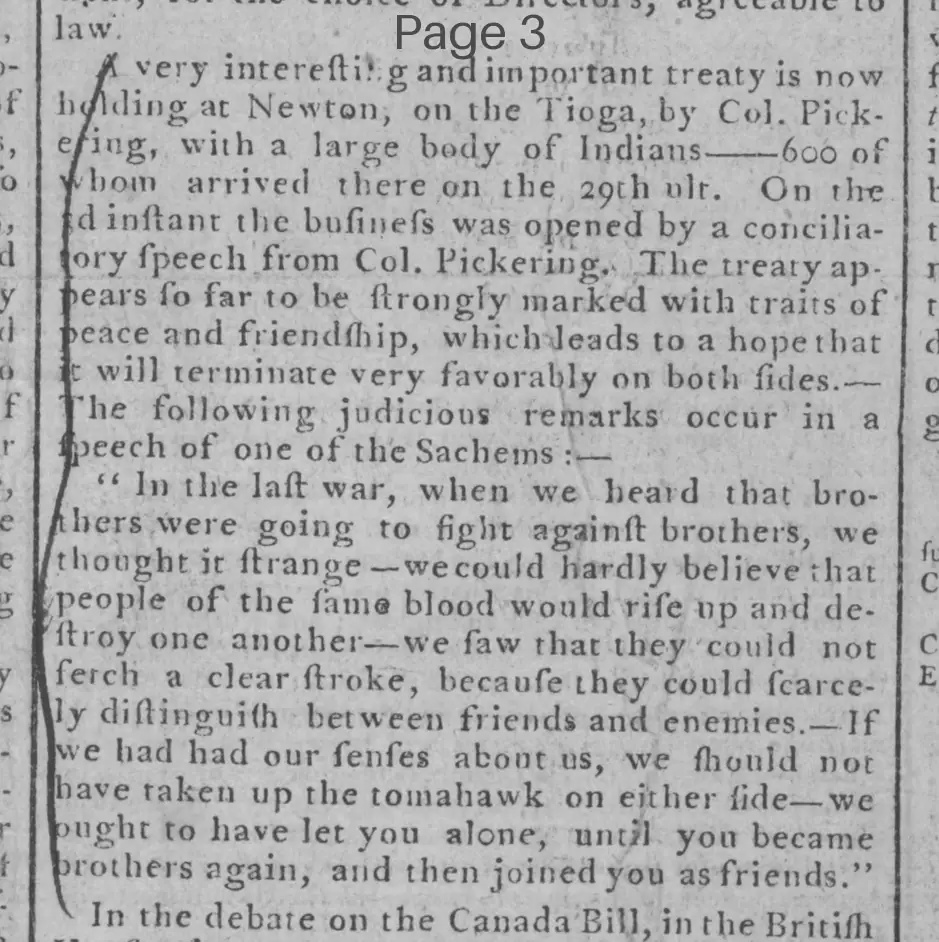
Treaty negotiations at Newton on the Tioga led by Col. Pickering with 600 Indians who arrived on the 20th ult., opened on the 1st instant with a conciliatory speech, proceeding with traits of peace and friendship; includes remarks from a Sachem on the last war.
Clipping
OCR Quality
Full Text
The following judicious remarks occur in a speech of one of the Sachems:
"In the last war, when we heard that brothers were going to fight against brothers, we thought it strange—we could hardly believe that people of the same blood would rise up and destroy one another—we saw that they could not fetch a clear stroke, because they could scarcely distinguish between friends and enemies.—If we had had our eyes about us, we should not have taken up the tomahawk on either side—we ought to have let you alone, until you became brothers again, and then joined you as friends."
What sub-type of article is it?
What keywords are associated?
What entities or persons were involved?
Where did it happen?
Domestic News Details
Primary Location
Newton, On The Tioga
Event Date
600 Arrived On The 20th Ult.; Opened On The 1st Instant
Key Persons
Outcome
appears strongly marked with traits of peace and friendship, leading to hope that it will terminate very favorably on both sides.
Event Details
A very interesting and important treaty is now holding at Newton, on the Tioga, by Col. Pickering, with a large body of Indians—600 of whom arrived there on the 20th ult. On the 1st instant the business was opened by a conciliatory speech from Col. Pickering. The following judicious remarks occur in a speech of one of the Sachems: "In the last war, when we heard that brothers were going to fight against brothers, we thought it strange—we could hardly believe that people of the same blood would rise up and destroy one another—we saw that they could not fetch a clear stroke, because they could scarcely distinguish between friends and enemies.—If we had had our eyes about us, we should not have taken up the tomahawk on either side—we ought to have let you alone, until you became brothers again, and then joined you as friends."