Thank you for visiting SNEWPapers!
Sign up free
Lynchburg Virginian
Lynchburg, Virginia
What is this article about?
Advice for maintaining dairy utensils: scald, rinse, and dry after use; avoid glazed pottery due to lead poisoning risk; prefer wooden vessels like maple or pine, clean tainted ones by boiling with salatus and soaking.
Clipping
OCR Quality
Full Text
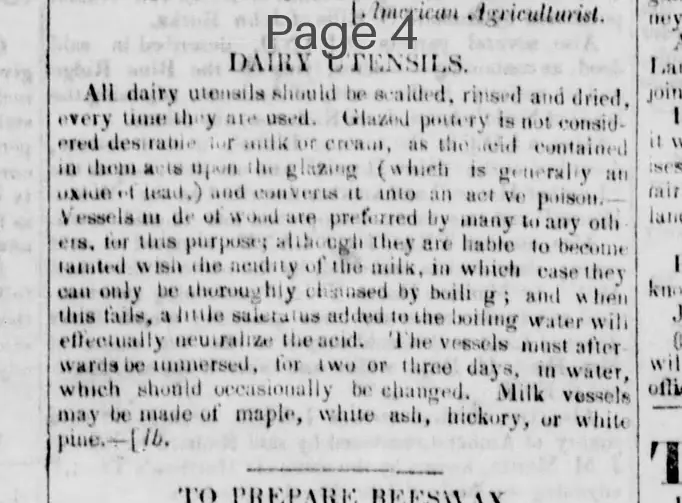
All dairy utensils should be scalded, rinsed and dried every time they are used. Glazed pottery is not considered desirable in milk or cream, as the acid contained in them eats upon the glazing (which is generally oxide of lead) and converts it into an active poison.
Vessels made of wood are preferred by many to any other sets, for this purpose though they are liable to become tainted with the acidity of the milk, in which case they can only be thoroughly cleansed by boiling; and when thus far as, a little salatus added to the boiling water will effectually neutralize the acid. The vessels must afterwards be immersed, for two or three days, in water, which should occasionally be changed. Milk vessels may be made of maple, white ash, hickory, or white pine.—[lb.
What sub-type of article is it?
What keywords are associated?
Domestic News Details
Event Details
Advice on cleaning dairy utensils by scalding, rinsing, and drying after each use. Glazed pottery is undesirable for milk or cream due to acid eating the lead oxide glazing, turning it into poison. Wooden vessels are preferred but can become tainted by milk acidity, requiring boiling to cleanse, with a little salatus added to neutralize acid, followed by immersion in water for two or three days with occasional changes. Suitable woods include maple, white ash, hickory, or white pine.