Thank you for visiting SNEWPapers!
Sign up free
Lynchburg Virginian
Lynchburg, Virginia
What is this article about?
Dr. Alexander Johnson recounts the pirate confession detailing the murder of Mrs. Alston, daughter of Aaron Burr, aboard a vessel seized off North Carolina. Pirates killed all aboard for her valuables, forcing her to walk the plank after drawing lots. Multiple dying pirates confirmed the event.
Clipping
OCR Quality
Full Text
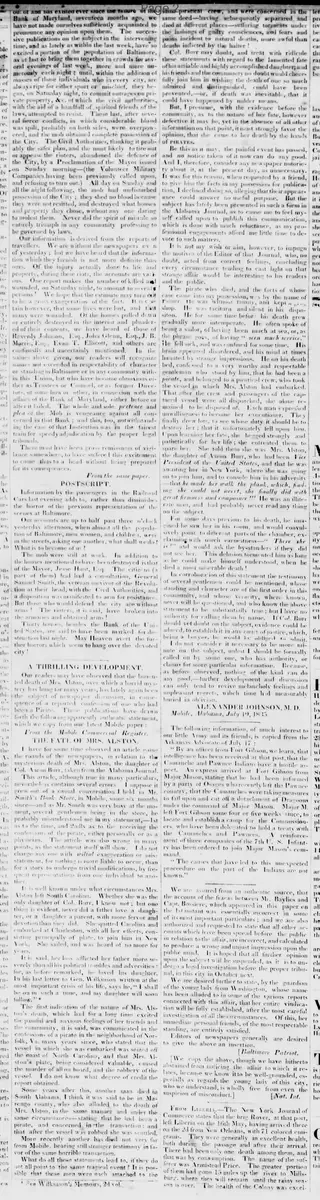
Our readers may have observed that the lamented death of Mrs. Alston, over which a horrid mystery has hung for many years, has lately again been the subject of newspaper discussion, in consequence of a reported confession of one who had been a Pirate. These publications have drawn forth the following apparently authentic statement, which we copy from our latest Mobile paper:
From the Mobile Commercial Register.
THE FATE OF MRS. ALSTON.
I have for some time observed an article going the rounds of the newspapers, in relation to the mysterious death of Mrs. Alston, the daughter of Col. Aaron Burr, taken from the Alabama Journal. This article, although true in many particulars, nevertheless contains several errors. I suppose it grew out of a casual conversation I held in Mr. Smith's Book Store, in Mobile, some six months since—and as Mr. Smith was very busy at the moment, several gentlemen being in the store, he probably misunderstood me in my statement,—1st as to the time, and 2ndly as to the receiving the confession, of the pirate, either personally or as a physician. The article was also wrong in many points, as the statement itself will show. I do not charge any one with wilful exaggeration or misstatement, for nothing is more liable to occur, than for a story to undergo trivial modifications, by frequent representations from one individual to another.
I well know under what circumstances Mrs. Alston left South Carolina. Whether she was the only daughter of Col. Burr, I know not; but one thing is evident, never did a father love a daughter, or a daughter a parent, with more fervor and devotion than they did. She quitted Carolina and embarked at Charleston, with all her effects, consisting principally of plate, to join him in New York. She sailed, and was heard of no more for years.
It is said, her loss afflicted her father more severely than all his political troubles and adversities: for, as before remarked, he loved his daughter. In his last letter to Gen. Wilkinson written at the most important crisis of his life, says he, "I shall be on my way such a time, and my daughter will soon follow."
The first indication of the nature of Mrs. Alston's death, which had for a long time excited the painful and anxious feelings of her friends and the community, it is said, was communicated in the confessions of a pirate in the neighborhood of Norfolk, Va. many years since, who stated that the vessel in which she was embarked was seized off the coast of North Carolina, and that Mrs. Alston's plate, being considered valuable, caused the murder of all on board, and the robbery of the vessel. I do not know what degree of credit the report obtained.
Some years after this, another man died in South Alabama. I think it was said to be in Marengo county, who also alluded to the death of Mrs. Alston, in the same manner and under the same circumstances—stating that he had been a pirate, and concerned in the transaction: and that after the vessel was robbed she was scuttled. More recently another has died not very far from Mobile, bearing still stronger testimony in favor of the same horrible transaction.
What do all these statements lead to, if they do not all point to the same tragical event? It is possible that these men were each attached to the same piratical crew, and were concerned in the same deed—having subsequently separated and died at different places—suffering torments under the lashings of guilty consciences, and fears and pains incident to natural deaths, more awful than deaths inflicted by the halter!
Col. Burr may doubt, and treat with ridicule these statements with regard to the lamented fate of his amiable and highly accomplished daughter; and his friends and the community no doubt would cheerfully join him in wishing the death of one so much admired and distinguished, could have been prevented, or, if death was inevitable, that it could have happened by milder means.
But, I presume, with the evidence before the community, as to the nature of her fate, however defective it may be, yet in the absence of all other information on that point, it must strongly favor the opinion, that she came to her death by the hands of PIRATES.
Be this as it may, the painful event has passed, and no notice taken of it now can do any good. And I, therefore, consider any newspaper notoriety about it, at the present day, as unnecessary. It was for this reason, when requested by a friend, to give him the facts in my possession for publication, I declined doing so, alleging that their appearance could answer no useful purpose. But the subject has lately been presented in such a form in the Alabama Journal, as to cause me to feel myself called upon to publish this communication, which is done with much reluctance, as my professional engagements afford me little time to devote to such matters.
It is not my wish or aim, however, to impugn the motives of the Editor of that Journal, who, no doubt, acted from correct feelings, concluding every circumstance tending to cast light on that strange affair would be interesting to his readers and the public.
The pirate who died, and the facts of whose case came into my possession, was by the name of Foster. He was without family, and kept a shoe shop. I was his physician. He was taciturn and silent in his disposition. He for some time before his death grew gradually more intemperate. He often spoke of being a sailor, of having been much at sea, or, as the phrase goes, of having "seen much service."
He fell sick, and was confined for some time. His brain appeared disordered, and his mind at times haunted by strange impressions. He on his death bed, confessed to a very worthy and respectable gentleman who stood by him, that he had been a pirate, and belonged to a piratical crew, who took the vessel in which Mrs. Alston had embarked. That after the crew and passengers of the captured vessel were all dispatched, she alone remained to be disposed of. Each man expressed unwillingness to become her executioner. They finally drew lots, to see whose duty it should be to destroy her; that it unfortunately fell upon him.
Upon learning her fate, she begged strongly and pathetically for her life; she entreated them to spare her. She told them she was Mrs. Alston, the daughter of Aaron Burr, who had been Vice President of the United States, and that he was awaiting her in New York, where she was going on to join him, and to console him in his adversities—that he made her walk the plank, which, finding she could not avert, she finally did with great firmness and composure!! He was an illiterate man, and had probably never read any thing on the subject.
For some days previous to his death, he imagined he saw her in his room, and would convulsively point to different parts of the chamber, exclaiming with much earnestness—“There she is!” and would ask the by-standers if they did not see her. This delusion tormented him as long as he could make himself understood, when he died a most miserable death!
In corroboration of this statement the testimony of several gentlemen could be mentioned, whose standing and character are of the first order in this community, and whose veracity, where known, never will be questioned, and who know the above statement to be substantially true; but I have no authority for calling them by name. If Col. Burr should yet doubt on the subject, evidence could be adduced, to establish it in any court of justice, which, being a lawyer, he would be obliged to admit.
I do not consider it necessary to be more minute on the subject, unless I should be formally called on by some one, who has authority, or claims for more particular information. Because, as before observed, nothing of the kind can do any good,—further development and discussion can only tend to revive melancholy feelings and unpleasant regrets, which time had measurably buried in oblivion.
ALEXANDER JOHNSON, M. D.
Mobile, Alabama, July 19, 1835.
What sub-type of article is it?
What themes does it cover?
What keywords are associated?
What entities or persons were involved?
Where did it happen?
Story Details
Key Persons
Location
Off The Coast Of North Carolina; Near Mobile, Alabama
Event Date
Many Years Since
Story Details
Mrs. Alston embarked from Charleston to join her father in New York but her vessel was seized by pirates off North Carolina. They murdered all aboard for her valuables; lots were drawn to decide her executioner, Foster, who made her walk the plank despite her pleas. Foster confessed on his deathbed to Johnson, haunted by visions of her.