Thank you for visiting SNEWPapers!
Sign up free
The Freeman's Journal, Or, New Hampshire Gazette
Portsmouth, Rockingham County, New Hampshire
What is this article about?
A British officer's letter details the amusements in occupied Boston, rebel shelling and fortification of Dorchester Heights, and the subsequent evacuation of British forces from March 3 to 17, 1776, amid the American Revolution.
Clipping
OCR Quality
Full Text
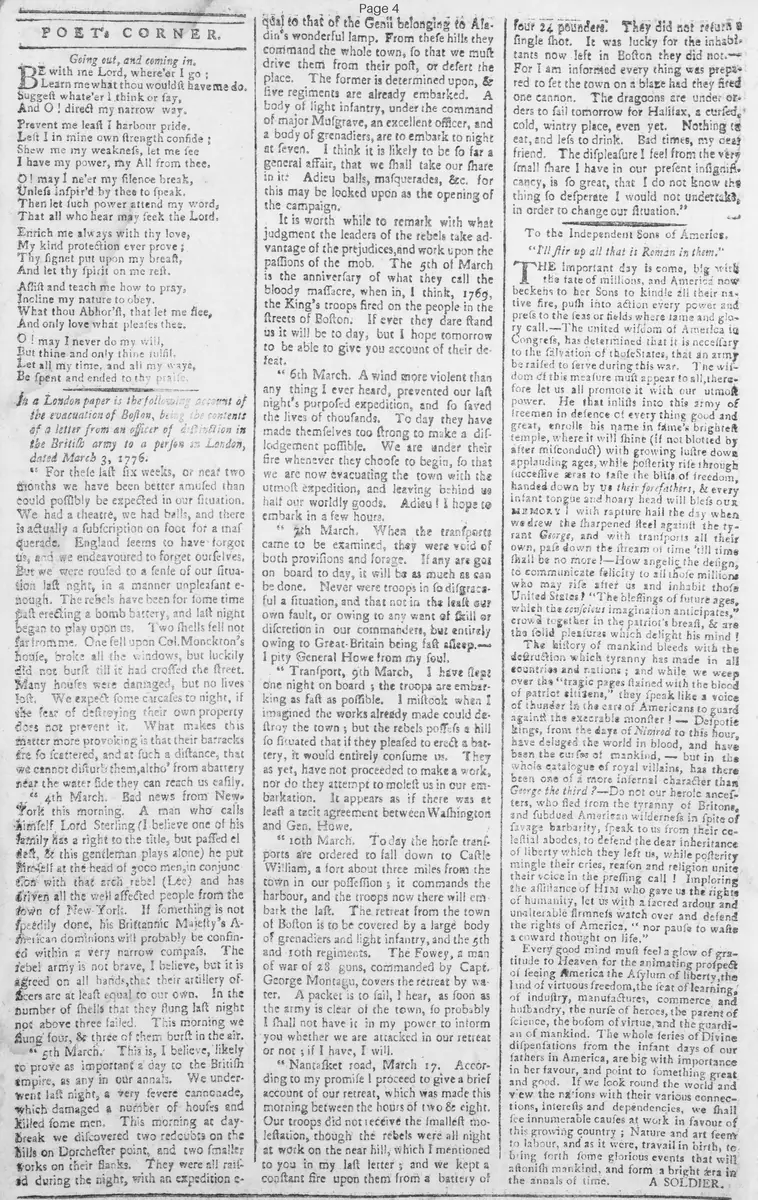
For these last six weeks, or near two months we have been better amused than could possibly be expected in our situation. We had a theatre, we had balls, and there is actually a subscription on foot for a masquerade. England seems to have forgot us, and we endeavoured to forget ourselves. But we were roused to a sense of our situation last night, in a manner unpleasant enough. The rebels have been for some time past erecting a bomb battery, and last night began to play upon us. Two shells fell not far from me. One fell upon Col. Monckton's house, broke all the windows, but luckily did not burst till it had crossed the street. Many houses were damaged, but no lives lost. We expect some carcasses to night, if the fear of destroying their own property does not prevent it. What makes this matter more provoking is that their barracks are so scattered, and at such a distance, that we cannot disturb them, altho' from a battery near the water side they can reach us easily.
4th March. Bad news from New York this morning. A man who calls himself Lord Sterling (I believe one of his family has a right to the title, but passed eldest. & this gentleman plays alone) he put himself at the head of 2000 men, in conjunction with that arch rebel (Lee) and has driven all the well affected people from the town of New York. If something is not speedily done, his Britannic Majesty's American dominions will probably be confined within a very narrow compass. The rebel army is not brave, I believe, but it is agreed on all hands, that their artillery officers are at least equal to our own. In the number of shells that they flung last night not above three failed. This morning we hung four, & three of them burst in the air.
5th March. This is, I believe, likely to prove as important a day to the British empire, as any in our annals. We underwent last night, a very severe cannonade, which damaged a number of houses and killed some men. This morning at day-break we discovered two redoubts on the hills on Dorchester point, and two smaller works on their flanks. They were all raised during the night, with an expedition equal to that of the Genii belonging to Aladdin's wonderful lamp. From these hills they command the whole town, so that we must drive them from their post, or desert the place. The former is determined upon, & five regiments are already embarked. A body of light infantry, under the command of major Musgrave, an excellent officer, and a body of grenadiers, are to embark to night at seven. I think it is likely to be so far a general affair, that we shall take our share in it: Adieu balls, masquerades, &c. for this may be looked upon as the opening of the campaign.
It is worth while to remark with what judgment the leaders of the rebels take advantage of the prejudices, and work upon the passions of the mob. The 5th of March is the anniversary of what they call the bloody massacre, when in, I think, 1770, the King's troops fired on the people in the streets of Boston: If ever they dare stand us it will be to day. but I hope tomorrow to be able to give you account of their defeat.
6th March. A wind more violent than any thing I ever heard, prevented our last night's purposed expedition, and so saved the lives of thousands. To day they have made themselves too strong to make a dislodgement possible. We are under their fire whenever they choose to begin, so that we are now evacuating the town with the utmost expedition, and leaving behind us half our worldly goods. Adieu! I hope to embark in a few hours.
7th March. When the transports came to be examined, they were void of both provisions and forage. If any are got on board to day, it will be as much as can be done. Never were troops in so disgraceful a situation, and that not in the least our own fault, or owing to any want of skill or discretion in our commander, but entirely owing to Great-Britain being fast asleep. I pity General Howe from my soul.
Transport, 9th March, I have slept one night on board; the troops are embarking as fast as possible. I mistook when I imagined the works already made could destroy the town; but the rebels possess a hill so situated that if they pleased to erect a battery, it would entirely consume us. They as yet, have not proceeded to make a work, nor do they attempt to molest us in our embarkation. It appears as if there was at least a tacit agreement between Washington and Gen. Howe.
10th March. Today the horse transports are ordered to fall down to Castle William, a fort about three miles from the town in our possession: it commands the harbour, and the troops now there will embark last. The retreat from the town of Boston is to be covered by a large body of grenadiers and light infantry, and the 47th and 52d regiments. The Fowey, a man of war of 28 guns, commanded by Capt. George Montagu, covers the retreat by water. A packet is to sail, I hear, as soon as the army is clear of the town, so probably I shall not have it in my power to inform you whether we are attacked in our retreat or not: if I have, I will.
Nantasket road, March 17. According to my promise I proceed to give a brief account of our retreat, which was made this morning between the hours of two & eight. Our troops did not receive the smallest molestation, though the rebels were all night at work on the near hill, which I mentioned to you in my last letter: and we kept a constant fire upon them from a battery of four 24 pounders. They did not return a single shot. It was lucky for the inhabitants now left in Boston they did not.-- For I am informed every thing was prepared to set the town on a blaze had they fired one cannon. The dragoons are under orders to sail tomorrow for Halifax, a cursed, cold, wintry place, even yet. Nothing to eat, and less to drink. Bad times, my dear friend. The displeasure I feel from the very small share I have in our present insignificance, is so great, that I do not know the thing so desperate I would not undertake, in order to change our situation.
What sub-type of article is it?
What keywords are associated?
What entities or persons were involved?
Where did it happen?
Domestic News Details
Primary Location
Boston
Event Date
March 3–17, 1776
Key Persons
Outcome
houses damaged by shelling; some men killed in cannonade; successful evacuation without molestation; troops leaving behind goods and facing shortages.
Event Details
British forces in Boston faced rebel shelling and rapid fortification of Dorchester Heights on March 5, 1776, leading to a decision to evacuate. A planned assault was halted by wind; troops embarked amid poor provisions, retreating unopposed on March 17 to Nantasket Road, bound for Halifax.