Thank you for visiting SNEWPapers!
Sign up free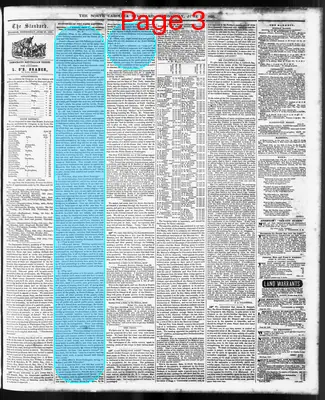
Editorial
June 27, 1855
Semi Weekly Standard
Raleigh, Wake County, North Carolina
What is this article about?
This editorial, part of a series, uses a Q&A format to criticize Know-Nothingism as a sectarian and political secret society that discriminates against Catholics and immigrants through binding oaths, contrasting it with the benevolent, non-political Masons and Odd Fellows. It argues against secrecy in politics and urges Know-Nothing members to withdraw.
Clipping
OCR Quality
98%
Excellent
Full Text
Series
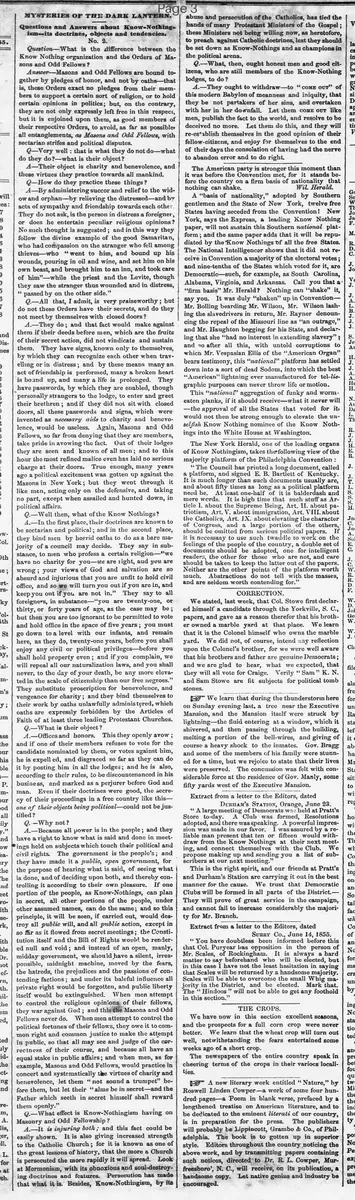
Questions and Answers about Know-Nothingism—its doctrines, objects and tendencies.
No. 2.
Question—What is the difference between the Know Nothing organization and the Orders of Masons and Odd Fellows?
Answer—Masons and Odd Fellows are bound together by pledges of honor, and not by oaths—that is, these Orders exact no pledges from their members to support a certain sort of religion, or to hold certain opinions in politics; but, on the contrary, they are not only expressly left free in this respect, but it is enjoined upon them, as good members of their respective Orders, to avoid, as far as possible all entanglements, as Masons and Odd Fellows, with sectarian strifes and political disputes.
Q—Very well: that is what they do not do—what do they do?—what is their object?
A—Their object is charity and benevolence, and these virtues they practice towards all mankind.
Q—How do they practice these things?
A—By administering succor and relief to the widow and orphan—by relieving the distressed—and by acts of sympathy and friendship towards each other. They do not ask, is the person in distress a foreigner, or does he entertain peculiar religious opinions? No such thought is suggested; and in this way they follow the divine example of the good Samaritan, who had compassion on the stranger who fell among thieves—who "went to him, and bound up his wounds, pouring in oil and wine, and set him on his own beast, and brought him to an inn, and took care of him"—while the priest and the Levite, though they saw the stranger thus wounded and in distress, "passed by on the other side."
Q.—All that, I admit, is very praiseworthy; but do not these Orders have their secrets, and do they not meet by themselves with closed doors?
A.—They do; and that fact would make against them if their deeds before men, which are the fruits of their secret action, did not vindicate and sustain them. They have signs, known only to themselves, by which they can recognize each other when travelling or in distress; and by these means many an act of friendship is performed, many a broken heart is bound up, and many a life is prolonged. They have passwords, by which they are enabled, though personally strangers to the lodge, to enter and greet their brethren; and if they did not sit with closed doors, all these passwords and signs, which were invented as necessary aids to charity and benevolence, would be useless. Again, Masons and Odd Fellows, so far from denying that they are members, take pride in avowing the fact. Out of their lodges they are seen and known of all men; and to this hour the most refined malice even has laid no serious charge at their doors. True enough, many years ago a political excitement was gotten up against the Masons in New York; but they went through it like men, acting only on the defensive, and taking no part, except when assailed and hunted down, in political affairs.
Q.—Well then, what of the Know Nothings?
A.—In the first place, their doctrines are known to be sectarian and political; and in the second place, they bind men by horrid oaths to do as a bare majority of a council may decide. They say in substance, to men who profess a certain religion—“we have no charity for you—we are right, and you are wrong; your views of God and salvation are so absurd and injurious that you are unfit to hold civil office, and so we will turn you out if you are in, and keep you out if you are not in.” They say to all foreigners, in substance—“you are twenty-one, or thirty, or forty years of age, as the case may be; but then you are too ignorant to be permitted to vote and hold office in the space of five years; you must go down to a level with our infants, and remain here, as they do, twenty-one years, before you shall enjoy any civil or political privileges—before you shall hold property even; and if you complain, we will repeal all our naturalization laws, and you shall never, to the day of your death, be any more elevated in the scale of citizenship than our free negroes.” They substitute proscription for benevolence, and vengeance for charity; and they bind themselves to their work by oaths unlawfully administered, which oaths are expressly forbidden by the Articles of Faith of at least three leading Protestant Churches.
Q.—What is their object?
A.—Offices and honors. This they openly avow; and if one of their members refuses to vote for the candidate nominated by them, or votes against him, he is expelled, and disgraced so far as they can do it by posting him in all the lodges; and he is also, according to their rules, to be discountenanced in his business, and marked as a perjurer before God and man. Even if their doctrines were good, the secrecy of their proceedings in a free country like this—one of their objects being political—could not be justified?
Q.—Why not?
A.—Because all power is in the people; and they have a right to know what is said and done in meetings held on subjects which touch their political and civil rights. The government is the people's; and they have made it a public, open government, for the purpose of hearing what is said, of seeing what is done, and of deciding upon both, and thereby controlling it according to their own pleasure. If one portion of the people, as Know-Nothings, can plan in secret, all other portions of the people, under other assumed names, can do the same; and so this principle, it will be seen, if carried out, would destroy all public will, and all public action, except in so far as it flowed from secret meetings; the Constitution itself and the Bill of Rights would be rendered null and void; and instead of an open, manly, midday government, we should have a silent, irresponsible, midnight machine, moved by the fears, the hatreds, the prejudices and the passions of contending factions; and under its baleful influence all private right would be forgotten, and public liberty itself would be extinguished. When men attempt to control the religious opinions of their fellows, they war against God; and this the Masons and Odd Fellows never do. When men attempt to control the political fortunes of their fellows, they owe it to common right and common justice to make the attempt in public, so that all may see and judge of the correctness of their course, and because all have an equal stake in public affairs; and when men, as for example, Masons and Odd Fellows, would practice in concert and systematically the virtues of charity and benevolence, let them "not sound a trumpet" before them, but let their "alms be in secret—and the Father which seeth in secret himself shall reward them openly."
Q.—What effect is Know-Nothingism having on Masonry and Odd Fellowship?
A.—It is injuring both; and this fact could be easily shown. It is also giving increased strength to the Catholic Church; for it is known as one of the great lessons of history, that the more a Church is persecuted the more rapidly it will spread. Look at Mormonism, with its obnoxious and soul-destroying doctrines and features. Persecution has made that what it is. Besides, Know-Nothingism, by its abuse and persecution of the Catholics, has tied the hands of many Protestant Ministers of the Gospel; these Ministers not being willing now, as heretofore, to preach against Catholic doctrines, lest they should be set down as Know-Nothings and as champions in the political arena.
Q.—What, then, ought honest men and good citizens, who are still members of the Know-Nothing lodges, to do?
A.—They ought to withdraw—to "come out" of this modern Babylon of meanness and iniquity, that they be not partakers of her sins, and overtaken with her in her downfall. Let them come out like men, publish the fact to the world, and resolve to be deceived no more. Let them do this, and they will re-establish themselves in the good opinion of their fellow-citizens, and enjoy for themselves to the end of their days the consolation of having had the nerve to abandon error and to do right.
Questions and Answers about Know-Nothingism—its doctrines, objects and tendencies.
No. 2.
Question—What is the difference between the Know Nothing organization and the Orders of Masons and Odd Fellows?
Answer—Masons and Odd Fellows are bound together by pledges of honor, and not by oaths—that is, these Orders exact no pledges from their members to support a certain sort of religion, or to hold certain opinions in politics; but, on the contrary, they are not only expressly left free in this respect, but it is enjoined upon them, as good members of their respective Orders, to avoid, as far as possible all entanglements, as Masons and Odd Fellows, with sectarian strifes and political disputes.
Q—Very well: that is what they do not do—what do they do?—what is their object?
A—Their object is charity and benevolence, and these virtues they practice towards all mankind.
Q—How do they practice these things?
A—By administering succor and relief to the widow and orphan—by relieving the distressed—and by acts of sympathy and friendship towards each other. They do not ask, is the person in distress a foreigner, or does he entertain peculiar religious opinions? No such thought is suggested; and in this way they follow the divine example of the good Samaritan, who had compassion on the stranger who fell among thieves—who "went to him, and bound up his wounds, pouring in oil and wine, and set him on his own beast, and brought him to an inn, and took care of him"—while the priest and the Levite, though they saw the stranger thus wounded and in distress, "passed by on the other side."
Q.—All that, I admit, is very praiseworthy; but do not these Orders have their secrets, and do they not meet by themselves with closed doors?
A.—They do; and that fact would make against them if their deeds before men, which are the fruits of their secret action, did not vindicate and sustain them. They have signs, known only to themselves, by which they can recognize each other when travelling or in distress; and by these means many an act of friendship is performed, many a broken heart is bound up, and many a life is prolonged. They have passwords, by which they are enabled, though personally strangers to the lodge, to enter and greet their brethren; and if they did not sit with closed doors, all these passwords and signs, which were invented as necessary aids to charity and benevolence, would be useless. Again, Masons and Odd Fellows, so far from denying that they are members, take pride in avowing the fact. Out of their lodges they are seen and known of all men; and to this hour the most refined malice even has laid no serious charge at their doors. True enough, many years ago a political excitement was gotten up against the Masons in New York; but they went through it like men, acting only on the defensive, and taking no part, except when assailed and hunted down, in political affairs.
Q.—Well then, what of the Know Nothings?
A.—In the first place, their doctrines are known to be sectarian and political; and in the second place, they bind men by horrid oaths to do as a bare majority of a council may decide. They say in substance, to men who profess a certain religion—“we have no charity for you—we are right, and you are wrong; your views of God and salvation are so absurd and injurious that you are unfit to hold civil office, and so we will turn you out if you are in, and keep you out if you are not in.” They say to all foreigners, in substance—“you are twenty-one, or thirty, or forty years of age, as the case may be; but then you are too ignorant to be permitted to vote and hold office in the space of five years; you must go down to a level with our infants, and remain here, as they do, twenty-one years, before you shall enjoy any civil or political privileges—before you shall hold property even; and if you complain, we will repeal all our naturalization laws, and you shall never, to the day of your death, be any more elevated in the scale of citizenship than our free negroes.” They substitute proscription for benevolence, and vengeance for charity; and they bind themselves to their work by oaths unlawfully administered, which oaths are expressly forbidden by the Articles of Faith of at least three leading Protestant Churches.
Q.—What is their object?
A.—Offices and honors. This they openly avow; and if one of their members refuses to vote for the candidate nominated by them, or votes against him, he is expelled, and disgraced so far as they can do it by posting him in all the lodges; and he is also, according to their rules, to be discountenanced in his business, and marked as a perjurer before God and man. Even if their doctrines were good, the secrecy of their proceedings in a free country like this—one of their objects being political—could not be justified?
Q.—Why not?
A.—Because all power is in the people; and they have a right to know what is said and done in meetings held on subjects which touch their political and civil rights. The government is the people's; and they have made it a public, open government, for the purpose of hearing what is said, of seeing what is done, and of deciding upon both, and thereby controlling it according to their own pleasure. If one portion of the people, as Know-Nothings, can plan in secret, all other portions of the people, under other assumed names, can do the same; and so this principle, it will be seen, if carried out, would destroy all public will, and all public action, except in so far as it flowed from secret meetings; the Constitution itself and the Bill of Rights would be rendered null and void; and instead of an open, manly, midday government, we should have a silent, irresponsible, midnight machine, moved by the fears, the hatreds, the prejudices and the passions of contending factions; and under its baleful influence all private right would be forgotten, and public liberty itself would be extinguished. When men attempt to control the religious opinions of their fellows, they war against God; and this the Masons and Odd Fellows never do. When men attempt to control the political fortunes of their fellows, they owe it to common right and common justice to make the attempt in public, so that all may see and judge of the correctness of their course, and because all have an equal stake in public affairs; and when men, as for example, Masons and Odd Fellows, would practice in concert and systematically the virtues of charity and benevolence, let them "not sound a trumpet" before them, but let their "alms be in secret—and the Father which seeth in secret himself shall reward them openly."
Q.—What effect is Know-Nothingism having on Masonry and Odd Fellowship?
A.—It is injuring both; and this fact could be easily shown. It is also giving increased strength to the Catholic Church; for it is known as one of the great lessons of history, that the more a Church is persecuted the more rapidly it will spread. Look at Mormonism, with its obnoxious and soul-destroying doctrines and features. Persecution has made that what it is. Besides, Know-Nothingism, by its abuse and persecution of the Catholics, has tied the hands of many Protestant Ministers of the Gospel; these Ministers not being willing now, as heretofore, to preach against Catholic doctrines, lest they should be set down as Know-Nothings and as champions in the political arena.
Q.—What, then, ought honest men and good citizens, who are still members of the Know-Nothing lodges, to do?
A.—They ought to withdraw—to "come out" of this modern Babylon of meanness and iniquity, that they be not partakers of her sins, and overtaken with her in her downfall. Let them come out like men, publish the fact to the world, and resolve to be deceived no more. Let them do this, and they will re-establish themselves in the good opinion of their fellow-citizens, and enjoy for themselves to the end of their days the consolation of having had the nerve to abandon error and to do right.
What sub-type of article is it?
Immigration
Moral Or Religious
Partisan Politics
What keywords are associated?
Know Nothingism
Secret Societies
Immigration Discrimination
Anti Catholicism
Masonry
Odd Fellows
Political Oaths
Nativism
What entities or persons were involved?
Know Nothings
Masons
Odd Fellows
Catholics
Foreigners
Protestant Churches
Editorial Details
Primary Topic
Critique Of Know Nothingism's Doctrines And Secrecy
Stance / Tone
Strongly Anti Know Nothing, Pro Masons And Odd Fellows
Key Figures
Know Nothings
Masons
Odd Fellows
Catholics
Foreigners
Protestant Churches
Key Arguments
Masons And Odd Fellows Promote Non Sectarian Charity Without Political Involvement
Know Nothings Impose Sectarian And Political Oaths Discriminating Against Catholics And Immigrants
Secrecy In Political Organizations Undermines Public Government And Liberty
Know Nothingism Harms Masonry, Odd Fellowship, And Strengthens Catholicism Through Persecution
Members Should Withdraw From Know Nothing Lodges To Uphold Justice