Thank you for visiting SNEWPapers!
Sign up free
The Detroit Times
Detroit, Wayne County, Michigan
What is this article about?
In Detroit, amid a severe coal shortage blamed on railroad mismanagement, operator A.H. Land predicts free flow within a week via rerouting. Fuel admin Prudden seizes 18,000 tons from boats for relief; prices fixed, conservation urged including Christmas closures and lightless nights. 10,000 WV miners idle.
Clipping
OCR Quality
Full Text
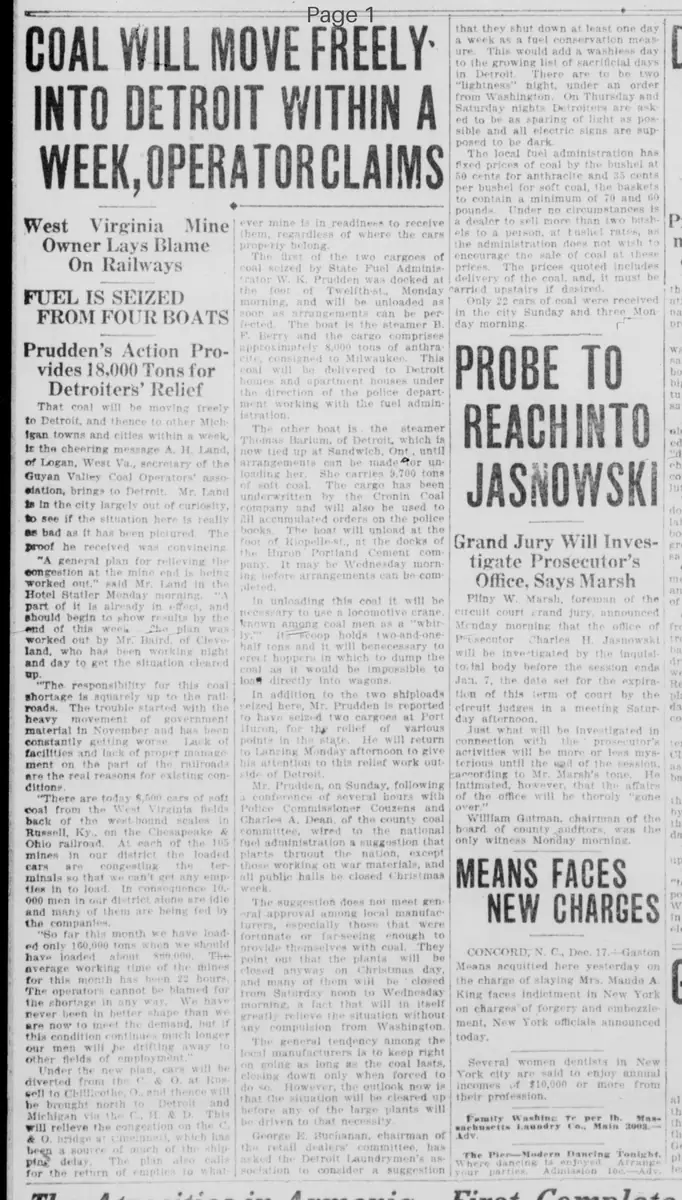
West Virginia Mine Owner: Lays Blame On Railways
FUEL IS SEIZED FROM FOUR BOATS
Prudden's Action Provides 18,000 Tons for Detroiters' Relief
That coal will be moving freely to Detroit, and thence to other Michigan towns and cities within a week, is the cheering message A. H. Land, of Logan, West Va., secretary of the Guyan Valley Coal Operators' association, brings to Detroit. Mr. Land is in the city largely out of curiosity to see if the situation here is really as bad as it has been pictured. The proof he received was convincing.
A general plan for relieving the congestion at the mines and is being worked out," said Mr. Land in the Hotel Statler Monday morning. "A part of it is already in effect, and should begin to show results by the end of this week. The plan was worked out by Mr. Baird of Cleveland, who has been working night and day to get the situation cleared up.
"The responsibility for this coal shortage is squarely up to the railroads. The trouble started with the heavy movement of government material in November and has been constantly getting worse. Lack of facilities and lack of proper management on the part of the railroads are the real reasons for existing conditions.
"There are today 5,000 cars of soft coal from the West Virginia field back of the west bound scales at Russell, Ky., on the Chesapeake & Ohio railroad. At each of the 15 mines in our district the loaded cars are congesting the terminals so that we can't get any empties in to load. In consequence 10,000 men in our district alone are idle and many of them are being fed by the companies.
"So far this month we have loaded only 160,000 tons when we should have loaded about 500,000. The average working time of the mines for this month has been 22 hours. The operators cannot be blamed for the shortage in any way. We have never been in better shape than we are now to meet the demand, but if this condition continues much longer our men will be drifting away to other fields of employment."
Under the new plan, cars will be diverted from the C. & O. at Kenova to Chillicothe, O., and thence will be brought north to Detroit and Michigan via the N. Y. C. This will relieve the congestion on the C. & O. bridge at Cincinnati, which has been a source of much of the shipping delay.
The plan also calls for the return of empties to the mines. Every mine is in readiness to receive them, regardless of where the cars properly belong.
The first of the two cargoes of coal seized by State Fuel Administrator W. K. Prudden was docked at the foot of Twelfth st. Monday morning, and will be unloaded as soon as arrangements can be perfected. The boat is the steamer B. F. Herrs and the cargo comprises approximately 8,000 tons of anthracite consigned to Milwaukee. This coal will be delivered to Detroit homes and apartment houses under the direction of the police department working with the fuel administration.
The other boat is the steamer Thomas Barlum, of Detroit, which is now tied up at Sandwich, Ont., until arrangements can be made for unloading her. She carries 7,000 tons of soft coal. The cargo has been underwritten by the Cronin Coal company and will also be used to fill accumulated orders on the police books. The boat will unload at the foot of Riopelle st. at the docks of the Huron Portland Cement company. It may be Wednesday morning before arrangements can be completed.
In unloading this coal it will be necessary to use a locomotive crane known among coal men as a "whirly." Its scoop holds two and one half tons and it will be necessary to erect hoppers in which to dump the coal as it would be impossible to load directly into wagons.
In addition to the two shiploads seized here, Mr. Prudden is reported to have seized two cargoes at Port Huron, for the relief of various points in the state. He will return to Lansing Monday afternoon to give his attention to this relief work out side of Detroit.
Mr. Prudden, on Sunday, following a conference of several hours with Police Commissioner Couzens and Charles A. Dean, of the county coal committee, wired to the national fuel administration a suggestion that plants throughout the nation, except those working on war materials, and all public halls be closed Christmas week.
The suggestion does not meet general approval among local manufacturers, especially those that were fortunate or farseeing enough to lay in a supply of coal. They point out that the plants will be closed anyway on Christmas day, and many of them will be closed from Saturday noon to Wednesday morning, a fact that will in itself greatly relieve the situation without any compulsion from Washington.
The general tendency among the local manufacturers is to keep right on going as long as the coal lasts, closing down only when forced to do so. However, the outlook now is that the situation will be cleared up before any of the large plants will be driven to that necessity.
George E. Buchanan, chairman of the retail dealers' committee, has asked the Detroit Laundrymen's association to consider a suggestion that they shut down at least one day a week as a fuel conservation measure. This would add a washless day to the growing list of sacrificial days in Detroit. There are to be two "lightless" nights, under an order from Washington. On Thursday and Saturday nights Detroiters are asked to be as sparing of light as possible and all electric signs are supposed to be dark.
The local fuel administration has fixed prices of coal by the bushel at 50 cents for anthracite and 35 cents per bushel for soft coal, the baskets to contain a minimum of 70 and 60 pounds. Under no circumstances is a dealer to sell more than two bushels to a person, at bushel rates, as the administration does not wish to encourage the sale of coal at these prices. The prices quoted include delivery of the coal, and it must be carried upstairs if desired.
Only 22 cars of coal were received in the city Sunday and three Monday morning.
What sub-type of article is it?
What keywords are associated?
What entities or persons were involved?
Where did it happen?
Domestic News Details
Primary Location
Detroit, Michigan
Key Persons
Outcome
18,000 tons of coal seized from four boats for detroit relief; 10,000 miners idle in west virginia; coal prices fixed at 50 cents per bushel for anthracite and 35 cents for soft coal; only 22 cars received sunday and three monday morning; suggestion to close plants christmas week and laundries one day a week.
Event Details
A. H. Land reports coal will move freely to Detroit within a week via new routing plan to relieve railroad congestion blamed on poor management and government material transport; State Fuel Administrator Prudden seizes coal cargoes from boats for local distribution; fuel conservation measures proposed including plant closures and lightless nights.