Thank you for visiting SNEWPapers!
Sign up free
The Ely Miner
Ely, Saint Louis County, Minnesota
What is this article about?
Prof. F. D. Gardner of Pennsylvania State College presents conclusions from over 40 years of fertilizer experiments, highlighting manure and fertilizer efficacy for maintaining crop yields and providing specific recommendations for corn, oats, wheat, clover, timothy, and lime use, at a recent Maryland Farm Bureau Federation meeting.
Clipping
OCR Quality
Full Text
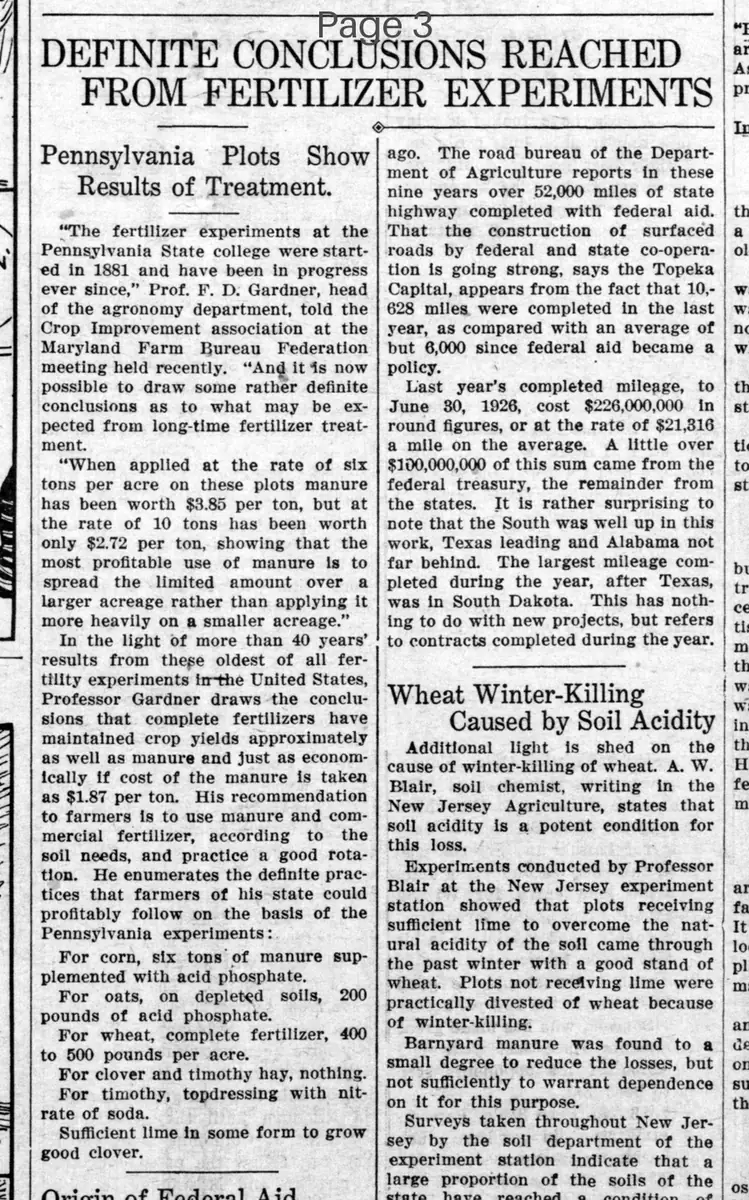
FROM FERTILIZER EXPERIMENTS
Pennsylvania Plots
Show
Results of Treatment.
"The fertilizer experiments at the Pennsylvania State college were started in 1881 and have been in progress ever since," Prof. F. D. Gardner, head of the agronomy department, told the Crop Improvement association at the Maryland Farm Bureau Federation meeting held recently. "And it is now possible to draw some rather definite conclusions as to what may be expected from long-time fertilizer treatment.
"When applied at the rate of six tons per acre on these plots manure has been worth $3.85 per ton, but at the rate of 10 tons has been worth only $2.72 per ton, showing that the most profitable use of manure is to spread the limited amount over a larger acreage rather than applying it more heavily on a smaller acreage."
In the light of more than 40 years' results from these oldest of all fertility experiments in the United States, Professor Gardner draws the conclusions that complete fertilizers have maintained crop yields approximately as well as manure and just as economically if cost of the manure is taken as $1.87 per ton. His recommendation to farmers is to use manure and commercial fertilizer, according to the soil needs, and practice a good rotation. He enumerates the definite practices that farmers of his state could profitably follow on the basis of the Pennsylvania experiments:
For corn, six tons of manure supplemented with acid phosphate.
For oats, on depleted soils, 200 pounds of acid phosphate.
For wheat, complete fertilizer, 400 to 500 pounds per acre.
For clover and timothy hay, nothing.
For timothy, topdressing with nitrate of soda.
Sufficient lime in some form to grow good clover.
What sub-type of article is it?
What keywords are associated?
What entities or persons were involved?
Where did it happen?
Domestic News Details
Primary Location
Pennsylvania State College
Event Date
Recently
Key Persons
Outcome
manure at 6 tons/acre worth $3.85/ton; at 10 tons/acre worth $2.72/ton. complete fertilizers maintain yields as well as manure at $1.87/ton cost. recommendations: corn (6 tons manure + acid phosphate), oats (200 lbs acid phosphate on depleted soils), wheat (400-500 lbs complete fertilizer/acre), clover/timothy hay (nothing), timothy (nitrate of soda topdressing), sufficient lime for clover.
Event Details
Prof. F. D. Gardner discussed 40+ years of fertilizer experiments started in 1881 at Pennsylvania State College, drawing conclusions on long-term treatment effects. He advised spreading limited manure over larger areas for profitability and combining manure, commercial fertilizers, and crop rotation based on soil needs. Specific practices for Pennsylvania farmers include tailored applications for corn, oats, wheat, clover, timothy hay, and timothy.