Thank you for visiting SNEWPapers!
Sign up free
The Camden Weekly Journal
Camden, Kershaw County, South Carolina
What is this article about?
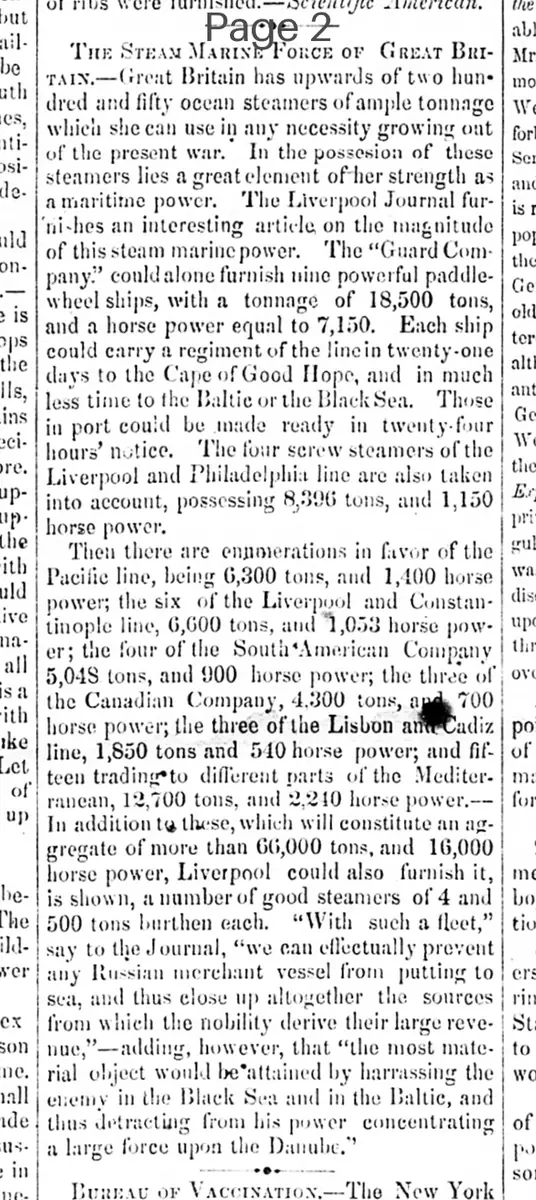
Article details Great Britain's extensive steam marine force, comprising over 250 ocean steamers, highlighting their tonnage, horsepower, and potential for rapid troop transport and naval blockade in the ongoing war against Russia in the Baltic, Black Sea, and Danube regions.
Clipping
OCR Quality
Full Text
Then there are enumerations in favor of the Pacific line, being 6,300 tons, and 1,400 horse power; the six of the Liverpool and Constantinople line, 6,600 tons, and 1,053 horse power; the four of the South American Company 5,048 tons, and 900 horse power; the three of the Canadian Company, 4,300 tons, and 700 horse power; the three of the Lisbon and Cadiz line, 1,850 tons and 540 horse power; and fifteen trading to different parts of the Mediterranean, 12,700 tons, and 2,210 horse power.—In addition to these, which will constitute an aggregate of more than 66,000 tons, and 16,000 horse power, Liverpool could also furnish it, is shown, a number of good steamers of 400 and 500 tons burthen each. "With such a fleet," say to the Journal, "we can effectually prevent any Russian merchant vessel from putting to sea, and thus close up altogether the sources from which the nobility derive their large revenue,"—adding, however, that "the most material object would be attained by harassing the enemy in the Black Sea and in the Baltic, and thus detracting from his power concentrating a large force upon the Danube."
What sub-type of article is it?
What keywords are associated?
Where did it happen?
Foreign News Details
Primary Location
Great Britain
Outcome
potential to blockade russian merchant vessels, harass enemy in black sea and baltic, prevent concentration of forces on danube; aggregate over 66,000 tons and 16,000 horsepower from listed steamers.
Event Details
Great Britain possesses over 250 ocean steamers for use in the present war, providing significant maritime strength. The Liverpool Journal details various companies' contributions: Guard Company (9 ships, 18,500 tons, 7,150 HP); Liverpool-Philadelphia line (4 ships, 8,306 tons, 1,150 HP); Pacific line (6,300 tons, 1,400 HP); Liverpool-Constantinople line (6 ships, 6,600 tons, 1,053 HP); South American Company (4 ships, 5,048 tons, 900 HP); Canadian Company (3 ships, 4,300 tons, 700 HP); Lisbon-Cadiz line (3 ships, 1,850 tons, 540 HP); Mediterranean traders (15 ships, 12,700 tons, 2,210 HP). Additional smaller steamers available. Ships can transport regiments quickly to Cape of Good Hope, Baltic, or Black Sea, ready in 24 hours.