Thank you for visiting SNEWPapers!
Sign up free
Story
September 27, 1821
Kentucky Gazette
Lexington, Fayette County, Kentucky
What is this article about?
Extracts from 1787 Constitutional Convention debates, featuring speakers like Madison, Hamilton, and others discussing national negation of state laws, representation issues, and balancing federal and state powers for effective government.
Clipping
OCR Quality
95%
Excellent
Full Text
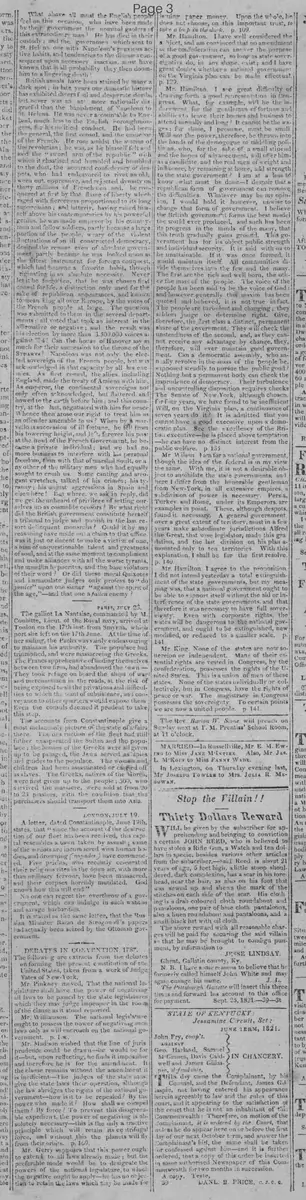
DEBATES IN CONVENTION 1787.
The following are extracts from the debates on forming the present constitution of the United States, taken from a work of Judge Yates of New-York.
Mr. Pinkney moved, That the national legislature shall have the power of negativing all laws to be passed by the state legislatures which they may judge improper in the room of the clause as it stood reported
Mr. Williamson. The national legislature ought to possess the power of negativing such laws only as will encroach on the national government. p. 1.
Mr. Madison wished that the line of jurisprudence could be drawn—he would be for it—but, upon reflecting, he finds it impossible and therefore he is for the amendment. If the clause remains without the amendment it is inefficient—The judges of the state must give the state laws their operation, although the law abridges the rights of the national government—how is it to be repealed? By the power who made it? How shall we compel them? By force? To prevent this disagreeable expedient, the power of negativing is absolutely necessary—this is the only attractive principle which will retain its centrifugal force, and without this the planets will fly from their orbits. p. 169.
Mr. Gerry supposes that this power ought to extend to all laws already made; but the preferable mode would be to designate the powers of the national legislature, to which the negative ought to apply—he has no objection to retain the laws which may be made for issuing paper money. Upon the whole, he does not choose, on this important trust, to take a leap in the dark. p. 109
Mr Hamilton. I have well considered the subject, and am convinced that no amendment of the confederation can answer the purpose of a good government, so long as state sovereignties do, in any shape, exist; and I have great doubts whether a national government on the Virginia plan can be made effectual p. 129.
Mr. Hamilton I see great difficulty of drawing forth a good representation in Congress. What, for example, will be the inducement for the gentleman of fortune and abilities to leave their houses and business to attend annually and long? It cannot be the wages; for these, I presume, must be small Will not the power, therefore, be thrown into the hands of the demagogue or middling politician, who, for the sake of a small stipend and the hopes of advancement, will offer himself a candidate, and the real men of weight and influence, by remaining at home, add strength to the state government? I am at a loss to know what must be done—I despair that a republican form of government can remove the difficulties. Whatever may be my opinion, I would hold it however, unwise to change that form of government. I believe the British government forms the best model the world ever produced. and such has been its progress in the minds of the many, that this truth gradually gains ground. This government has for its object public strength and individual security. It is said with us to be unattainable. If it was once formed, it would maintain itself All communities divide themselves into the few and the many. The first are the rich and well born, the other the mass of the people. The voice of the people has been said to be the voice of God : and however generally this maxim has been quoted and believed, it is not true in fact The people are turbulent and changing; they seldom judge or determine right. Give, therefore, the first class a distinct, permanent share of the government. They will check the unsteadiness of the second, and, as they cannot receive any advantage by change, they, therefore, will ever maintain good government. Can a democratic assembly, who annually revolve in the mass of the people be. supposed steadily to pursue the public good? Nothing but a permanent body can check the imprudence of democracy. Their turbulence and uncontrolling disposition requires checks The Senate of New.York, although chosen. for four years, we have found to be inefficient Will, on the Virginia plan, a continuance of seven years do it? It is admitted that you cannot have a good executive upon a democratic plan. See the excellency of the British executive—he is placed above temptation -he can have no distinct interest from the public welfare. p 135
Mr Wilson I am for a national government though the idea of the federal is in my view the same. With me, it is not a desirable object to annihilate the state governments: and here I differ from the honorable gentleman from New-York, in all extensive empires, a subdivision of power is necessary. Persia, Turkey. and Rome, under its Emperors, are examples in point. These, although despots. found it necessary. A general government over a great extent of territory, must in a few years make subordinate jurisdictions Alfred the Great, that wise legislator, made this gradation, and the last division on his plan a mounted only to ten territories. With this explanation, I shall be for the first resolve p. 140
Mr Hamilton I agree to the proposition I did not intend yesterday a total extinguishment of the state governments, but my meaning was, that a national government ought to be able to support itself without the aid or interference of the state governments, and that therefore it was necessary to have full sovereignty. Even with corporate rights, the states will be dangerous to the national government, and ought to be extinguished, new modified, or reduced to a smaller scale. p 141
Mr King. None of the states are now sovereign or independent. Many of their essential rights are vested in Congress, by the confederation. possesses the rights of the United States. This is a union of men of these states. None of the states individually or collectively, but in Congress, have the rights of peace or war. The magistracy in Congress possesses the sovereignty To certain points we are now a united people. p 141
The following are extracts from the debates on forming the present constitution of the United States, taken from a work of Judge Yates of New-York.
Mr. Pinkney moved, That the national legislature shall have the power of negativing all laws to be passed by the state legislatures which they may judge improper in the room of the clause as it stood reported
Mr. Williamson. The national legislature ought to possess the power of negativing such laws only as will encroach on the national government. p. 1.
Mr. Madison wished that the line of jurisprudence could be drawn—he would be for it—but, upon reflecting, he finds it impossible and therefore he is for the amendment. If the clause remains without the amendment it is inefficient—The judges of the state must give the state laws their operation, although the law abridges the rights of the national government—how is it to be repealed? By the power who made it? How shall we compel them? By force? To prevent this disagreeable expedient, the power of negativing is absolutely necessary—this is the only attractive principle which will retain its centrifugal force, and without this the planets will fly from their orbits. p. 169.
Mr. Gerry supposes that this power ought to extend to all laws already made; but the preferable mode would be to designate the powers of the national legislature, to which the negative ought to apply—he has no objection to retain the laws which may be made for issuing paper money. Upon the whole, he does not choose, on this important trust, to take a leap in the dark. p. 109
Mr Hamilton. I have well considered the subject, and am convinced that no amendment of the confederation can answer the purpose of a good government, so long as state sovereignties do, in any shape, exist; and I have great doubts whether a national government on the Virginia plan can be made effectual p. 129.
Mr. Hamilton I see great difficulty of drawing forth a good representation in Congress. What, for example, will be the inducement for the gentleman of fortune and abilities to leave their houses and business to attend annually and long? It cannot be the wages; for these, I presume, must be small Will not the power, therefore, be thrown into the hands of the demagogue or middling politician, who, for the sake of a small stipend and the hopes of advancement, will offer himself a candidate, and the real men of weight and influence, by remaining at home, add strength to the state government? I am at a loss to know what must be done—I despair that a republican form of government can remove the difficulties. Whatever may be my opinion, I would hold it however, unwise to change that form of government. I believe the British government forms the best model the world ever produced. and such has been its progress in the minds of the many, that this truth gradually gains ground. This government has for its object public strength and individual security. It is said with us to be unattainable. If it was once formed, it would maintain itself All communities divide themselves into the few and the many. The first are the rich and well born, the other the mass of the people. The voice of the people has been said to be the voice of God : and however generally this maxim has been quoted and believed, it is not true in fact The people are turbulent and changing; they seldom judge or determine right. Give, therefore, the first class a distinct, permanent share of the government. They will check the unsteadiness of the second, and, as they cannot receive any advantage by change, they, therefore, will ever maintain good government. Can a democratic assembly, who annually revolve in the mass of the people be. supposed steadily to pursue the public good? Nothing but a permanent body can check the imprudence of democracy. Their turbulence and uncontrolling disposition requires checks The Senate of New.York, although chosen. for four years, we have found to be inefficient Will, on the Virginia plan, a continuance of seven years do it? It is admitted that you cannot have a good executive upon a democratic plan. See the excellency of the British executive—he is placed above temptation -he can have no distinct interest from the public welfare. p 135
Mr Wilson I am for a national government though the idea of the federal is in my view the same. With me, it is not a desirable object to annihilate the state governments: and here I differ from the honorable gentleman from New-York, in all extensive empires, a subdivision of power is necessary. Persia, Turkey. and Rome, under its Emperors, are examples in point. These, although despots. found it necessary. A general government over a great extent of territory, must in a few years make subordinate jurisdictions Alfred the Great, that wise legislator, made this gradation, and the last division on his plan a mounted only to ten territories. With this explanation, I shall be for the first resolve p. 140
Mr Hamilton I agree to the proposition I did not intend yesterday a total extinguishment of the state governments, but my meaning was, that a national government ought to be able to support itself without the aid or interference of the state governments, and that therefore it was necessary to have full sovereignty. Even with corporate rights, the states will be dangerous to the national government, and ought to be extinguished, new modified, or reduced to a smaller scale. p 141
Mr King. None of the states are now sovereign or independent. Many of their essential rights are vested in Congress, by the confederation. possesses the rights of the United States. This is a union of men of these states. None of the states individually or collectively, but in Congress, have the rights of peace or war. The magistracy in Congress possesses the sovereignty To certain points we are now a united people. p 141
What sub-type of article is it?
Historical Event
What themes does it cover?
Moral Virtue
Social Manners
Justice
What keywords are associated?
Constitutional Convention
National Government
State Sovereignty
Legislative Power
Government Structure
What entities or persons were involved?
Mr. Pinkney
Mr. Williamson
Mr. Madison
Mr. Gerry
Mr Hamilton
Mr Wilson
Mr King
Where did it happen?
In Convention
Story Details
Key Persons
Mr. Pinkney
Mr. Williamson
Mr. Madison
Mr. Gerry
Mr Hamilton
Mr Wilson
Mr King
Location
In Convention
Event Date
1787
Story Details
Extracts from debates on forming the US Constitution, discussing national legislature's power to negate state laws, challenges of representation, preference for British government model, and balance between national and state governments.