Thank you for visiting SNEWPapers!
Sign up free
The Massachusetts Spy, And Worcester County Advertiser
Worcester, Worcester County, Massachusetts
What is this article about?
A letter from Smyrna describes dining with a Greek merchant whose son, a patriot in the Greek Revolution, escaped persecution, returned secretly to flee with his betrothed, but was betrayed by an Austrian captain and killed in a failed escape attempt.
Clipping
OCR Quality
Full Text
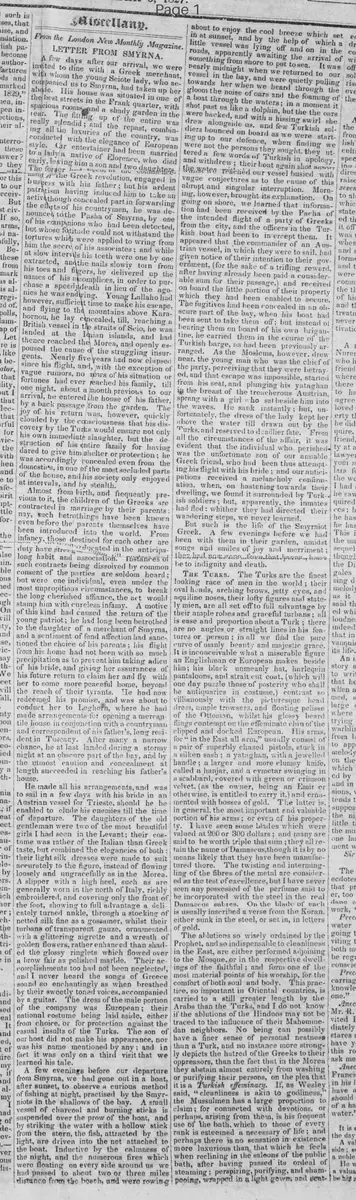
LETTER FROM SMYRNA.
A few days after our arrival, we were invited to dine with a Greek merchant, with whom the young Sciote lady, who accompanied us to Smyrna, had taken up her abode. His house was situated in one of the best streets in the Frank quarter, with spacious rooms and a shady garden in the rear. The fitting up of the entire was really splendid; and the repast, combining all the luxuries of the country, was conducted with the elegance of European style. Our entertainer had been married to a lady a native of Florence, who died early, leaving him a son and two daughters. The former had, by the commencement of the Greek revolution, engaged in business with his father; but his ardent patriotism having induced him to take an active though concealed part in forwarding the efforts of his countrymen, he was denounced to the Pasha of Smyrna, by one of his companions who had been detected, but whose fortitude could not withstand the tortures which were applied to wring from him the secret of his associates; and while at slow intervals his teeth were one by one extracted, and the nails slowly torn from his toes and fingers, he delivered up the names of his accomplices, in order to purchase a speedy death in lieu of the agonies he was enduring. Young Lallaho had, however, sufficient time to make his escape, and flying to the mountains above Karaborne, he lay concealed, till, reaching a British vessel in the straits of Scio, he was landed at the Indian islands, and had thence reached the Morea, and openly espoused the cause of the struggling insurgents. Nearly five years had now elapsed since his flight, and, with the exception of vague rumors, no news of his situation or fortunes had ever reached his family, till one night, about a month previous to our arrival, he entered the house of his father, by a back passage from the garden. The joy of his return was, however, quickly clouded by the consciousness that his discovery by the Turks would ensure not only his own immediate slaughter, but the destruction of his entire family for having dared to give him shelter or protection; he was accordingly concealed even from the domestics, in one of the most secluded parts of the house, and his society only enjoyed at intervals, and by stealth.
Almost from birth, and frequently previous to it, the children of the Greeks are contracted in marriage by their parents: nay, such betrothments have been known even before the parents themselves have been introduced into the world. From infancy, those destined for each other are educated in the anticipation of long habit and association. Instances of such contracts being dissolved by common consent of the parties are seldom heard: but were one individual, even under the most unpropitious circumstances, to break the long cherished affiance, the act would stamp him with cureless infamy. A motive of this kind had caused the return of the young patriot; he had long been betrothed to the daughter of a merchant of Smyrna, and a sentiment of fond affection had sanctioned the choice of his parents; his flight from his home had not been with so much precipitation as to prevent him taking adieu of his bride, and giving her assurances of his future return to claim her and fly with her to some more peaceful home, beyond the reach of their tyrants. He had now redeemed his promise, and was about to conduct her to Leghorn, where he had made arrangements for opening a mercantile house in conjunction with a countryman and correspondent of his father's, long resident in Tuscany. After many a narrow chance, he at last landed during a stormy night at an obscure part of the bay, and by the utmost caution and concealment at length succeeded in reaching his father's house.
He made all his arrangements, and was to sail in a few days with his bride in an Austrian vessel for Trieste, should he be enabled to elude his enemies till the time of departure. The daughters of the old gentleman were two of the most beautiful girls I had seen in the Levant; their costume was rather of the Italian than Greek taste, but combined the elegancies of both: their light silk dresses were made to suit accurately to the figure, instead of flowing loosely and ungracefully as in the Morea. A slipper with a high heel, such as are generally worn in the north of Italy, richly embroidered, and covering only the front of the foot, showing to full advantage a delicately turned ankle, through a stocking of netted silk fine as a gossamer, whilst their turbans of transparent gauze, ornamented with a glittering aigrette and a wreath of golden flowers, rather enhanced than shadowed the glossy ringlets which flowed over a brow fair as polished marble. Their accomplishments too had not been neglected, and I never heard the songs of Greece sound so enchantingly as when breathed by their sweetly toned voices, accompanied by a guitar. The dress of the male portion of the company was European; their national costume being laid aside, either from choice, or for protection against the casual insults of the Turks. The son of our host did not make his appearance, nor was his name mentioned by any: and in fact it was only on a third visit that we learned his tale.
A few evenings before our departure from Smyrna, we had gone out in a boat, after sunset, to observe a curious method of fishing at night, practised by the Smyrniots in the shallows of the bay. A small vessel of charcoal and burning sticks is suspended over the prow of the boat, and by striking the water with a hollow stick from the stern, the fish, attracted by the light, are driven into the net attached to the boat. Indulging in the calmness of the night, and the numerous fires which were floating on every side around us we had passed to about two or three miles distance from the beach, and were rowing about to enjoy the cool breeze which sets in at sunset, and by the help of which roads, apparently awaiting the arrival of something from shore to put to sea. It was nearly midnight when we returned to our vessel in the bay, and were quietly pulling towards her when we heard through the gloom the noise of oars and the foaming of a boat through the waters; in a moment it shot past us like a dolphin, but the oars were backed, and with a hissing swirl she drew alongside us, and few Turkish soldiers bounced on board as we were starting up to our defence, when finding we were not the persons they sought, they uttered a few words of Turkish in apology, and withdrew; their boat again shot across the waters reached our vessel busied with vague conjectures as to the cause of this abrupt and singular interruption. Morning, however, brought its explanation. On going on shore, we learned that information had been received by the Pacha of the intended flight of a party of Greeks from the city, and the officers in the Turkish boat had been to intercept them. It appeared that the commander of an Austrian vessel, in which they were to sail, had given notice of their intention to their government, (for the sake of a trifling reward, after having already been paid a considerable sum for their passage.) and received on board the little portion of their property which they had been enabled to secure. The fugitives had been concealed in an obscure part of the bay, when his boat had been sent to take them off: but instead of bearing them on board of his own brigantine, he carried them in the course of the Turkish barge, as had been previously arranged. As the Moslems, however, drew near, the young man who was the chief of the party, perceiving that they were betrayed, and that escape was impossible, started from his seat, and plunging his yataghan in the breast of the treacherous Austrian, sprang with a girl who sat beside him into the waves. He sank instantly: but, unfortunately, the dress of the lady kept her above the water till drawn out by the Turks, and reserved to deadlier fate. From all the circumstances of the affair, it was evident that the individual who perished was the unfortunate son of our amable Greek friend, who had been thus attempting his flight with his bride; and our anticipations received a melancholy confirmation, when, on hastening towards their dwelling, we found it surrounded by Turkish soldiers: but, apparently, the inmates had fled: whither they had directed their wandering steps, we never learned.
But such is the life of the Smyrniot Greek. A few evenings before we had been with them in their garden, amidst songs and smiles of joy and merriment: they had plucked pomegranates from that happy bower be to indignity and death.
What sub-type of article is it?
What themes does it cover?
What keywords are associated?
What entities or persons were involved?
Where did it happen?
Story Details
Key Persons
Location
Smyrna
Event Date
During The Greek Revolution, Nearly Five Years After Commencement
Story Details
Young Lallaho, son of a Greek merchant in Smyrna, joined the Greek Revolution, escaped torture and persecution, fought in the Morea, returned secretly to flee with his betrothed to Leghorn, but was betrayed by an Austrian captain, killed himself after stabbing the traitor, while his bride was captured by Turks; family fled.