Thank you for visiting SNEWPapers!
Sign up free
The Enquirer
Richmond, Henrico County, Virginia
What is this article about?
French Minister Champagny's 1810 report to Napoleon justifies empire's expansion through victories over English-led coalitions, rejected peace offers, and annexations like Holland to counter British Orders in Council via continental blockade. (Paris Senate sitting, Dec 10).
Merged-components note: Continuation of report on Paris Conservative Senate sitting and French foreign policy across pages.
Clippings
1 of 2
OCR Quality
Full Text
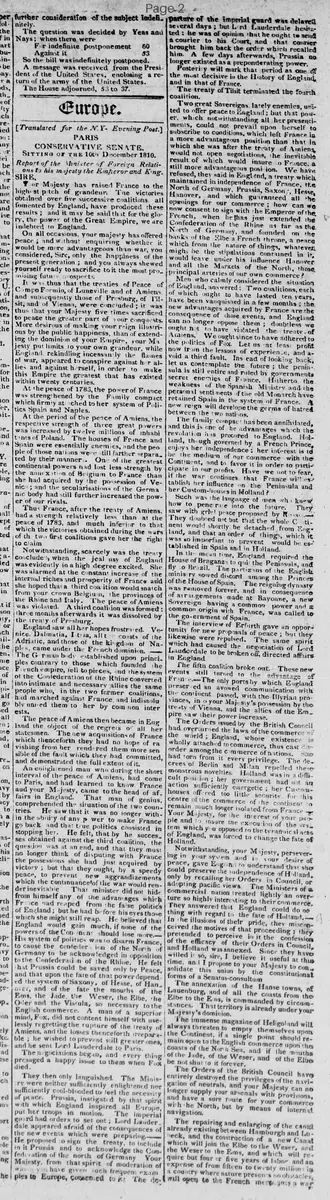
The question was decided by Yeas and Nays; when there were
For indefinite postponement 60
Against it 53
So the bill was indefinitely postponed.
A message was received from the President of the United States, enclosing a return of the army of the United States.
The House adjourned, 53 to 57.
Europe.
[Translated for the N.Y. Evening Post.]
PARIS
CONSERVATIVE SENATE.
SITTING OF THE 10th December 1810.
Report of the Minister of Foreign Relations to his majesty the Emperor and King.
SIRE.
Your Majesty has raised France to the highest pitch of grandeur. The victories obtained over five successive coalitions, all fomented by England, have produced these results; and it may be said that for the glory, the power of the Great Empire, we are indebted to England.
On all occasions, your majesty has offered peace; and without enquiring whether it would be more advantageous than war, you considered, Sire, only the happiness of the present generation; and you always shewed yourself ready to sacrifice to it the most promising future prospects.
It was thus that the treaties of Peace of Campo Formio, of Luneville and of Amiens and subsequently those of Presburg, of Tilsit, and of Vienna, were Concluded; it was thus that your Majesty five times sacrificed to peace the greater part of your conquests.
More desirous of making your reign illustrious by the public happiness, than of extending the dominion of your Empire, your Majesty put limits to your own grandeur, while England rekindling incessantly the flames of war, appeared to conspire against her allies and against herself, in order to make this Empire the greatest that has existed within twenty centuries.
At the peace of 1783, the power of France was strengthened by the Family compact which firmly attached to her system of Politics Spain and Naples.
At the period of the peace of Amiens, the respective strength of three great powers was increased by twelve millions of inhabitants of Poland. The houses of France and Spain were essentially enemies, and the people of those nations were still farther separated by their manners. One of the greatest continental powers had lost less strength by the annexation of Belgium to France than she had acquired by the possession of Venice; and the secularisations of the Germanic body had still further increased the power of our rivals.
Thus France, after the treaty of Amiens, had a strength relatively less than at the peace of 1783, and much inferior to that which the victories obtained during the wars of the two first coalitions gave her the right to claim.
Notwithstanding, scarcely was the treaty concluded when the jealousy of England was evidently in a high degree excited. She was alarmed at the constant increase of the internal riches and prosperity of France and she hoped that a third coalition would snatch from your crown Belgium, the provinces of the Rhine and Italy. The peace of Amiens was violated. A third coalition was formed: three months afterwards it was dissolved by the treaty of Presburg.
England saw all her hopes frustrated. Venice, Dalmatia, Istria, all the coasts of the Adriatic, and those of the kingdom of Naples, came under the French dominion.—The Germanic body established upon principles contrary to those which founded the French empire, fell to pieces, and the system of the Confederation of the Rhine converted into intimate and necessary allies the same people who, in the two former coalitions, had marched against France, and indissolubly united them to her by common interests.
The peace of Amiens then became in England the object of the regrets of all her statesmen. The new acquisitions of France which thenceforth they had no hope of ravishing from her rendered them more sensible of the fault which they had committed, and demonstrated the full extent of it.
An enlightened man who during the short interval of the peace of Amiens, had come to Paris, and had learned to know France and your Majesty, came to the head of affairs in England. That man of genius, comprehended the situation of the two countries. He saw that it was no longer within the ability of any power to make France go back and that true politics consisted in stopping her. He felt, that by the successes obtained against the third coalition, the question was at an end, and that they must no longer think of disputing with France the possessions she had just acquired by victory; but that they ought, by a speedy peace, to prevent new aggrandizements which the continuance of the war would render inevitable.
That minister did not hide from himself any of the advantages which France had reaped from the false politics of England; but he had before his eyes those which she might still reap. He believed that England would gain much, if none of the powers of the Continent should lose more.—His system of politics was to disarm France, to cause the confederation of the North of Germany to be acknowledged in opposition to the Confederation of the Rhine. He felt that Prussia could be saved only by Peace, and that upon the fate of that power depended the system of Saxony, of Hesse, of Hanover, and of the fate the mouths of the Ems, the Jade, the Weser, the Elbe, the Oder and the Vistula, so necessary to the English commerce. A man of a superior mind, Fox, did not content himself with uselessly regretting the rupture of the treaty of Amiens, and the losses thenceforth irreparable; he wished to prevent still greater ones, and he sent Lord Lauderdale to Paris.
The negotiations began, and every thing presaged a happy issue to them when Fox died.
They then only languished. The Ministry were neither sufficiently enlightened nor sufficiently cool-blooded to feel the necessity of peace. Prussia, instigated by that spirit with which England inspired all Europe, put her troops in motion. The imperial guard had orders to set out: Lord Lauderdale appeared afraid of the consequences of the new events which were preparing.—He proposed to sign the treaty, to include Prussia and to acknowledge the Confederation of the north of Germany. Your Majesty, from that spirit of moderation of which you have given such frequent examples to Europe, consented to it: The departure of the imperial guard was delayed several days; but Lord Lauderdale hesitated: he was of opinion that he ought to send a courier to his Court, and that courier brought him back the order which recalled him. A few days afterwards, Prussia no longer existed as a preponderating power.
Posterity will mark that period as one of the most decisive in the History of England, and in that of France.
The treaty of Tilsit terminated the fourth coalition.
Two great Sovereigns, lately enemies, united to offer peace to England; but that power, which notwithstanding all her pretensions, could not prevail upon herself to subscribe to conditions, which left France in a more advantageous position than that in which she was after the treaty of Amiens would not open negotiations, the inevitable result of which would insure to France, a still more advantageous position. We have refused, they said in England, a treaty which maintained in independence of France, the North of Germany, Prussia, Saxony, Hesse, Hanover, and which guaranteed all the openings for our commerce; how can we now consent to sign with the Emperor of the French, when he has just extended the Confederation of the Rhine as far as the North of Germany, and founded on the banks of the Elbe a French throne, a peace which from the nature of things, whatever might be the stipulations contained in it, would leave under his influence Hanover and all the Markets of the North, those principal arteries of our own commerce?
Men who calmly considered the situation of England, answered: Two coalitions, each of which ought to have lasted ten years, have been vanquished in a few months; the new advantages acquired by France are the consequence of those events, and England can no longer oppose them; doubtless we ought not to have violated the treaty of Amiens. We ought since to have adhered to the politics of Fox. Let us at least profit now from the lessons of experience, and avoid a third fault. Instead of looking back, let us contemplate the future; the peninsula is still entire and ruled by governments secret enemies of France. Hitherto, the weakness of the Spanish Ministry and the personal sentiments of the old Monarch have retained Spain in the system of France. A new reign will develope the germs of hatred between the two nations.
The family compact has been annihilated, and this is one of the advantages which the revolution has procured to England. Holland, though governed by a French Prince, enjoys her independence: her interest is to be the medium of our commerce with the Continent, and to favor it in order to participate in our profits. Have we not to fear, if the war continues, that France will establish her influence on the Peninsula and her Custom-houses in Holland?
Such was the language of men who knew how to penetrate into the future. They saw with grief peace proposed by Russia. They doubted not but that the whole Continent would shortly be detached from England, and that an order of things, which it was so important to prevent would be established in Spain and in Holland.
In the mean time, England required the House of Braganza to quit the Peninsula, and fly to Brazil. The partizans of the English ministry sowed discord among the Princes of the House of Spain. The reigning dynasty was removed forever, and in consequence of arrangements made at Bayonne, a new Sovereign having a common power and a common origin with France, was called to the government of Spain.
The interview of Erfurth gave an opportunity for new proposals of peace; but they likewise were repulsed. The same spirit which had caused the negociation of Lord Lauderdale to be broken off, directed affairs in England.
The fifth coalition broke out.—These new events still turned to the advantage of France.—The only ports by which England preserved an avowed communication with the continent passed, with the Illyrian provinces, into your Majesty's possession by the treaty of Vienna, and the allies of the Empire saw their power increase.
The Orders issued by the British Council had overturned the laws of the commerce of the world; England, whose existence is wholly attached to commerce, thus cast disorder among the commerce of nations. She had torn from it every privilege. The decrees of Berlin and Milan repelled these monstrous novelties. Holland was in a difficult position; her government had not an action sufficiently energetic; her Custom-houses offered too little security for his centre of the commerce of the continent to remain much longer isolated from France. Your Majesty, for the interest of your people and to insure the execution of the system which you opposed to the tyrannical acts of England, was forced to change the fate of Holland.
Notwithstanding, your Majesty, persevering in your system and in your desire of peace, gave England to understand that she could preserve the independence of Holland, only by recalling her Orders in Council, or adopting pacific views. The Ministers of a commercial nation treated lightly an overture so highly interesting to their commerce. They answered that England could do nothing with regard to the fate of Holland.—In the illusions of their pride, they misconceived the motives of that proceeding; they pretended to perceive in it the confession of the efficacy of their Orders in Council, and Holland was annexed. Since they have willed it so, sire, I believe it useful at this time, and I propose to your Majesty to consolidate this union by the Constitutional forms of a Senatus-consultum.
The annexation of the Hanse towns, of Lauenburg, and of all the coasts from the Elbe to the Ems, is commanded by circumstances. That territory is already under your Majesty's dominion.
The immense magazine of Heligoland will always threaten to empty themselves upon the Continent, if a single point should remain open to the English commerce upon the coasts of the North Sea, and if the mouths of the Jade, of the Weser, and of the Elbe be not shut to it forever.
The Orders of the British Council have entirely destroyed the privileges of the navigation of neutrals, and your Majesty can no longer supply your arsenals with provisions, and have a sure route for your commerce with the North, but by means of internal navigation.
The repairing and enlarging of the canals already existing between Hamburgh and Lubeck, and the construction of a new Canal which will join the Elbe to the Weser, and the Weser to the Ems, and which will require but four or five years of labor and an expense of from fifteen to twenty millions in a country where nature presents no obstacles, will open to the French merchants a way
Economical, easy, and free from every danger. Your Empire may trade at all times with the Baltic, send to the North the produce of your soil and of your manufactures, and draw from thence the productions necessary to your Majesty's navy.
The flags of Hamburgh, of Bremen and of Lubeck, which now wander upon the seas, denationalized by the British Orders in Council, will partake of the lot of the French flag, and will concur with it for the interest of the common cause, for the re-establishment of the liberty of the seas.
Peace will arrive at last; for sooner or later the great interests of the people, of justice and of humanity, prevail over the passions and over hatred; but the experience of sixty years has taught us that peace with England can never give to commerce more than a deceitful security. In 1756, in February 1793, in 1804 with regard to Spain, as in May 1805, at the period of the violation of the treaty of Amiens, England commenced hostilities before having declared war.
Vessels which navigated upon the faith of the peace, were surprised; commerce was plundered; peaceable citizens lost their liberty, and the ports of England were filled with her disgraceful trophies. If such scenes are to be one day renewed, the English traveller, merchants, their properties & their persons seized in our ports from the Baltic sea to the Adriatic gulf, will afford the means of retaliation; and if the English government, to make the people in London forget the injustice of the war, should again give it the spectacle of captures made in contempt of the law of nations, it will also have to shew them the losses so occasioned.
Sire, as long as England shall persist in her orders in council, your majesty will persist in your decrees. Your majesty will oppose to the blockade of the coasts, the continental blockade, and to the pillage on the seas, the confiscation of English goods on the Continent.
It is my duty to say so to your Majesty; your Majesty cannot henceforth hope to bring back your enemies to more moderate ideas, otherwise than by your perseverance in this system. There must result from it such a state of inconvenience to England, that she shall be forced at length to acknowledge that she cannot violate the rights of neutrals upon the seas, and claim their protection on the continent; that the only source of her evils is in her orders of council, and that that aggrandizement of France which will long excite her uneasiness and her jealousy, she owes to the blind passions of those who, violating the treaty of Amiens, breaking off the negociation of Paris, rejecting the proposals of Tilsit and Erfurth, disdaining the overtures made before the annexation of Holland, have given the last blows to her commerce & to her power, and conducted our Empire to the accomplishment of its high destinies.
CHAMPAGNY, Duke de Cadore.
Paris, 8th Dec. 1810.
[The French papers in our possession contain some important documents never before published relative to Lord Lauderdale's negociation in 1806, to the negociation after the peace of Tilsit, and to the negociation between the Dutch ministry and the English government in February, 1810.]
[Our papers also contain a decree of Napoleon of the 5th Dec. relative to imports and exports in licensed vessels—and a decree of the 4th Dec. respecting newspapers.]
It appears from papers laid before the conservative senate by the minister of foreign relations, that in February, 1810, the Dutch ministry attempted to open a negociation with Great Britain in order to prevent the annexation of Holland to France, but, according to the French editor, England preferred the continuance of the war to the Independence of Holland.
[Translator]
What sub-type of article is it?
What keywords are associated?
What entities or persons were involved?
Where did it happen?
Foreign News Details
Primary Location
Paris
Event Date
10th December 1810
Key Persons
Outcome
peace proposals rejected by england; annexations of holland, hanse towns, lauenburg, and coasts from elbe to ems; persistence in continental blockade against british orders in council.
Event Details
Report by Minister of Foreign Relations Champagny to Emperor Napoleon on French victories over five coalitions fomented by England, peace treaties (Campo Formio, Luneville, Amiens, Presburg, Tilsit, Vienna), rejected peace negotiations (including by Fox and Lord Lauderdale), annexations, and justification for continental system and blockades to counter British policies.