Thank you for visiting SNEWPapers!
Sign up free
Literary
September 15, 1809
The National Intelligencer And Washington Advertiser
Washington, District Of Columbia
What is this article about?
An essay reflecting on humanity's indifference to distant tragedies and wars, quoting Adam Smith's 'Theory of Moral Sentiments' on reactions to hypothetical disasters. It discusses recent battles on the Danube, the scale of European conflicts over 20 years, blames coalitions and British policy for escalating wars under Napoleon, and anticipates future peace or new contests.
Clipping
OCR Quality
95%
Excellent
Full Text
From the Enquirer.
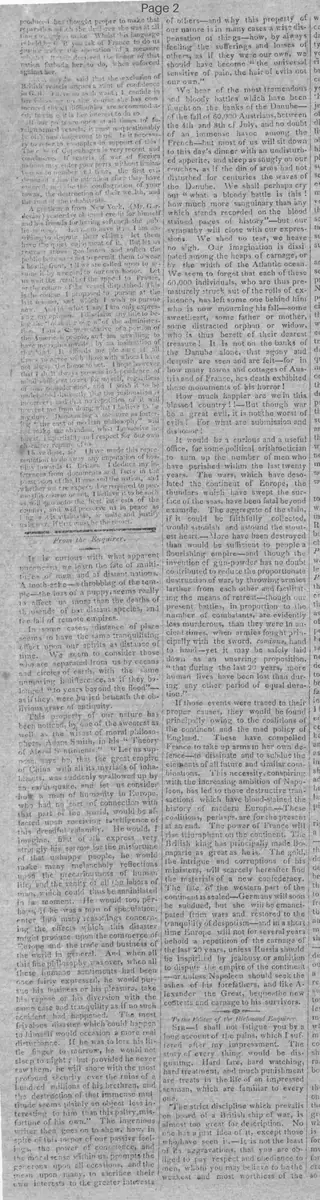
It is curious with what apparent unconcern we learn the fate of multitudes of men and of distant nations. A tooth-ache - a throbbing of the temple - the loss of a puppy, seems really to affect us more than the deaths of thousands of our distant species, and the fall of remote empires.
In some cases, distance of place seems to have the same tranquilising effect upon our spirits as distance of time. We seem to consider those who are separated from us by oceans and circles of earth, with the same unmoving indifference, as if they belonged "to years beyond the flood" - as if they were buried beneath the oblivious grave of antiquity.
This property of our nature has been noticed, by one of the sweetest as well as the wisest of moral philosophers, Adam Smith, in his "Theory of Moral Sentiments." "Let us suppose, says he, that the great empire of China with all its myriads of inhabitants, was suddenly swallowed up by an earthquake, and let us consider - how a man of humanity in Europe, who had no sort of connection with that part of the world, would be affected upon receiving intelligence of this dreadful calamity. He would, I imagine, first of all, express very strongly his sorrow for the misfortune of that unhappy people, he would make many melancholy reflections upon the precariousness of human life, and the vanity of all the labors of man, which could thus be annihilated in a moment. He would too, perhaps, if he was a man of speculation, enter into many reasonings concerning the effects which this disaster might produce upon the commerce of Europe and the trade and business of the world in general. And when all this fine philosophy was over, when all these humane sentiments had been once fairly expressed, he would pursue his business or his pleasure, take his repose or his diversion with the same ease and tranquility as if no such accident had happened. The most frivolous disaster which could happen to himself would occasion a more real disturbance. If he was to lose his little finger to morrow, he would not sleep to night ; but provided he never saw them, he will snore with the most profound security over the ruins of a hundred millions of his brethren, and the destruction of that immense multitude seems plainly an object less interesting to him than this paltry misfortune of his own." The ingenious writer then goes on to shew, how, in spite of this torpor of our passive feelings, the power of conscience, and the moral sense within us. prompts the generous upon all occasions, and the mean upon many, to sacrifice their own interests to the greater interests of others--and why this property of our nature is in many cases a wise dispensation of things--how, by always feeling the sufferings and losses of others, as if they were our own, we should have become "the universal sensitive of pain, the heir of evils not our own."
We hear of the most tremendous and bloody battles which have been fought on the banks of the Danube - of the fall of 60,000 Austrians, between the 4th and 8th of July, and no doubt of an immense havoc among the French--but most of us will sit down to this day's dinner with an undisturbed appetite, and sleep as snugly on our couche, as if the din of arms had not disturbed for centuries the waves of the Danube. We shall perhaps cry out "what a bloody battle is this! how much more sanguinary than any which stands recorded on the blood stained pages of history"-but our sympathy will close with our expressions. We shed no tear, we heave no sigh, Our imagination is dissipated among the heaps of carnage, or by the width of the Atlantic ocean. We seem to forget that each of these 60,000 individuals, who are thus prematurely struck out of the rolls of existence, has left some one behind him who is now mourning his fall-some sweetheart, some father or mother, some distracted orphan or widow, who is thus bereft of their dearest treasure! It is not on the banks of the Danube alone, that agony and despair are seen and are felt-for in how many towns and cottages of Austria and of France, has death exhibited these monuments of his horror!
How much happier are we in this blessed country!! But though war be a great evil, it is not the worst of evils! For what are submission and dishonor!
It would be a curious and a useful office, for some political arithmetician to sum up the number of men who have perished within the last twenty years. The wars, which have desolated the continent of Europe, the thunders which have swept the surface of the seas, have been fatal beyond example. The aggregate of the slain, if it could be faithfully collected. would astonish and astound the stoutest heart.-More have been destroyed than would be sufficient to people a flourishing empire--and though the invention of gun-powder has no doubt contributed to reduce the proportionate destruction of war, by throwing armies farther from each other and facilitating the means of retreat--though our present battles, in proportion to the number of combatants, are evidently less murderous, than they were in ancient times, when armies fought principally with the sword, cominus, hand to hand--yet it may be safely laid down as an unerring proposition, "that during the last 20 years, more human lives have been lost than during any other period of equal duration."
If those events were traced to their proper causes, they would be found principally owing to the coalitions of the continent and the mad policy of England, These have compelled France to take up arms in her own defence--to dissipate and to subdue the elements of all future and similar combinations. This necessity, conspiring with the increasing ambition of Napoleon, has led to those destructive transactions which have blood-stained the history of modern Europe. These coalitions, perhaps, are for the present at an end. The power of France will rise triumphant on the continent. The British king has principally made Bonaparte as great as he is. The gold, the intrigue and corruptions of his ministers, will scarcely hereafter find the materials of a new confederacy. The fate of the western part of the continent is sealed-Germany will soon be subdued, but she will be emancipated from wars and restored to the tranquility of despotism--and in a short time Europe will not for several years behold a repetition of the carnage of the last 20 years, unless Russia should be inspirited by jealousy or ambition to dispute the empire of the continent --or unless Napoleon should seek the ashes of his forefathers, and like Alexander the Great, bequeath new contests and carnage to his survivors.
It is curious with what apparent unconcern we learn the fate of multitudes of men and of distant nations. A tooth-ache - a throbbing of the temple - the loss of a puppy, seems really to affect us more than the deaths of thousands of our distant species, and the fall of remote empires.
In some cases, distance of place seems to have the same tranquilising effect upon our spirits as distance of time. We seem to consider those who are separated from us by oceans and circles of earth, with the same unmoving indifference, as if they belonged "to years beyond the flood" - as if they were buried beneath the oblivious grave of antiquity.
This property of our nature has been noticed, by one of the sweetest as well as the wisest of moral philosophers, Adam Smith, in his "Theory of Moral Sentiments." "Let us suppose, says he, that the great empire of China with all its myriads of inhabitants, was suddenly swallowed up by an earthquake, and let us consider - how a man of humanity in Europe, who had no sort of connection with that part of the world, would be affected upon receiving intelligence of this dreadful calamity. He would, I imagine, first of all, express very strongly his sorrow for the misfortune of that unhappy people, he would make many melancholy reflections upon the precariousness of human life, and the vanity of all the labors of man, which could thus be annihilated in a moment. He would too, perhaps, if he was a man of speculation, enter into many reasonings concerning the effects which this disaster might produce upon the commerce of Europe and the trade and business of the world in general. And when all this fine philosophy was over, when all these humane sentiments had been once fairly expressed, he would pursue his business or his pleasure, take his repose or his diversion with the same ease and tranquility as if no such accident had happened. The most frivolous disaster which could happen to himself would occasion a more real disturbance. If he was to lose his little finger to morrow, he would not sleep to night ; but provided he never saw them, he will snore with the most profound security over the ruins of a hundred millions of his brethren, and the destruction of that immense multitude seems plainly an object less interesting to him than this paltry misfortune of his own." The ingenious writer then goes on to shew, how, in spite of this torpor of our passive feelings, the power of conscience, and the moral sense within us. prompts the generous upon all occasions, and the mean upon many, to sacrifice their own interests to the greater interests of others--and why this property of our nature is in many cases a wise dispensation of things--how, by always feeling the sufferings and losses of others, as if they were our own, we should have become "the universal sensitive of pain, the heir of evils not our own."
We hear of the most tremendous and bloody battles which have been fought on the banks of the Danube - of the fall of 60,000 Austrians, between the 4th and 8th of July, and no doubt of an immense havoc among the French--but most of us will sit down to this day's dinner with an undisturbed appetite, and sleep as snugly on our couche, as if the din of arms had not disturbed for centuries the waves of the Danube. We shall perhaps cry out "what a bloody battle is this! how much more sanguinary than any which stands recorded on the blood stained pages of history"-but our sympathy will close with our expressions. We shed no tear, we heave no sigh, Our imagination is dissipated among the heaps of carnage, or by the width of the Atlantic ocean. We seem to forget that each of these 60,000 individuals, who are thus prematurely struck out of the rolls of existence, has left some one behind him who is now mourning his fall-some sweetheart, some father or mother, some distracted orphan or widow, who is thus bereft of their dearest treasure! It is not on the banks of the Danube alone, that agony and despair are seen and are felt-for in how many towns and cottages of Austria and of France, has death exhibited these monuments of his horror!
How much happier are we in this blessed country!! But though war be a great evil, it is not the worst of evils! For what are submission and dishonor!
It would be a curious and a useful office, for some political arithmetician to sum up the number of men who have perished within the last twenty years. The wars, which have desolated the continent of Europe, the thunders which have swept the surface of the seas, have been fatal beyond example. The aggregate of the slain, if it could be faithfully collected. would astonish and astound the stoutest heart.-More have been destroyed than would be sufficient to people a flourishing empire--and though the invention of gun-powder has no doubt contributed to reduce the proportionate destruction of war, by throwing armies farther from each other and facilitating the means of retreat--though our present battles, in proportion to the number of combatants, are evidently less murderous, than they were in ancient times, when armies fought principally with the sword, cominus, hand to hand--yet it may be safely laid down as an unerring proposition, "that during the last 20 years, more human lives have been lost than during any other period of equal duration."
If those events were traced to their proper causes, they would be found principally owing to the coalitions of the continent and the mad policy of England, These have compelled France to take up arms in her own defence--to dissipate and to subdue the elements of all future and similar combinations. This necessity, conspiring with the increasing ambition of Napoleon, has led to those destructive transactions which have blood-stained the history of modern Europe. These coalitions, perhaps, are for the present at an end. The power of France will rise triumphant on the continent. The British king has principally made Bonaparte as great as he is. The gold, the intrigue and corruptions of his ministers, will scarcely hereafter find the materials of a new confederacy. The fate of the western part of the continent is sealed-Germany will soon be subdued, but she will be emancipated from wars and restored to the tranquility of despotism--and in a short time Europe will not for several years behold a repetition of the carnage of the last 20 years, unless Russia should be inspirited by jealousy or ambition to dispute the empire of the continent --or unless Napoleon should seek the ashes of his forefathers, and like Alexander the Great, bequeath new contests and carnage to his survivors.
What sub-type of article is it?
Essay
What themes does it cover?
Death Mortality
Political
Moral Virtue
What keywords are associated?
Moral Sentiments
Distant Tragedies
European Wars
Napoleon
Adam Smith
Danube Battle
Human Indifference
Political Coalitions
Literary Details
Key Lines
Let Us Suppose, Says He, That The Great Empire Of China With All Its Myriads Of Inhabitants, Was Suddenly Swallowed Up By An Earthquake...
The Most Frivolous Disaster Which Could Happen To Himself Would Occasion A More Real Disturbance. If He Was To Lose His Little Finger To Morrow, He Would Not Sleep To Night ; But Provided He Never Saw Them, He Will Snore With The Most Profound Security Over The Ruins Of A Hundred Millions Of His Brethren...
We Hear Of The Most Tremendous And Bloody Battles Which Have Been Fought On The Banks Of The Danube Of The Fall Of 60,000 Austrians, Between The 4th And 8th Of July...
"That During The Last 20 Years, More Human Lives Have Been Lost Than During Any Other Period Of Equal Duration."
The British King Has Principally Made Bonaparte As Great As He Is.