Thank you for visiting SNEWPapers!
Sign up free
Editorial
February 10, 1825
Kentucky Gazette
Lexington, Fayette County, Kentucky
What is this article about?
Editorial argues against Kentucky judges' claims of judicial independence from legislative control, citing revolutionary state constitutions that empower legislatures to establish and alter courts while separating powers, refuting misinterpretation of Declaration of Independence.
Clipping
OCR Quality
70%
Good
Full Text
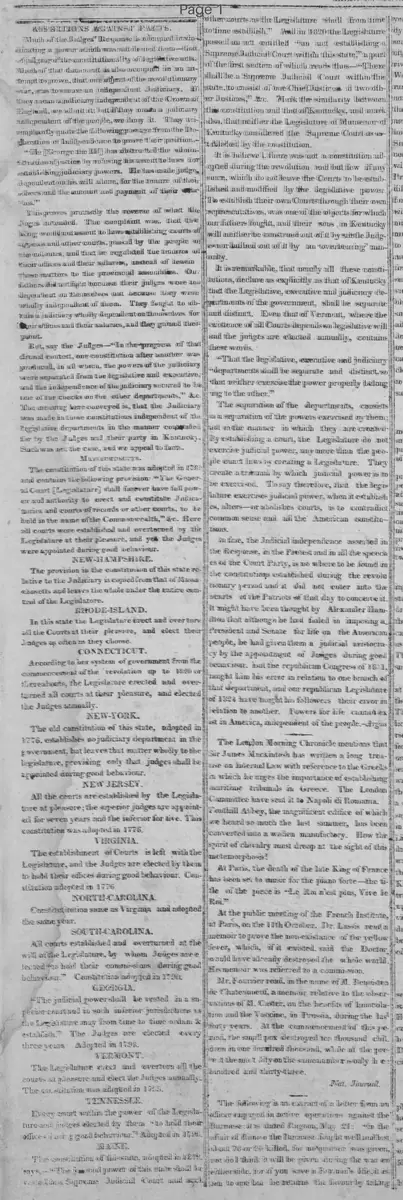
ASSERTIONS AGAINST FACT.
Much of the Judges' Response opposes in vain a power which was denied them within the constitutional limits of legislative acts. What that document is, an absurd command, in an attempt to prove, that the object out of the moral union were numerous, war was to secure an independent judiciary. If they mean a judiciary independent of the Crown of England, we admit it; but if they mean a judiciary independent of the people, we deny it. They unnecessarily quote the following passage from the Declaration of Independence to prove their position.
'George the III has destroyed the administration of justice by making them, as rent, follows for establishing judiciary powers. He has made judges dependent on his will alone, for the tenure of their offices and the amount and payment of their salaries.'
This quote goes greatly the reverse of what they intended. The complaint was that while the King wanted to prevent the House from establishing his courts of superior and all other courts, created by the people elected and the times the regulated the tenures of their offices and their salaries, instead of leaving those matters to the provincial assemblies. Our fathers did not cause their judges to be now dependent on themselves but because they were wholly independent of them. They fought to obtain a judiciary wholly dependent on themselves for their tenure and their salaries, and they gained that point.
But now the Judges, in the progress of that memorable contest, one constitution after another was adopted, in all which, the powers of the judiciary were carefully separated from the legislative and executive, and the independence of the judiciary secured as one of the checks on the other departments, &c.
The meaning here, we will say, is, that the Judiciary was made in those constitutions independent of the legislative departments in the manner contended for by the Judges and their party in Kentucky.
Such was not the case, and we appeal to facts.
MASSACHUSETTS.
The constitution of this state was adopted in 1780 and contains the following provision: 'The General Court shall forever have full power and authority to erect and constitute Judiciary Courts and courts of records or other courts, to be held in the name of the Commonwealth.' &c. Here all courts were established and overturned by the Legislature at their pleasure, and yet the Judges were appointed during good behaviour.
NEW-HAMPSHIRE
The provision in the constitution of this state relative to the Judiciary is copied from that of Massachusetts and leaves the whole under the entire control of the Legislature.
RHODE-ISLAND.
In this state the Legislature erect and overturn all the Courts at their pleasure, and elect the Judges as often as they choose.
CONNECTICUT
According to their system of government from its commencement of the revolution up to 1818 or thereabouts, the Legislature erected and overturned all courts at their pleasure, and elected the Judges annually.
NEW-YORK.
The old constitution of this state, adopted in 1776, establishes no judiciary department in the government, but leaves that matter wholly to the legislature, providing only that judges shall be appointed during good behaviour.
NEW JERSEY.
All the courts are established by the Legislature at pleasure; the superior judges are appointed for seven years and the inferior for five. This constitution was adopted in 1776.
VIRGINIA
The establishment of Courts is left with the Legislature, and the Judges are elected by them to hold their offices during good behaviour. Constitution adopted in 1776.
NORTH CAROLINA
Constitution same as Virginia and adopted the same year.
SOUTH CAROLINA
All courts established and overturned at the will of the Legislature, by whom Judges are elected to hold their commissions during good behaviour. Constitution adopted in 1790.
GEORGIA.
The judicial powers shall be vested in a superior court and in such inferior jurisdictions as the Legislature may from time to time ordain & establish. The Judges are elected every three years. Adopted in 1779.
VERMONT.
The Legislature erect and overturn all the courts at pleasure and elect the Judges annually. The above was adopted in 1777.
TENNESSEE.
Every court within the power of the Legislature and judges elected by them to hold their office during good behaviour. Adopted in 1796.
MAINE.
The constitution of this state, adopted in 1820 says-'The judicial power of this state shall be vested in a Supreme Judicial Court and such other courts as the Legislature shall from time to time establish.' All in 1820 the Legislature passed an act establishing a Supreme Judicial Court within this state, in part of the first section of which it is thus-'There shall be a Supreme Judicial Court within this state to consist of a Chief Justice and two other Judges,' &c. Mark the similarity between this constitution and that of Kentucky, and mark likewise, that neither the Legislature of Massachusetts or of Kentucky once altered the Supreme Court after established by the constitution.
It has however, we believe, there was not a constitution adopted during the revolution and but few if any since, which do not leave the Courts to erect, establish, abolish and modified by the Legislative power.
The establishment of their own Courts through their own legislatures, was one of the acts for which our forefathers fought, and their sons in Kentucky will never be construed out of it by subtle Judges or by any too endearing minority.
It is remarkable, that mostly all these constitutions, declare as explicitly as that of Kentucky that the Legislative, Executive and Judicial departments of the government, shall be separate and distinct. Even that of Vermont, where the existence of all Courts depends on legislative will and the judges are elected annually, contains these words.
'That the legislative, executive and judiciary departments shall be separate and distinct, so that neither exercise the power properly belonging to the other.'
The separation of the departments, consists in a separation of the powers exercised by them; not in the manner in which they are created.
By establishing a court, the Legislature do not exercise judicial power, any more than the people enact laws by creating a Legislature. They create a tribunal by which judicial powers to be exercised. To say therefore, that the legislature exercises judicial power, when it establishes or abolishes courts, is to contradict common sense and all the American constitutions.
In fine, the Judicial independence asserted in the Response, in the Protest and in all the speeches of the Court Party, is no where to be found in the constitutions established during the revolution at any period and it did not enter into the excogitations of the Patriots of that day to conceive it.
Much of the Judges' Response opposes in vain a power which was denied them within the constitutional limits of legislative acts. What that document is, an absurd command, in an attempt to prove, that the object out of the moral union were numerous, war was to secure an independent judiciary. If they mean a judiciary independent of the Crown of England, we admit it; but if they mean a judiciary independent of the people, we deny it. They unnecessarily quote the following passage from the Declaration of Independence to prove their position.
'George the III has destroyed the administration of justice by making them, as rent, follows for establishing judiciary powers. He has made judges dependent on his will alone, for the tenure of their offices and the amount and payment of their salaries.'
This quote goes greatly the reverse of what they intended. The complaint was that while the King wanted to prevent the House from establishing his courts of superior and all other courts, created by the people elected and the times the regulated the tenures of their offices and their salaries, instead of leaving those matters to the provincial assemblies. Our fathers did not cause their judges to be now dependent on themselves but because they were wholly independent of them. They fought to obtain a judiciary wholly dependent on themselves for their tenure and their salaries, and they gained that point.
But now the Judges, in the progress of that memorable contest, one constitution after another was adopted, in all which, the powers of the judiciary were carefully separated from the legislative and executive, and the independence of the judiciary secured as one of the checks on the other departments, &c.
The meaning here, we will say, is, that the Judiciary was made in those constitutions independent of the legislative departments in the manner contended for by the Judges and their party in Kentucky.
Such was not the case, and we appeal to facts.
MASSACHUSETTS.
The constitution of this state was adopted in 1780 and contains the following provision: 'The General Court shall forever have full power and authority to erect and constitute Judiciary Courts and courts of records or other courts, to be held in the name of the Commonwealth.' &c. Here all courts were established and overturned by the Legislature at their pleasure, and yet the Judges were appointed during good behaviour.
NEW-HAMPSHIRE
The provision in the constitution of this state relative to the Judiciary is copied from that of Massachusetts and leaves the whole under the entire control of the Legislature.
RHODE-ISLAND.
In this state the Legislature erect and overturn all the Courts at their pleasure, and elect the Judges as often as they choose.
CONNECTICUT
According to their system of government from its commencement of the revolution up to 1818 or thereabouts, the Legislature erected and overturned all courts at their pleasure, and elected the Judges annually.
NEW-YORK.
The old constitution of this state, adopted in 1776, establishes no judiciary department in the government, but leaves that matter wholly to the legislature, providing only that judges shall be appointed during good behaviour.
NEW JERSEY.
All the courts are established by the Legislature at pleasure; the superior judges are appointed for seven years and the inferior for five. This constitution was adopted in 1776.
VIRGINIA
The establishment of Courts is left with the Legislature, and the Judges are elected by them to hold their offices during good behaviour. Constitution adopted in 1776.
NORTH CAROLINA
Constitution same as Virginia and adopted the same year.
SOUTH CAROLINA
All courts established and overturned at the will of the Legislature, by whom Judges are elected to hold their commissions during good behaviour. Constitution adopted in 1790.
GEORGIA.
The judicial powers shall be vested in a superior court and in such inferior jurisdictions as the Legislature may from time to time ordain & establish. The Judges are elected every three years. Adopted in 1779.
VERMONT.
The Legislature erect and overturn all the courts at pleasure and elect the Judges annually. The above was adopted in 1777.
TENNESSEE.
Every court within the power of the Legislature and judges elected by them to hold their office during good behaviour. Adopted in 1796.
MAINE.
The constitution of this state, adopted in 1820 says-'The judicial power of this state shall be vested in a Supreme Judicial Court and such other courts as the Legislature shall from time to time establish.' All in 1820 the Legislature passed an act establishing a Supreme Judicial Court within this state, in part of the first section of which it is thus-'There shall be a Supreme Judicial Court within this state to consist of a Chief Justice and two other Judges,' &c. Mark the similarity between this constitution and that of Kentucky, and mark likewise, that neither the Legislature of Massachusetts or of Kentucky once altered the Supreme Court after established by the constitution.
It has however, we believe, there was not a constitution adopted during the revolution and but few if any since, which do not leave the Courts to erect, establish, abolish and modified by the Legislative power.
The establishment of their own Courts through their own legislatures, was one of the acts for which our forefathers fought, and their sons in Kentucky will never be construed out of it by subtle Judges or by any too endearing minority.
It is remarkable, that mostly all these constitutions, declare as explicitly as that of Kentucky that the Legislative, Executive and Judicial departments of the government, shall be separate and distinct. Even that of Vermont, where the existence of all Courts depends on legislative will and the judges are elected annually, contains these words.
'That the legislative, executive and judiciary departments shall be separate and distinct, so that neither exercise the power properly belonging to the other.'
The separation of the departments, consists in a separation of the powers exercised by them; not in the manner in which they are created.
By establishing a court, the Legislature do not exercise judicial power, any more than the people enact laws by creating a Legislature. They create a tribunal by which judicial powers to be exercised. To say therefore, that the legislature exercises judicial power, when it establishes or abolishes courts, is to contradict common sense and all the American constitutions.
In fine, the Judicial independence asserted in the Response, in the Protest and in all the speeches of the Court Party, is no where to be found in the constitutions established during the revolution at any period and it did not enter into the excogitations of the Patriots of that day to conceive it.
What sub-type of article is it?
Constitutional
Legal Reform
What keywords are associated?
Judicial Independence
State Constitutions
Separation Of Powers
Legislative Control
Kentucky Judiciary
Declaration Of Independence
What entities or persons were involved?
Judges' Response
Court Party In Kentucky
George Iii
State Legislatures
Editorial Details
Primary Topic
Refutation Of Judicial Claims To Independence From Legislative Control In State Constitutions
Stance / Tone
Opposition To Judiciary Independence From Legislature
Key Figures
Judges' Response
Court Party In Kentucky
George Iii
State Legislatures
Key Arguments
Judges Misquote Declaration Of Independence To Support Independence From People
Colonial Complaint Was Against Judges Dependent On King, Not Assemblies
Revolutionary Constitutions Separated Judicial Powers But Left Court Establishment To Legislatures
Examples From Multiple States Show Legislatures Control Courts While Judges Hold During Good Behavior
Separation Of Departments Means Separation Of Powers Exercised, Not Manner Of Creation