Thank you for visiting SNEWPapers!
Sign up free
Literary
October 9, 1838
The New Hampshire Gazette
Portsmouth, Rockingham County, New Hampshire
What is this article about?
In 17th-century New Hampshire, settler Cornelius Campbell's family is murdered by Indian prophet Chocorua, avenging his son's accidental poisoning. Campbell kills Chocorua on a cliff, who curses the white settlers with misfortune, leading to their colony's ruin and Campbell's hermitage.
Clipping
OCR Quality
95%
Excellent
Full Text
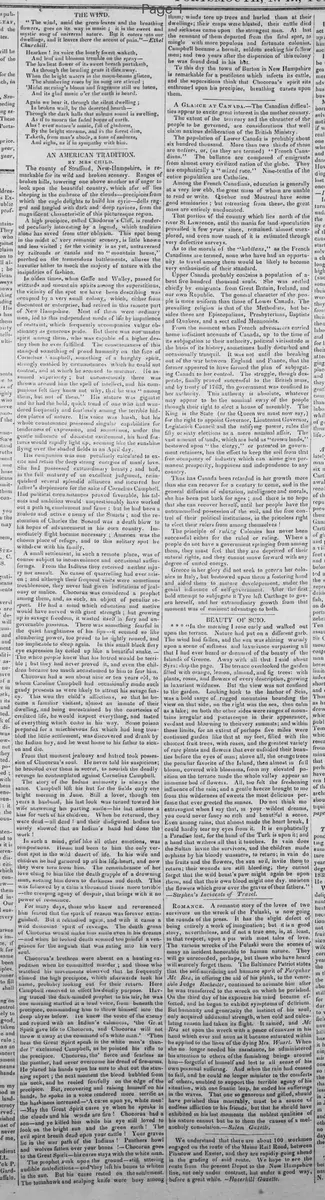
AN AMERICAN TRADITION.
BY MRS CHILD.
The county of Strafford, New-Hampshire, is remarkable for its wild and broken scenery. Ranges of broken hills, towering one above another as if eager to look upon the beautiful country, which afar off lies sleeping in the embrace of the clouds—precipices from which the eagle delights to build his eyrie—dells rugged and tangled with dark and deep ravines, from the magnificent characteristic of this picturesque region.
A high precipice, called Chocorua's Cliff, is rendered peculiarly interesting by a legend, which tradition alone has saved from utter oblivion. This spot being in the midst of very romantic scenery, is little known and less visited; for the vicinity is as yet, untraversed by railroads or canals and no "mountain house," perched on the tremendous battlements, allures the traveller hither to mock the majesty of nature with the insipidities of fashion.
In olden times, when Goffe and Whalley, passed for wizards and mountain spirits among the superstitious, the vicinity of the spot we have been describing was occupied by a very small colony, which, either from discontent or enterprise, had retired in this remote part of New Hampshire. Most of them were ordinary men, led to this independent mode of life by impatience of restraint, which frequently accompanies vulgar obstinacy as generous pride. But there was one master spirit among them, who was capable of a higher destiny than he ever fulfilled. The consciousness of this stamped something of proud humanity on the face of Cornelius Campbell, something of a haughty spirit, strongly enabled by circumstances which he could not control, and at which he scorned to murmur. He assumed superiority; but unconsciously there was thrown around him the spell of intellect, and his companions felt they knew not why, that he was "among them, but not of them." His stature was gigantic and he had the bold, quick tread of one who had wandered frequently and fearlessly among the terrible hidden places of nature. His voice was harsh, but his whole countenance possessed singular capabilities for tenderness of expression, and sometimes, under the gentle influence of domestic excitement, his hard features would rapidly light up, seeming like the sunshine flying over the shaded fields in an April day.
His companion was one peculiarly calculated to excite and retain the deep strong energies of manly love. She had possessed extraordinary beauty; and had, in the full maturity of an excellent judgment, relinquished several splendid alliances and incurred her father's displeasure for the sake of Cornelius Campbell.
Had political circumstances proved favorable, his talents and ambition would unquestionably have worked out a path to emolument and fame; but he had been a zealous and active enemy of the Stuarts; and the restoration of Charles the Second was a death blow to his hopes of advancement in his own country. Immediately flight became necessary; America was the chosen place of refuge, and to this solitary spot he withdrew with his family,
A small settlement, in such a remote place, was of course subject to inconvenience and occasional sufferings. From the Indians they received neither injury nor assault. No cause of quarrelling had ever arisen; and although their frequent visits were sometimes troublesome, they never had given indications of jealousy or malice. Chocorua was considered a prophet among them, and, as such, an object of peculiar respect. He had a mind which education and motive would have nerved with giant strength; but growing up in savage freedom, it wasted itself in fury and ungovernable passions. There was something fearful in the quiet haughtiness of his lips—it seemed so like slumbering power, too proud to be lightly roused, and too implacable to sleep again. In this small black fiery eye expression lay coiled up like a beautiful snake.—The white people knew that his hatred would be terrible; but they had never proved it, and even the children became too much accustomed to him to fear him.
Chocorua had a son about nine or ten years old, to whom Caroline Campbell had occasionally made such gaudy presents as were likely to attract his savage fancy. This won the child's affections, so that he became a familiar visitant, almost an inmate of their dwelling, and being unrestrained by the courtesies of civilized life, he would inspect everything, and tasted of everything which came in his way. Some poison prepared for a mischievous fox which had long troubled the little settlement, was discovered and drank by the Indian boy, and he went home to his father to sicken and die.
From that moment jealousy and hatred took possession of Chocorua's soul. He never told his suspicions; he brooded over them in secret, to nourish the deadly revenge he contemplated against Cornelius Campbell.
The story of the Indian animosity is always the same. Campbell left his hut for the fields early one bright morning in June. Still a lover, though ten years a husband, his last look was turned toward his wife answering her parting smile—his last actions a kiss for each of his children. When he returned, they were dead—all dead! and their disfigured bodies too surely showed that an Indian's hand had done the work!
In such a mind, grief like all other emotions, was tempestuous. Home had been to him the only verdant spot in the wild desert of life. In his wife and children he had garnered up all his life-heart, and now they were torn from him. The remembrance of her love clung to him like the death grapple of a drowning man, sucking him down to darkness and death. This was followed by a calm a thousand times more terrible—the creeping agony of despair, that brings with it no power of resistance.
For many days, those who knew and reverenced him feared that the spark of reason was forever extinguished. But it rekindled again, and with it came a wild demoniac spirit of revenge. The death groan of Chocorua would make him smile even in his dreams—and when he looked death seemed too painful a vengeance for the anguish that was eating into his very soul.
Chocorua's brethren were absent on a hunting expedition when he committed murder; and those who watched his movements observed that he frequently climbed the high precipice, which afterwards took his name, probably looking out for their return. Here Campbell resolved to effect his deadly purpose. Having traced the dark-minded prophet to his lair, he was one morning startled at a loud voice, from beneath the precipice, commanding him to throw himself into the deep abyss below. He knew the voice of the enemy and replied with an Indian's calmness, the Great Spirit gave life to Chocorua, and Chocorua will not throw it away at the command of a white man.' Then hear the Great Spirit speak in the white man's thunder!' exclaimed Campbell, as he pointed his rifle to the precipice. Chocorua, tho' fierce and fearless as the panther, had never overcome his dread of fire-arms. He placed his hands upon his ears to shut out the stunning report; the next moment the blood bubbled from his neck, and he reeled fearfully on the edge of the precipice. But, recovering and raising himself on his hands, he spoke in a voice rendered more terrific as the huskiness increased—'A curse upon ye, white men! Chocorua had a son—and ye killed him while his eye still loved to look on the bright sun and the green earth! The clouds and his words are fire! Chocorua had a son—and ye killed him! May the Great Spirit curse ye when he speaks in the thunder—May the evil spirit breath dead upon your cattle! Your graves lie in the war path of the Indians! Panthers howl and wolves fatten over your bones!—Chocorua goes to the Great Spirit—his curse stays with the white man. in the sun. But his curse rested on the settlement.
The prophet sunk upon the ground—still uttering audible maledictions—and they left his bones to whiten in the sun.
The tomahawk and scalping knife were busy among them; winds tore up trees and hurled them at their dwellings; their crops were blasted, their cattle died and sickness came upon the strongest men. At last the remnant of them departed from the fatal spot, to mingle with more populous and fortunate colonies.
Campbell became a hermit, seldom seeking his fellow men; and two years after the dispersion of this colony he was found dead in his hut.
To this day the town of Burton in New Hampshire is remarkable for a pestilence which infects its cattle, and the superstitious think that Chocorua's spirit sits enthroned upon his precipice, breathing curses upon them.
BY MRS CHILD.
The county of Strafford, New-Hampshire, is remarkable for its wild and broken scenery. Ranges of broken hills, towering one above another as if eager to look upon the beautiful country, which afar off lies sleeping in the embrace of the clouds—precipices from which the eagle delights to build his eyrie—dells rugged and tangled with dark and deep ravines, from the magnificent characteristic of this picturesque region.
A high precipice, called Chocorua's Cliff, is rendered peculiarly interesting by a legend, which tradition alone has saved from utter oblivion. This spot being in the midst of very romantic scenery, is little known and less visited; for the vicinity is as yet, untraversed by railroads or canals and no "mountain house," perched on the tremendous battlements, allures the traveller hither to mock the majesty of nature with the insipidities of fashion.
In olden times, when Goffe and Whalley, passed for wizards and mountain spirits among the superstitious, the vicinity of the spot we have been describing was occupied by a very small colony, which, either from discontent or enterprise, had retired in this remote part of New Hampshire. Most of them were ordinary men, led to this independent mode of life by impatience of restraint, which frequently accompanies vulgar obstinacy as generous pride. But there was one master spirit among them, who was capable of a higher destiny than he ever fulfilled. The consciousness of this stamped something of proud humanity on the face of Cornelius Campbell, something of a haughty spirit, strongly enabled by circumstances which he could not control, and at which he scorned to murmur. He assumed superiority; but unconsciously there was thrown around him the spell of intellect, and his companions felt they knew not why, that he was "among them, but not of them." His stature was gigantic and he had the bold, quick tread of one who had wandered frequently and fearlessly among the terrible hidden places of nature. His voice was harsh, but his whole countenance possessed singular capabilities for tenderness of expression, and sometimes, under the gentle influence of domestic excitement, his hard features would rapidly light up, seeming like the sunshine flying over the shaded fields in an April day.
His companion was one peculiarly calculated to excite and retain the deep strong energies of manly love. She had possessed extraordinary beauty; and had, in the full maturity of an excellent judgment, relinquished several splendid alliances and incurred her father's displeasure for the sake of Cornelius Campbell.
Had political circumstances proved favorable, his talents and ambition would unquestionably have worked out a path to emolument and fame; but he had been a zealous and active enemy of the Stuarts; and the restoration of Charles the Second was a death blow to his hopes of advancement in his own country. Immediately flight became necessary; America was the chosen place of refuge, and to this solitary spot he withdrew with his family,
A small settlement, in such a remote place, was of course subject to inconvenience and occasional sufferings. From the Indians they received neither injury nor assault. No cause of quarrelling had ever arisen; and although their frequent visits were sometimes troublesome, they never had given indications of jealousy or malice. Chocorua was considered a prophet among them, and, as such, an object of peculiar respect. He had a mind which education and motive would have nerved with giant strength; but growing up in savage freedom, it wasted itself in fury and ungovernable passions. There was something fearful in the quiet haughtiness of his lips—it seemed so like slumbering power, too proud to be lightly roused, and too implacable to sleep again. In this small black fiery eye expression lay coiled up like a beautiful snake.—The white people knew that his hatred would be terrible; but they had never proved it, and even the children became too much accustomed to him to fear him.
Chocorua had a son about nine or ten years old, to whom Caroline Campbell had occasionally made such gaudy presents as were likely to attract his savage fancy. This won the child's affections, so that he became a familiar visitant, almost an inmate of their dwelling, and being unrestrained by the courtesies of civilized life, he would inspect everything, and tasted of everything which came in his way. Some poison prepared for a mischievous fox which had long troubled the little settlement, was discovered and drank by the Indian boy, and he went home to his father to sicken and die.
From that moment jealousy and hatred took possession of Chocorua's soul. He never told his suspicions; he brooded over them in secret, to nourish the deadly revenge he contemplated against Cornelius Campbell.
The story of the Indian animosity is always the same. Campbell left his hut for the fields early one bright morning in June. Still a lover, though ten years a husband, his last look was turned toward his wife answering her parting smile—his last actions a kiss for each of his children. When he returned, they were dead—all dead! and their disfigured bodies too surely showed that an Indian's hand had done the work!
In such a mind, grief like all other emotions, was tempestuous. Home had been to him the only verdant spot in the wild desert of life. In his wife and children he had garnered up all his life-heart, and now they were torn from him. The remembrance of her love clung to him like the death grapple of a drowning man, sucking him down to darkness and death. This was followed by a calm a thousand times more terrible—the creeping agony of despair, that brings with it no power of resistance.
For many days, those who knew and reverenced him feared that the spark of reason was forever extinguished. But it rekindled again, and with it came a wild demoniac spirit of revenge. The death groan of Chocorua would make him smile even in his dreams—and when he looked death seemed too painful a vengeance for the anguish that was eating into his very soul.
Chocorua's brethren were absent on a hunting expedition when he committed murder; and those who watched his movements observed that he frequently climbed the high precipice, which afterwards took his name, probably looking out for their return. Here Campbell resolved to effect his deadly purpose. Having traced the dark-minded prophet to his lair, he was one morning startled at a loud voice, from beneath the precipice, commanding him to throw himself into the deep abyss below. He knew the voice of the enemy and replied with an Indian's calmness, the Great Spirit gave life to Chocorua, and Chocorua will not throw it away at the command of a white man.' Then hear the Great Spirit speak in the white man's thunder!' exclaimed Campbell, as he pointed his rifle to the precipice. Chocorua, tho' fierce and fearless as the panther, had never overcome his dread of fire-arms. He placed his hands upon his ears to shut out the stunning report; the next moment the blood bubbled from his neck, and he reeled fearfully on the edge of the precipice. But, recovering and raising himself on his hands, he spoke in a voice rendered more terrific as the huskiness increased—'A curse upon ye, white men! Chocorua had a son—and ye killed him while his eye still loved to look on the bright sun and the green earth! The clouds and his words are fire! Chocorua had a son—and ye killed him! May the Great Spirit curse ye when he speaks in the thunder—May the evil spirit breath dead upon your cattle! Your graves lie in the war path of the Indians! Panthers howl and wolves fatten over your bones!—Chocorua goes to the Great Spirit—his curse stays with the white man. in the sun. But his curse rested on the settlement.
The prophet sunk upon the ground—still uttering audible maledictions—and they left his bones to whiten in the sun.
The tomahawk and scalping knife were busy among them; winds tore up trees and hurled them at their dwellings; their crops were blasted, their cattle died and sickness came upon the strongest men. At last the remnant of them departed from the fatal spot, to mingle with more populous and fortunate colonies.
Campbell became a hermit, seldom seeking his fellow men; and two years after the dispersion of this colony he was found dead in his hut.
To this day the town of Burton in New Hampshire is remarkable for a pestilence which infects its cattle, and the superstitious think that Chocorua's spirit sits enthroned upon his precipice, breathing curses upon them.
What sub-type of article is it?
Prose Fiction
What themes does it cover?
Nature
War Peace
Death Mortality
What keywords are associated?
American Tradition
Chocorua
Indian Legend
Revenge
Settlers
New Hampshire
Curse
Cliff
What entities or persons were involved?
By Mrs Child.
Literary Details
Title
An American Tradition.
Author
By Mrs Child.
Subject
Legend Of Chocorua's Cliff
Key Lines
A Curse Upon Ye, White Men! Chocorua Had A Son—And Ye Killed Him While His Eye Still Loved To Look On The Bright Sun And The Green Earth! The Clouds And His Words Are Fire! Chocorua Had A Son—And Ye Killed Him! May The Great Spirit Curse Ye When He Speaks In The Thunder—May The Evil Spirit Breath Dead Upon Your Cattle! Your Graves Lie In The War Path Of The Indians! Panthers Howl And Wolves Fatten Over Your Bones!—Chocorua Goes To The Great Spirit—His Curse Stays With The White Man.