Thank you for visiting SNEWPapers!
Sign up free
Editorial
November 15, 1826
The Massachusetts Spy, And Worcester County Advertiser
Worcester, Worcester County, Massachusetts
What is this article about?
An editorial advocating for a new protective tariff to support American manufactures in New England, arguing that the current tariff enables foreign competition through evasions, threatening jobs, villages, and the national economy, with comparisons to the embargo's impacts on commerce.
Clipping
OCR Quality
95%
Excellent
Full Text
[For the Massachusetts Spy.]
OUR MANUFACTURES.
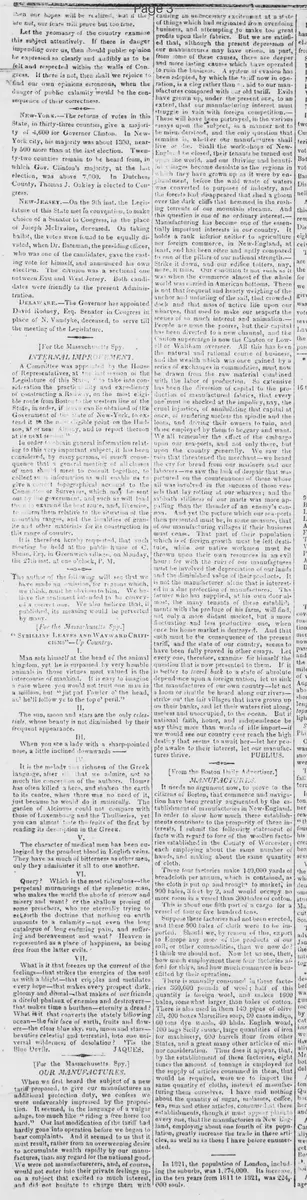
When we first heard the subject of a new tariff proposed, to give our manufactures an additional protection duty, we confess we were unfavorably impressed by the proposition. It seemed, in the language of a vulgar adage, too much like "riding a free horse too hard." Our last modification of the tariff had hardly gone into operation before we began to hear complaints. And it seemed to us that it must result, rather from an overweening desire to accumulate wealth rapidly by our manufactures, than any regard for the national good. We were not manufacturers, and, of course, would not enter into their private feelings upon a subject that excited so much interest and did not hesitate to charge them with causing an unnecessary excitement at a state of things which had originated from overdoing business, and attempting to make too great profits upon their fabrics. But we are satisfied that, although the present depression of our manufactures may have arisen, in part, from some of these causes, there are deeper and more lasting causes which have operated to ruin the business. A system of evasion has been adopted, by which the tariff now in operation, is a clog rather than an aid to our manufactures compared with our old tariff. Evils have grown up, under the present one, to an extent, that our manufacturing interest must struggle in vain with foreign competition. These will have been portrayed, in the various essays upon the subject, in a manner not to be misunderstood, and the only question that remains is, whether our manufactures shall live or die. Shall the work-shops of New-England be closed, their tenants be turned out upon the world, and our thriving and beautiful villages become desolate as the regions in which they have grown up as it were by enchantment, before the wild waste of waters was converted to purposes of industry, and the forests had disappeared that shed a gloom over the dark cliffs that hemmed in the rushing torrents of our mountain streams. And this question is one of no ordinary interest. Manufacturing has become one of the essentially important interests in our country. It holds a rank inferior neither to agriculture nor foreign commerce, in New-England, at least, and has been often and aptly compared to one of the pillars of our national strength. Strike it down, and our edifice totters, nay, more, it falls. Our condition is not such as it was when the commerce almost of the whole world was carried in American bottoms. There is not that frequent and hearty weighing of the anchor and unfurling of the sail, that crowded dock and that mass of active life upon our wharves, that used to make our seaports the scenes of so much interest and animation. People are none the poorer, but their capital has been diverted to a new channel, and the Canton supercargo is now the Canton or Lowell or Waltham overseer. All this has been the natural and rational course of business, and the wealth which was once gained by a series of exchanges in commodities, must now be drawn from the raw material combined with the labor of production. So extensive has been the diversion of capital to the production of manufactured fabrics, that every one must be shocked at the impolicy, nay, the cruel injustice, of annihilating that capital at once, of rendering useless the spindle and the loom, and driving their owners to ruin, and those employed by them to beggary and want. We all remember the effect of the embargo upon our sea-ports, and not only there, but upon the country generally. We saw the ruin that threatened the merchant-we heard the cry for bread from our mariners and our laborers-we saw the look of despair that was pictured on the countenances of those whose all was involved in the success of those vessels that lay rotting at our wharves; and the sabbath stillness of our marts was more appalling than the thunder of an enemy's Cannon. And yet the picture which our sea-ports then presented must be, in some measure, that of our manufacturing villages if their business must cease. That part of their population which is of foreign growth must be left destitute, while our native workmen must be thrown upon their own resources in an evil hour: for with the ruin of our manufactures must be involved the depreciation of our lands and the diminished value of their products. It is not the manufacturer alone that is interested in a due protection of manufactures. The farmer who has supplied, at his own door almost, the many tenants of these establishments with the produce of his farm, will find, not only a more distant market, but a more fluctuating and less productive one, when once his home market is destroyed. And that such must be the consequence of the present tariff, and the state of our country, seems to have been fully proved in other essays. Let every one, therefore, examine for himself the question that is now presented to them. If it is better to travel back to a state of absolute dependence upon a foreign nation, let us sink the manufactures of our own country-let not a loom or shuttle be heard along our rivers--strike out the fair villages that have grown up on their banks, and let their waters riot along, useless and unoccupied, to the ocean. But if national faith, honor, and independence be any thing more than words of idle import-if we would see our country ever reach the high destiny that seems to await her-let her people awake to their interest, let our manufactures thrive.
PUBLIUS.
OUR MANUFACTURES.
When we first heard the subject of a new tariff proposed, to give our manufactures an additional protection duty, we confess we were unfavorably impressed by the proposition. It seemed, in the language of a vulgar adage, too much like "riding a free horse too hard." Our last modification of the tariff had hardly gone into operation before we began to hear complaints. And it seemed to us that it must result, rather from an overweening desire to accumulate wealth rapidly by our manufactures, than any regard for the national good. We were not manufacturers, and, of course, would not enter into their private feelings upon a subject that excited so much interest and did not hesitate to charge them with causing an unnecessary excitement at a state of things which had originated from overdoing business, and attempting to make too great profits upon their fabrics. But we are satisfied that, although the present depression of our manufactures may have arisen, in part, from some of these causes, there are deeper and more lasting causes which have operated to ruin the business. A system of evasion has been adopted, by which the tariff now in operation, is a clog rather than an aid to our manufactures compared with our old tariff. Evils have grown up, under the present one, to an extent, that our manufacturing interest must struggle in vain with foreign competition. These will have been portrayed, in the various essays upon the subject, in a manner not to be misunderstood, and the only question that remains is, whether our manufactures shall live or die. Shall the work-shops of New-England be closed, their tenants be turned out upon the world, and our thriving and beautiful villages become desolate as the regions in which they have grown up as it were by enchantment, before the wild waste of waters was converted to purposes of industry, and the forests had disappeared that shed a gloom over the dark cliffs that hemmed in the rushing torrents of our mountain streams. And this question is one of no ordinary interest. Manufacturing has become one of the essentially important interests in our country. It holds a rank inferior neither to agriculture nor foreign commerce, in New-England, at least, and has been often and aptly compared to one of the pillars of our national strength. Strike it down, and our edifice totters, nay, more, it falls. Our condition is not such as it was when the commerce almost of the whole world was carried in American bottoms. There is not that frequent and hearty weighing of the anchor and unfurling of the sail, that crowded dock and that mass of active life upon our wharves, that used to make our seaports the scenes of so much interest and animation. People are none the poorer, but their capital has been diverted to a new channel, and the Canton supercargo is now the Canton or Lowell or Waltham overseer. All this has been the natural and rational course of business, and the wealth which was once gained by a series of exchanges in commodities, must now be drawn from the raw material combined with the labor of production. So extensive has been the diversion of capital to the production of manufactured fabrics, that every one must be shocked at the impolicy, nay, the cruel injustice, of annihilating that capital at once, of rendering useless the spindle and the loom, and driving their owners to ruin, and those employed by them to beggary and want. We all remember the effect of the embargo upon our sea-ports, and not only there, but upon the country generally. We saw the ruin that threatened the merchant-we heard the cry for bread from our mariners and our laborers-we saw the look of despair that was pictured on the countenances of those whose all was involved in the success of those vessels that lay rotting at our wharves; and the sabbath stillness of our marts was more appalling than the thunder of an enemy's Cannon. And yet the picture which our sea-ports then presented must be, in some measure, that of our manufacturing villages if their business must cease. That part of their population which is of foreign growth must be left destitute, while our native workmen must be thrown upon their own resources in an evil hour: for with the ruin of our manufactures must be involved the depreciation of our lands and the diminished value of their products. It is not the manufacturer alone that is interested in a due protection of manufactures. The farmer who has supplied, at his own door almost, the many tenants of these establishments with the produce of his farm, will find, not only a more distant market, but a more fluctuating and less productive one, when once his home market is destroyed. And that such must be the consequence of the present tariff, and the state of our country, seems to have been fully proved in other essays. Let every one, therefore, examine for himself the question that is now presented to them. If it is better to travel back to a state of absolute dependence upon a foreign nation, let us sink the manufactures of our own country-let not a loom or shuttle be heard along our rivers--strike out the fair villages that have grown up on their banks, and let their waters riot along, useless and unoccupied, to the ocean. But if national faith, honor, and independence be any thing more than words of idle import-if we would see our country ever reach the high destiny that seems to await her-let her people awake to their interest, let our manufactures thrive.
PUBLIUS.
What sub-type of article is it?
Economic Policy
Trade Or Commerce
What keywords are associated?
Tariff Protection
American Manufactures
New England Economy
Foreign Competition
Protective Duties
Manufacturing Depression
National Independence
What entities or persons were involved?
New England Manufacturers
American Farmers
Foreign Competitors
Editorial Details
Primary Topic
Advocacy For Protective Tariff On Manufactures
Stance / Tone
Supportive Of New Tariff For Manufacturing Protection
Key Figures
New England Manufacturers
American Farmers
Foreign Competitors
Key Arguments
Current Tariff Enables Evasions That Hinder Domestic Manufactures
New Protective Tariff Needed To Counter Foreign Competition
Manufactures Are Essential Pillar Of National Strength Alongside Agriculture And Commerce
Decline Would Desolate Villages, Cause Unemployment And Beggary
Capital Diversion From Commerce To Manufacturing Must Not Be Reversed
Effects Similar To Embargo's Ruin On Seaports
Farmers Lose Local Markets If Manufactures Fail
Preserve National Independence Over Foreign Dependence