Thank you for visiting SNEWPapers!
Sign up free
Trainman News
Indianapolis, Marion County, Indiana
What is this article about?
In 1951, U.S. and Canadian railroads transported record amounts of commercial and military explosives without any deaths or injuries attributable to them, continuing a 30-year safety streak. One employee injury from a rifle explosion in baggage and one fatality from a gasoline-loaded car fire occurred.
Clipping
OCR Quality
Full Text
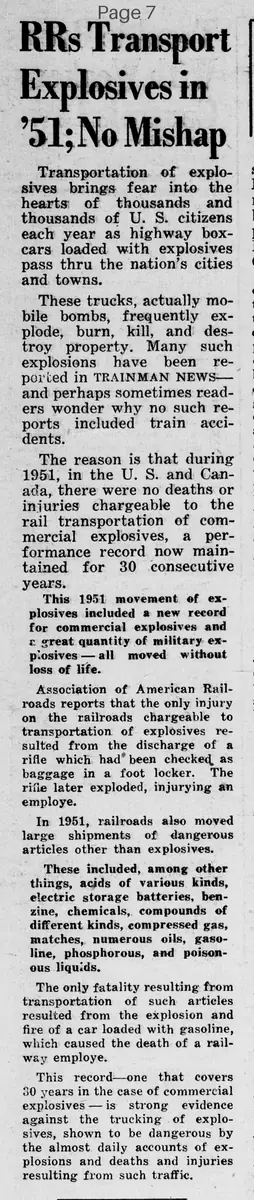
Transportation of explosives brings fear into the hearts of thousands and thousands of U. S. citizens each year as highway boxcars loaded with explosives pass thru the nation's cities and towns.
These trucks, actually mobile bombs, frequently explode, burn, kill, and destroy property. Many such explosions have been reported in TRAINMAN NEWS--and perhaps sometimes readers wonder why no such reports included train accidents.
The reason is that during 1951, in the U. S. and Canada, there were no deaths or injuries chargeable to the rail transportation of commercial explosives, a performance record now maintained for 30 consecutive years.
This 1951 movement of explosives included a new record for commercial explosives and a great quantity of military explosives--all moved without loss of life.
Association of American Railroads reports that the only injury on the railroads chargeable to transportation of explosives resulted from the discharge of a rifle which had been checked as baggage in a foot locker. The rifle later exploded, injuring an employee.
In 1951, railroads also moved large shipments of dangerous articles other than explosives. These included, among other things, acids of various kinds, electric storage batteries, benzine, chemicals, compounds of different kinds, compressed gas, matches, numerous oils, gasoline, phosphorous, and poisonous liquids.
The only fatality resulting from transportation of such articles resulted from the explosion and fire of a car loaded with gasoline, which caused the death of a railway employee.
This record one that covers 30 years in the case of commercial explosives--is strong evidence against the trucking of explosives, shown to be dangerous by the almost daily accounts of explosions and deaths and injuries resulting from such traffic.
What sub-type of article is it?
What keywords are associated?
Where did it happen?
Domestic News Details
Primary Location
U. S. And Canada
Event Date
1951
Outcome
no deaths or injuries from rail transportation of commercial explosives; one employee injury from rifle discharge in baggage; one railway employee fatality from gasoline car explosion and fire.
Event Details
Railroads transported record commercial and military explosives without loss of life; also moved other dangerous articles like acids, batteries, gasoline; contrasts with dangerous truck transport.