Thank you for visiting SNEWPapers!
Sign up free
Story
April 17, 1902
Delaware Gazette And State Journal
Wilmington, New Castle County, Delaware
What is this article about?
Article profiles Alfred Beit as the likely successor to Cecil Rhodes in expanding British influence in South Africa, highlighting their partnership in consolidating De Beers diamond mines and Beit's financial prominence.
Clipping
OCR Quality
95%
Excellent
Full Text
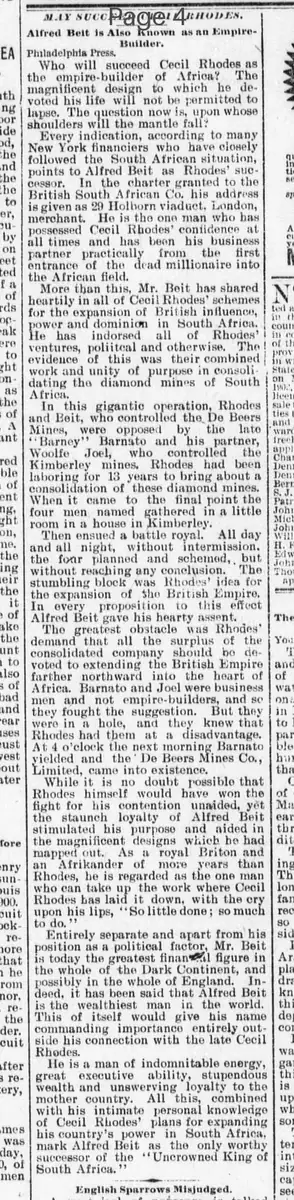
Alfred Beit is Also Known as an Empire-Builder.
Philadelphia Press.
Who will succeed Cecil Rhodes as the empire-builder of Africa? The magnificent design to which he devoted his life will not be permitted to lapse. The question now is, upon whose shoulders will the mantle fall?
Every indication, according to many New York financiers who have closely followed the South African situation, points to Alfred Beit as Rhodes' successor. In the charter granted to the British South African Co. his address is given as 29 Holborn viaduct. London, merchant. He is the one man who has possessed Cecil Rhodes' confidence at all times and has been his business partner practically from the first entrance of the dead millionaire into the African field.
More than this, Mr. Beit has shared heartily in all of Cecil Rhodes' schemes for the expansion of British influence, power and dominion in South Africa. He has indorsed all of Rhodes ventures, political and otherwise. The evidence of this was their combined work and unity of purpose in consolidating the diamond mines of South Africa.
In this gigantic operation, Rhodes and Beit, who controlled the De Beers Mines, were opposed by the late Barney Barnato and his partner, Woolf Joel, who controlled the Kimberley mines. Rhodes had been laboring for 13 years to bring about a consolidation of those diamond mines. When it came to the final point the four men named gathered in a little room in a house in Kimberley.
Then ensued a battle royal. All day and all night, without intermission. the four planned and schemed,. but without reaching any conclusion. : The stumbling block was Rhodes' idea for the expansion of the British Empire. In every proposition to this effect Alfred Beit gave his hearty assent.
The greatest obstacle was Rhodes demand that all the surplus of the consolidated company should be devoted to extending the British Empire farther northward into the heart of Africa. Barnato and Joel were business men and not empire-builders, and so they fought the suggestion. But they were in a hole, and they know that Rhodes had them at a disadvantage.
At 4 o'clock the next morning Barnato yielded and the'De Beers Mines Co., Limited, came into existence.
While it is no doubt possible that Rhodes himself would have won the fight for his contention unaided, yet the staunch loyalty of Alfred Beit stimulated his purpose and aided in the magnificent designs which he had mapped out. As a royal Briton and an Afrikander of more years than Rhodes, he is regarded as the one man who can take up the work where Cecil Rhodes has laid it down, with the cry upon his lips, "So little done; so much to do."
Entirely separate and apart from his position as a political factor, Mr. Beit is today the greatest financial figure in the whole of the Dark Continent, and possibly in the whole of England. Indeed. it has been said that Alfred Beit is the wealthiest man in the world. This of itself would give his name commanding importance entirely outside his connection with the late Cecil Rhodes.
He is a man of indomitable energy, great executive ability, stupendous wealth and unswerving loyalty to the mother country. All this, combined with his intimate personal knowledge of Cecil Rhodes' plans for expanding his country's power in South Africa. mark Alfred Beit as the only worthy successor of the "Uncrowned King of South Africa."
Philadelphia Press.
Who will succeed Cecil Rhodes as the empire-builder of Africa? The magnificent design to which he devoted his life will not be permitted to lapse. The question now is, upon whose shoulders will the mantle fall?
Every indication, according to many New York financiers who have closely followed the South African situation, points to Alfred Beit as Rhodes' successor. In the charter granted to the British South African Co. his address is given as 29 Holborn viaduct. London, merchant. He is the one man who has possessed Cecil Rhodes' confidence at all times and has been his business partner practically from the first entrance of the dead millionaire into the African field.
More than this, Mr. Beit has shared heartily in all of Cecil Rhodes' schemes for the expansion of British influence, power and dominion in South Africa. He has indorsed all of Rhodes ventures, political and otherwise. The evidence of this was their combined work and unity of purpose in consolidating the diamond mines of South Africa.
In this gigantic operation, Rhodes and Beit, who controlled the De Beers Mines, were opposed by the late Barney Barnato and his partner, Woolf Joel, who controlled the Kimberley mines. Rhodes had been laboring for 13 years to bring about a consolidation of those diamond mines. When it came to the final point the four men named gathered in a little room in a house in Kimberley.
Then ensued a battle royal. All day and all night, without intermission. the four planned and schemed,. but without reaching any conclusion. : The stumbling block was Rhodes' idea for the expansion of the British Empire. In every proposition to this effect Alfred Beit gave his hearty assent.
The greatest obstacle was Rhodes demand that all the surplus of the consolidated company should be devoted to extending the British Empire farther northward into the heart of Africa. Barnato and Joel were business men and not empire-builders, and so they fought the suggestion. But they were in a hole, and they know that Rhodes had them at a disadvantage.
At 4 o'clock the next morning Barnato yielded and the'De Beers Mines Co., Limited, came into existence.
While it is no doubt possible that Rhodes himself would have won the fight for his contention unaided, yet the staunch loyalty of Alfred Beit stimulated his purpose and aided in the magnificent designs which he had mapped out. As a royal Briton and an Afrikander of more years than Rhodes, he is regarded as the one man who can take up the work where Cecil Rhodes has laid it down, with the cry upon his lips, "So little done; so much to do."
Entirely separate and apart from his position as a political factor, Mr. Beit is today the greatest financial figure in the whole of the Dark Continent, and possibly in the whole of England. Indeed. it has been said that Alfred Beit is the wealthiest man in the world. This of itself would give his name commanding importance entirely outside his connection with the late Cecil Rhodes.
He is a man of indomitable energy, great executive ability, stupendous wealth and unswerving loyalty to the mother country. All this, combined with his intimate personal knowledge of Cecil Rhodes' plans for expanding his country's power in South Africa. mark Alfred Beit as the only worthy successor of the "Uncrowned King of South Africa."
What sub-type of article is it?
Biography
Historical Event
What themes does it cover?
Triumph
Exploration
Moral Virtue
What keywords are associated?
Alfred Beit
Cecil Rhodes
Diamond Mines
De Beers
British Empire
South Africa
Empire Builder
What entities or persons were involved?
Alfred Beit
Cecil Rhodes
Barney Barnato
Woolf Joel
Where did it happen?
South Africa, Kimberley, London
Story Details
Key Persons
Alfred Beit
Cecil Rhodes
Barney Barnato
Woolf Joel
Location
South Africa, Kimberley, London
Story Details
Alfred Beit is positioned as Cecil Rhodes' successor in empire-building in Africa, having been his trusted partner in business and political ventures, including the consolidation of diamond mines into De Beers through intense negotiations where Beit's support helped overcome opposition from Barnato and Joel.