Thank you for visiting SNEWPapers!
Sign up free
The Charlotte Journal
Charlotte, Mecklenburg County, North Carolina
What is this article about?
An editorial letter defends the North Carolina Assembly's decision to invest surplus federal revenue in state internal improvements rather than distributing it to counties, critiques Mr. Byrd's alternative bill, and urges unity against sectional divisions between East and West.
Merged-components note: Continuation of political article from Raleigh Standard on state affairs; original labels were story and editorial, unified to editorial as it is opinionated political commentary.
Clippings
1 of 2
OCR Quality
Full Text
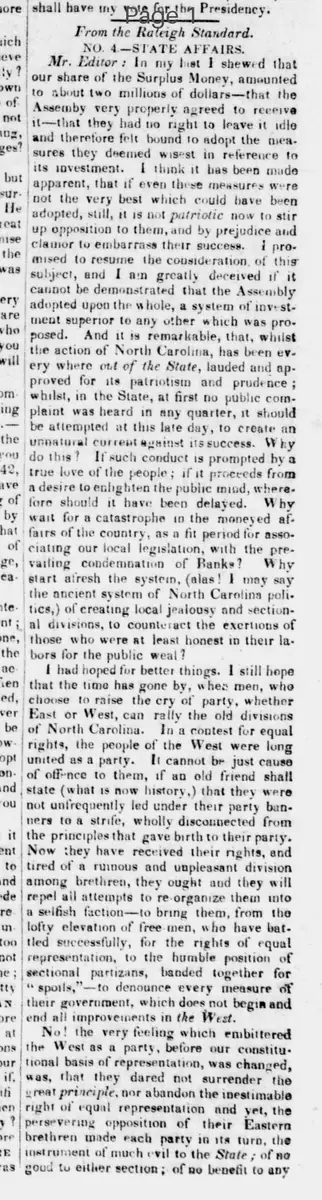
NO. 4—STATE AFFAIRS.
Mr. Editor: In my last I showed that our share of the Surplus Money, amounted to about two millions of dollars—that the Assembly very properly agreed to receive it—that they had no right to leave it idle and therefore felt bound to adopt the measures they deemed wisest in reference to its investment. I think it has been made apparent, that if even these measures were not the very best which could have been adopted, still, it is not patriotic now to stir up opposition to them, and by prejudice and clamor to embarrass their success. I promised to resume the consideration of this subject, and I am greatly deceived if it cannot be demonstrated that the Assembly adopted upon the whole, a system of investment superior to any other which was proposed. And it is remarkable, that, whilst the action of North Carolina, has been everywhere out of the State, lauded and approved for its patriotism and prudence; whilst, in the State, at first no public complaint was heard in any quarter, it should be attempted at this late day, to create an unnatural current against its success. Why do this? If such conduct is prompted by a true love of the people; if it proceeds from a desire to enlighten the public mind, wherefore should it have been delayed. Why wait for a catastrophe in the moneyed affairs of the country, as a fit period for associating our local legislation, with the prevailing condemnation of Banks? Why start afresh the system, (alas! I may say the ancient system of North Carolina politics,) of creating local jealousy and sectional divisions, to counteract the exertions of those who were at least honest in their labors for the public weal?
I had hoped for better things. I still hope that the time has gone by, when men, who choose to raise the cry of party, whether East or West, can rally the old divisions of North Carolina. In a contest for equal rights, the people of the West were long united as a party. It cannot be just cause of offence to them, if an old friend shall state (what is now history,) that they were not unfrequently led under their party banners to a strife, wholly disconnected from the principles that gave birth to their party. Now they have received their rights, and tired of a ruinous and unpleasant division among brethren, they ought and they will repel all attempts to re-organize them into a selfish faction—to bring them, from the lofty elevation of free men, who have battled successfully, for the rights of equal representation, to the humble position of sectional partizans, banded together for "spoils,"—to denounce every measure of their government, which does not begin and end all improvements in the West.
No! the very feeling which embittered the West as a party, before our constitutional basis of representation, was changed, was, that they dared not surrender the great principle, nor abandon the inestimable right of equal representation and yet, the persevering opposition of their Eastern brethren made each party in its turn, the instrument of much evil to the State; of no good to either section; of no benefit to any person, save a few, whose patriotism was bounded by a love of office, they might thereby be able to acquire, or of a temporary consequence, which under other circumstances they could not hope to attain. Thank Heaven, in spite of the ill-timed and ill-advised efforts of short-sighted or selfish public servants, the East and West will now be looked upon, by the people of each section, as a part of their own—their beloved State. The question will not be, as it ought not to be—whether a State measure is for East or West, but is it for the aggrandizement of the State of North Carolina.
But besides these general and more enlarged views of my subject, I shall establish beyond controversy, that, even if the measures adopted by our Assembly, had been liable to the appearance of partiality, the facts will show it was otherwise. This can be more easily done in the sequel.—One fact alone shall be recorded here, that must startle the suspicious on this subject, and it goes far to establish my confidence in the belief, that the old sectional party lines of North Carolina, are almost if not altogether obliterated. The Bill for Internal Improvement, (said to be for the East, though I will show hereafter, it is not altogether so,) was supported by a large majority of Western Members. This was not a bill for the East, as East, but a measure for North Carolina: and on the Journals of her legislation, it is an honor to her representatives, that these old divisions were then overlooked; it gives bright promise to the hope, that they are or will be obliterated.
For among the whole delegation from the West, in the Commons, only 5 or 6 voted against it, and only 7 or 8 of them voted to substitute Mr. Byrd's bill for it! How very ridiculous then, would the West appear, if they had not too much regard to their patriotism, political consistency, and love of justice, to denounce it as an Eastern measure?—The West, vote almost unanimously for one proposition, and against another. And shall they, who are opposed to this legislation, and design to excite the West against it, denounce it as an Eastern measure? It will not do. It ought not to do.—Nay, it ought not to be attempted.
I will now proceed to give in detail what was proposed and rejected, with some general reasons for such rejection. And then all which was adopted, and the general reasons for it.
The first is Mr. Byrd's bill, as it is called: more properly speaking it should be "a Bill introduced by Mr. Byrd," (a member from Yancey.) I shall say nothing about its details, some of which were wholly inadmissible. If the principle of the Bill was right I admit no legislator could rightfully oppose it, because the details were bad, till it was finally read, and after he had used his best exertions to correct these details. Nor let it be supposed I intend to impugn the motives or the general correctness of those who approved it. Far from it. They voted as they thought right. I think it is fortunate for the country, that they were in a minority and did not succeed, but I do not esteem it a crime that these gentlemen differed from their fellows.
But, what was the Bill? (I have not the Bill before me, but Mr. Byrd's speech I have) It proposed to take all the moneys of the State, especially the Surplus Money, and apportion it out amongst the counties; to put it under the management of officers chosen by the County Court, to be loaned out, or invested. If the County thought fit to do so, they might expend it in Roads. The people who borrowed the money, were to give security, and pay interest for it. And the interest was to go into the County Treasury. The money was to be apportioned according to their number of Members in the Assembly.
The following objections will at once show the injustice and impolicy of this proposition, and what follows them, may expose to the "poor" what kind of fruits they would reap from the fallacious assurances of such as pretend to denounce the rejection of this measure, for the sake of "we the people."
1st. The mode of division is flagrantly unfair. Are taxes for the support of Government paid by counties in the proportion of the members? On the contrary, each county no matter how small, is by our Constitution, entitled to a member. And their claim to share this money by the rule proposed, is a complete inversion of the maxim, "one good turn deserves another." The larger counties agreed to give the least counties a member, though they had a very small population, (too small to entitle them to demand it, as a right,) and are they, therefore entitled to an undue share of the public money? Because they are generously allowed to have a share of representation greater than their population entitles them to demand; must they therefore, be suffered to take an undue share of the public funds?
2d. This money belonged to the State, to the people as a State. It was not deposited by the General Government, to be re-deposited by the Legislatures with County Courts. It would be violating the faith of the State, to pass such Bill. Do you say not? Then the County Courts, as soon as we deposited it with them, might have re-divided it, among the districts of each county; and the latter would have been no more a violation of their faith, than this deposit with them by the State, was a disregard of hers.
3d. If the money were placed with the County Courts it would be in the management of men, whom the people do not choose, cannot remove nor in any wise make responsible to them. Emphatically, it would be giving away the people's money, to bodies of men wholly beyond their reach.
4th. It would not be many years, before the control of these County funds would fall into the hands of irresponsible men, and be squandered. Suppose the money to be at the Court house, and the Court about to proceed in the election of Treasurers to manage it. If one wishes to get the place, will he not electioneer with the Justices, and for every vote promise a loan to the voter? To keep in afterwards, may he not grant indulgence upon bad security? His borrowers will be his electors, and his borrowers will be his sureties—until a final bankruptcy blows up the concern, and involves the country in a disgrace, by the exposed speculation of its courts and the loss of all their funds.
5th. If it terminated more favorably. If a few of the counties, nay if it were possible all of them could drive a gainful business in this operation—this new system of Banking!—what must be the end of it? The Court, wholly free from responsibility to the people, may become fascinated by some wild schemes of county aggrandizement, and anticipating the income of this Fund, will embark upon a system of extravagance: involve the county in debts and liabilities which otherwise they never would have encountered. Let these monies be then called for: let the debtors fail, and the public be disappointed of the income from this fund, who will have to pay off these extraordinary liabilities? Why, those people—those "poor people" whom it is hoped to enlist, upon the pretext, that this is a measure for their good! For be it recollected that a man whose income is equal to $10,000, pays the same tax on his head (poll tax) with the overseer he employs, at perhaps $75 a year: and no species of tax on property, will ever be endured that can equalize the burden.
6th. If the Legislature of the State, in love to the poor, were determined to throw this money among the people, to be scrambled for at the County Courts, why loan it on security! The poor man cannot borrow it, for he has no property to pledge and no security to give. Why do not all exclusive advocates of the poor, insist on dividing it out and giving each man his share? It would be quite interesting to see the members of Assembly riding round the county, to hand each man his $2 or $3; (or it may be $5) his share of the Surplus!! Or rather one fourth each quarter; 50 to 75 cents every pay day! But no, this will not answer. It would expose by its practical enforcement the folly of such a law.
7th. I shall pass by the consideration of expense. A Treasurer in each County, (66 in all) and their salaries! The necessary loss of debts! the neighborhood bickerings! the partialities practised in the granting of loans! the corruption of public agents, and such like necessary results of this ill-digested and anomalous project. Surely, I have said enough to prove its impolicy.
Yet, there is one argument urged for it, which I must not suffer to escape my notice. I have heard it said, that this Bill would have relieved the poor from taxes. I think I have proved the reverse. But suppose I have not. "Repeal the taxes!" is a specious argument to the poor, yet it is very deceptive. If I did not feel confident, that they who urge it, act without thought: I believe on the contrary that they have seen its length and breadth, I would not hesitate to denounce them as they merit. What? Repeal all the taxes of the poor! Take care Freemen of North Carolina! If the taxes are repealed, if the poor man is released from his poll tax, his right to vote goes with it. This is your Constitution; has been so, ever since '76; and to abolish the small taxes imposed on our people—whether intended or not, will be cheating the poor into a surrender of the right of Suffrage. Stand forth now, and advocate this repeal of taxes, ye lovers of the poor. Tell them the whole truth and see if they are willing to sell their birthright, at a price so mean—at any price less than their blood.
Mr. Byrd and his associates, had no such views—no such intentions. I feel warranted in saying this positively. But I wish to guard the people, against deceptions that I know are practised on them, in neighborhoods etc., by others.
MENTOR.
What sub-type of article is it?
What keywords are associated?
What entities or persons were involved?
Editorial Details
Primary Topic
Defense Of Assembly's Investment Of Surplus Money In Internal Improvements
Stance / Tone
Supportive Of State Measures And Unity, Critical Of Sectional Opposition And Byrd's Bill
Key Figures
Key Arguments